Best Place to Check Tire Pressure: A Practical Guide
Discover the best place to check tire pressure for accurate readings, how TPMS interacts with gauges, and a practical step-by-step method from Tire Pressure Tips.


Goal: Learn the best place to check tire pressure for accurate readings and safe driving. The most reliable spots minimize heat buildup, surface contact, and gauge error, such as a level, shaded area away from direct sun or heat. For best results, check cold tires and use a high-quality gauge. Tire Pressure Tips guides you to choose the ideal spot and how to verify results with TPMS and gauges.
Why the best place to check tire pressure matters
Choosing the right place to check tire pressure isn’t just about convenience. The ground surface, ambient temperature, and how recently the tire was driven all influence the reading you get from your gauge. A stable, level spot protects against tilt readings that can understate or overstate actual pressure. An ideal location also minimizes heat transfer from the sun or a hot road, which can temporarily raise tire pressure. According to Tire Pressure Tips, the best place to check tire pressure is a level, shaded area with tires cold. Using a proper gauge in these conditions reduces variability, helping you maintain tires at the manufacturer’s recommended PSI and improving fuel efficiency, grip, and tire life. In real-world terms, the right spot is a calm driveway, a shaded parking lot, or a clean garage floor where the tires have time to return to ambient temperature before measurement. By prioritizing the right environment, you set a solid foundation for accurate, repeatable readings that you and your vehicle can trust.
For readers of Tire Pressure Tips, consistency matters as much as accuracy. If you alternate between hot and cold measurements, you’ll introduce inconsistency into maintenance routines. The goal is to measure cold tires, making it easier to compare against the vehicle’s official PSI specification. It’s also important to document readings so you can notice gradual pressure loss over time, which may indicate a slow leak or a wear pattern that requires maintenance or rotation. In short, your best place to check tire pressure is where you can hold the measurement steady, read the gauge clearly, and compare against the car’s official recommendations.
Tire pressure basics: cold vs hot, PSI, and accuracy
Tire pressure is a balance between safety, performance, and efficiency. The recommended PSI values come from the vehicle manufacturer and are listed on the door jamb sticker and in the owner’s manual. These values assume cold tires, since heat from driving increases pressure inside the tire. To avoid chasing numbers that drift with temperature, always check after tires have cooled for a reasonable period and use a reliable gauge. When reading, aim for internal consistency: compare new readings with your previous checks under similar conditions, and track any changes over time. A consistent approach, using the same gauge and method, yields the most meaningful results for tire wear, fuel economy, and handling. In addition, remember that TPMS provides a warning if pressure deviates significantly from the target, but it is not a substitute for a precise measurement with a gauge.
For everyday driving, consider reviewing the PSI range that your tires were designed to run at and how loads (passengers, cargo) affect those pressures. Underinflation and overinflation both carry risks: underinflated tires can wear on the edges and reduce fuel efficiency, while overinflated tires can lead to harsher rides and uneven wear. The goal is not to hit an exact number in every instance, but to keep each tire within the recommended range for your specific vehicle and driving conditions.
Indoor vs outdoor checks: where is best and why
The visibility and accessibility of your tire pressure check location matter as well. Indoors, you have reliable lighting, a stable surface, and a controlled temperature that minimizes reading variability. Outdoors, choose a shaded area to avoid glare on the gauge display, ideally in the morning or late afternoon when temperatures are moderate. Level ground is essential; a sloped driveway or uneven pavement can tilt the gauge or misread the stem, yielding an artificial pressure value. If you must check on a driveway or street, position the car so the tire is perpendicular to the scale, and place the gauge squarely on the valve stem to prevent leaks from a poor seal. The best practice, whenever possible, is to use a garage or a flat, paved surface with shade—a simple condition you can control for repeatable results. In addition to the surface, ensure you’re checking all four tires, including the spare if it’s a full-size tire, to maintain even wear and handling performance.
Industry guidance from Tire Pressure Tips emphasizes that the most reliable readings come from cold tires in a level, shaded spot. This is particularly important for vehicles with variable tire pressures across axles or unusual weight distribution. If you store your car in a sunlit location, anticipate slight gauge variance and plan a re-check at the first opportunity in shade. The more consistent your environment, the easier it is to detect real changes in tire pressure, whether due to temperature shifts, seasonal changes, or slow leaks.
Tools and gauges: choosing the right instrument
Selecting the right gauge is as important as picking the right spot to measure. A reliable tire pressure gauge should be easy to read, durable, and calibrated. Digital gauges are simple to read and often provide an audible confirmation when a target pressure is reached; analog gauges (dial or pencil) can be equally effective if you can read them accurately. When choosing a gauge, prioritize models with clear scale markings, minimal parallax error, and sturdy stems that seal well on the valve. If you prefer a multipurpose tool, some tire gauges include a built-in air inflation gauge; just ensure you’re not confusing gauge readings with the inflation reading. Keep spare batteries on hand for digital gauges and replace worn-out parts promptly. Regardless of the gauge type, practice a few test measurements on a known-accurate source to verify accuracy before using it on your tires. Consistent tools and technique help you monitor changes over time and reduce unnecessary trips to service centers.
How to verify with TPMS and gauge accuracy
TPMS provides a quick signal that something is off, but it isn’t a substitute for a precise pressure reading with a reliable gauge. Use TPMS as a first alert: if the light comes on, verify each tire with your gauge, especially if temperatures have shifted or you’ve loaded the vehicle differently. When you compare gauge readings with the manufacturer’s recommended PSI, you’ll have an objective measure to decide whether you need to inflate or deflate any tire. If TPMS readings disagree with your gauge by more than a small margin, inspect the valve stems and tires for leaks or damage. In some cases, TPMS sensors can report stale or inaccurate data due to battery degradation or sensor faults. Regular hand checks compliment TPMS alerts and provide a margin of safety by ensuring you are operating within the optimal tire pressure range for fuel efficiency, handling, and tire longevity.
Tools & Materials
- Tire pressure gauge (digital or analog)(Choose a model with a clear display and a good seal on the valve stem.)
- Vehicle owner’s manual or door jamb sticker(Use it to confirm the cold PSI recommendations for front and rear tires.)
- Flat, level testing surface(A driveway, garage floor, or shaded parking space works well.)
- Valve caps and tool for valve stem inspection (optional)(Cap replacement helps prevent dust and debris entry; inspect for leaks if needed.)
- Notebook or smartphone for recording readings(Helpful for tracking changes over time and during seasonal shifts.)
- TPMS tool or cross-check method (optional)(Useful if you want to independently verify sensor readings.)
Steps
Estimated time: 20-30 minutes
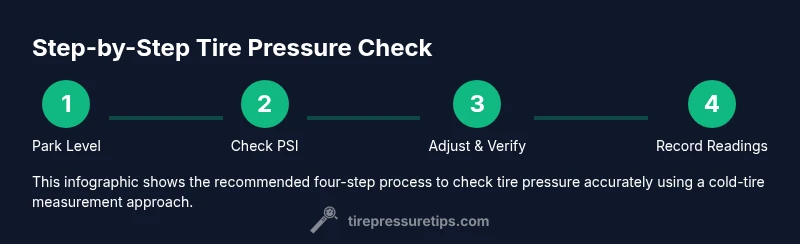
- 1
Park on a level surface
Find a flat, level area away from direct sunlight. Turn off the engine and set the parking brake. If possible, allow tires to cool for a short period to avoid heat-caused pressure increases.
Tip: Firmly apply the parking brake to keep the vehicle stable during measurement. - 2
Find the correct PSI values
Consult the owner’s manual or the door jamb sticker to confirm the cold tire pressure for each axle. Note differences between front and rear tires if applicable.
Tip: Prioritize the lower of the two values when loads or configurations differ between tires. - 3
Remove valve caps and attach gauge
Carefully remove the cap from the valve stem and press the gauge’s stem squarely onto the valve. Apply steady pressure without twisting to prevent air leaks.
Tip: If air hisses, reseat the gauge and try again with a correct seal. - 4
Read pressure and compare
Take a moment to read the gauge and record the value. Compare it to the manufacturer’s cold PSI values. Do this for all four tires.
Tip: If readings are inconsistent across tires, re-check each one to rule out a faulty gauge hold. - 5
Adjust to target pressure
If any tire is low, inflate slowly until it reaches the target. If over, release air in small increments until the reading matches the spec. Do not exceed the tire sidewall maximum.
Tip: Inflate in small steps and re-check after each adjustment to avoid overshoot. - 6
Recheck and document
Re-measure all tires after adjustments. Reattach valve caps and record the final readings for future reference.
Tip: Take a photo of the gauge reading or log it in your notes for trend tracking.
Frequently Asked Questions
Should I check tire pressure when tires are cold or warm?
Check tires when cold for the most accurate readings. If you must check after driving, anticipate higher readings and re-measure once the tires cool.
Check when cold for accuracy. If you just drove, wait for them to cool, then verify.
Is it safe to inflate tires at a gas station air pump?
Gas station pumps are convenient but can misread or lack calibration. Always cross-check with your own gauge before departing.
Gas pumps are handy, but always verify with your own gauge.
How often should I check tire pressure?
Check at least once a month and before long trips. Temperature changes and loads can affect pressure, so more frequent checks may be smart in extreme conditions.
Check monthly and before long trips; adjust more often if temperature or loads change.
What is the relationship between TPMS readings and actual pressure?
TPMS signals use pressure thresholds but do not provide precise PSI. Use a gauge to verify the exact number and adjust as needed.
TPMS alerts you that pressure is off, but you should measure with a gauge for exact PSI.
Can underinflation affect fuel economy and tire wear?
Yes. Underinflated tires increase rolling resistance and wear on edges. Maintaining proper pressure supports safety, handling, and efficiency.
Underinflation hurts fuel economy and wears tires faster—keep to the recommended PSI.
What should I do if the valve stem is damaged?
If the valve stem is damaged, avoid inflating and seek professional repair or replacement to prevent leaks.
If the valve stem is damaged, get it repaired promptly.
What to Remember
- Check tires when cold for accuracy
- Use a reliable gauge and record readings
- Compare readings to manufacturer PSI
- TPMS supports but does not replace gauge checks
- Inflate within the tire’s max pressure and recheck