4x4 Tyre Pressure Guide: Check, Adjust & Maintain Safely
A practical, step-by-step guide to checking and maintaining properly inflated tires on 4x4 vehicles under load and varying terrain. Learn TPMS roles, tool lists, and best practices for safety and efficiency.


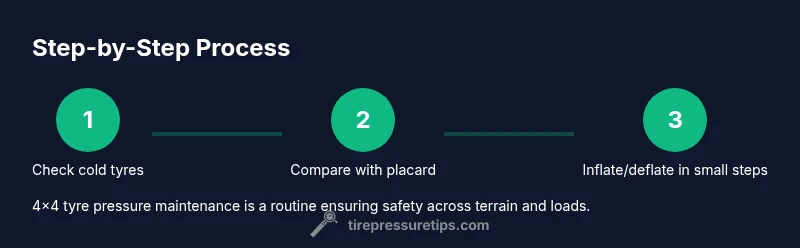
This guide helps you check, adjust, and maintain proper 4x4 tyre pressure for safety, traction, and efficiency. According to Tire Pressure Tips, you’ll learn the right tools, how to read TPMS versus manual gauges, and how to adjust for load, terrain, and temperature. Start with manufacturer specs on the door placard, verify cold readings, inflate or deflate in small increments, and recheck after changes for reliable performance.
Why 4x4 tyre pressure matters
Maintaining correct 4x4 tyre pressure is not just about avoiding a flat; it directly affects traction, steering feel, braking response, wear patterns, and fuel efficiency on mixed terrain. Off-road and heavy-load driving place different demands on tire contact patches, sidewall flex, and heat buildup. When pressures are too low, the tire can overheat, leading to faster wear and an increased risk of bead damage on rough surfaces. When pressures are too high, the contact patch shrinks, reducing grip on loose surfaces and increasing ride harshness. Tire Pressure Tips emphasizes checking cold tires, using the door placard as the baseline, and accounting for load and terrain. The approach is simple: start from manufacturer recommended pressures, verify readings with a reliable gauge, and adjust in small steps to preserve even wear and predictable handling. Based on Tire Pressure Tips Analysis, 2026, regular checks matter for safety and efficiency on mixed routes and highway trips.
Understanding TPMS and manual checks
Tire Pressure Monitoring System (TPMS) is a valuable warning tool, but it should not replace a hands-on pressure check. TPMS alerts you when a tire is under- or over-pressurized, but it cannot tell you the exact pressure on the tire or how the pressure changes with load or temperature. For 4x4 tyres, where off-road and heavy loads can alter pressure requirements, manual checks using a reliable gauge remain essential. In most vehicles, the door placard lists separate values for front and rear tyres and sometimes for the spare. In addition to TPMS, keep a portable gauge in the vehicle to verify readings when TPMS indicates a potential issue or when you adjust pressures for terrain. Regular confirmation with a gauge helps confirm that the TPMS readings match reality and reduces the risk of running out of spec when terrains shift from asphalt to dirt and back.
How to check tyre pressure on a 4x4 SUV
Before you start, ensure the vehicle is on level ground and the tyres are cold. Remove the valve cap, press the gauge onto the valve stem, and note the reading. If the reading is outside the door placard range, adjust accordingly using a portable inflator. Recheck after inflation, and re-tighten the valve cap. For 4x4s, it’s common to inflate to the front and rear values differently based on load (passengers, gear, trailer hitch) and sometimes to reduce rear overhang. Always verify both front and rear values, and do not rely on a single tire’s reading to determine overall pressure. If you have an onboard TPMS, cross-check the readings with your gauge to ensure consistency. The goal is a cold-reading baseline, not a warmed-up measurement after a drive.
Pressure ranges for load, terrain, and temperature
Your vehicle’s placard provides the baseline pressures for standard use. When you’re carrying heavy loads or towing, many drivers increase pressures slightly to stabilize the contact patch and resist tire squirm. For off-road or mixed-terrain trips, some drivers reduce pressures to expand the contact patch for grip, but this should be done only within safe limits and with caution to avoid pinch flats or overheating. Temperature changes also influence readings; hot days raise tire pressure while cold days lower it. If you travel from a chilly morning to a hot afternoon, the pressure can drift by several psi. Use a reliable gauge to verify cold readings, apply incremental adjustments, and recheck after cooling.
Common mistakes and how to avoid them
Avoid relying on rough memory of a single 'recommended' pressure. Always check the placard and the manual. Don’t inflate on hot tires or immediately after driving; readings will be inaccurate due to residual heat. Don’t inflate differently between front and rear without confirmation; some 4x4 configurations require different values to optimize handling. Avoid overcorrecting in large increments; small adjustments (0.5–1 psi) lead to safer, more predictable results. Finally, do not neglect the spare tire; a low spare can leave you stranded.
Seasonal and terrain considerations
Seasonal shifts affect tyre pressure: cold mornings can drop pressure, while extended highway driving on hot days can push it higher. If you operate in variable climates, check pressures at the start of each season and after significant altitude changes. Terrain matters too: sand or mud tends to benefit from slightly lower pressures to widen the contact patch, while paved roads expect closer adherence to placard values for precision. Always be mindful of road surface temperature and load when adjusting 4x4 tyre pressure for off-road adventures or overland trips.
Maintenance routines to keep 4x4 tyre pressure optimal
Create a simple monthly routine to check pressures on all four tyres and the spare. Start by validating readings against the placard, then adjust as needed and recheck after a short cooldown period. Keep your gauge calibrated and store it in a protective case to avoid wear. Log the date and target pressure in your vehicle’s maintenance notebook so you can spot drift over time. Finally, consider a TPMS refresh or sensor check if warnings persist after adjustments. A consistent routine reduces the risk of under- or overinflation during demanding trips.
Tools & Materials
- Digital tire pressure gauge(Reads in psi/bar; choose a gauge with at least 0.5 psi accuracy)
- Portable air compressor or hand pump(12V if mobile, or portable electric pump)
- Vehicle door placard/manual(Shows recommended pressures for front/rear)
- TPMS reader (optional)(For quick cross-checks outside the vehicle's system)
- Valve cap wrench or spare valve caps(Keep on hand in case caps are missing)
Steps
Estimated time: 20-30 minutes
- 1
Gather tools and locate target pressures
Collect your gauge, inflator, placard, and manual. Find the door placard values for front and rear tires and note them. Confirm whether your 4x4 has different pressures for duals or spare locations and set a notepad nearby.
Tip: Have the vehicle on level ground and ensure tires are cold before starting. - 2
Find the manufacturer’s pressures
Inspect the placard on the door jamb or consult the owner’s manual to capture the exact front and rear pressures. If your 4x4 has a tow hitch or a heavy roof rack, note any recommendations specific to those conditions.
Tip: Double-check if the vehicle has separate front/rear values; do not assume symmetry. - 3
Check cold pressures with a gauge
Attach the gauge to each valve stem and record the cold reading. Do not rely on a reading taken after driving, as heat skews measurements. Compare each value to the placard targets before adjusting.
Tip: If readings differ by more than 1–2 psi between tires, inspect for leaks or valve issues. - 4
Adjust pressures in small steps
Inflate or deflate each tire toward its target by increments of about 0.5–1 psi. Recheck after each adjustment and ensure the same target is used for both sides where applicable.
Tip: Avoid large jumps; small changes yield safer, more predictable results. - 5
Check spare and TPMS
Don’t overlook the spare tire; verify it has adequate pressure. If your vehicle uses TPMS, verify the sensors read within a reasonable range compared to the gauge.
Tip: Use a TPMS reader if available to confirm readings when TPMS shows a warning. - 6
Record, then recheck after terrain or load changes
Document the final pressures and recheck after longer drives or when terrain changes (load, towing, off-road). Allow tires to cool for 10–15 minutes before a final check if you’ve just completed inflating.
Tip: Keep a simple log of pressures and any changes to detect drift over time.
Frequently Asked Questions
Why do off-road tyres require different pressures than highway tyres?
Off-road tyres benefit from a larger contact patch on soft surfaces, which improves grip. However, pressures must stay within the tire’s rating and vehicle design limits. Always start with the placard and adjust gradually for terrain and load.
Off-road tyres need more contact with the ground on soft surfaces for grip, but you should stay within safe limits and start from the placard values.
What is the safe starting point for a 4x4 tyre pressure?
Begin with the manufacturer’s recommended pressures shown on the door placard. Use a gauge to verify, then adjust for load or terrain in small increments.
Start with the placard values and verify with a gauge before adjusting.
How does temperature affect tyre pressure?
Temperature changes make tyres lose pressure when cold and gain with heat. Check pressures when tyres are cold and recheck after temperature shifts or long drives to maintain accuracy.
Cold temps lower pressure, hot temps raise it; check when cold and recheck after temperature changes.
Can TPMS replace a manual gauge?
No. TPMS provides warnings, but you should verify actual pressures with a reliable gauge, especially when confirming adjustments for terrain or loads.
TPMS warns you, but you should still verify pressures with a gauge.
How often should I check and adjust tyre pressure?
Check monthly and before long trips, and after significant load changes or terrain shifts. Regular checks prevent drift and improve safety.
Check monthly or before trips, and after big loads or terrain changes.
Watch Video
What to Remember
- Check cold tyres monthly and before trips
- Always start with the placard values from the door jamb
- Adjust for load and terrain with small, measured changes
- TPMS is a warning system; verify with a manual gauge
- Document readings and recheck after long drives or terrain changes