Honda Fit Tire Pressure: A Practical Guide
Learn how to check and maintain the correct tire pressure for the Honda Fit. Practical steps, TPMS guidance, and weather tips to maximize safety, fuel economy, and tire life.


Goal: Learn how to check and maintain Honda Fit tire pressure accurately. This guide covers how to find the correct PSI from the door placard or owner’s manual, how to measure cold tires with a reliable gauge, and how to adjust for load, speed, and weather. You’ll also understand TPMS alerts and seasonal effects on pressure for safety and efficiency.
Understanding tire pressure basics for Honda Fit
Maintaining proper tire pressure is essential for safety, fuel economy, and tire longevity. For the Honda Fit, the exact cold tire pressure specification is shown on the driver’s door placard and in the owner’s manual. Always start with cold tires; pressure rises when tires heat up from driving. In this guide, Tire Pressure Tips explains how to locate the correct psi, how to measure accurately, and how to adjust without overinflating. The Honda Fit’s compact chassis and load characteristics mean a small deviation in pressure can affect handling and ride quality more than you might expect. Regular checks help keep steering predictable and prevent uneven wear. According to Tire Pressure Tips, consistency matters: check the same tires in the same conditions for reliable readings, and record your results so you can track changes over time.
Finding the correct PSI for your Honda Fit
The starting point is the door placard on the driver’s side, which lists the cold tire pressure for the front and rear tires. If the placard is missing or illegible, consult the owner's manual or contact a dealer. Do not rely on the maximum PSI printed on the tire sidewall; that's the tire's limit, not a target for inflation. When the car is loaded heavily or when you drive at high speeds, manufacturers may recommend a different pressure. Always aim for the numbers specified by the manufacturer, and verify them for your specific trim and tire size. This step ensures balanced handling and even tread wear.
When and how to check tire pressure
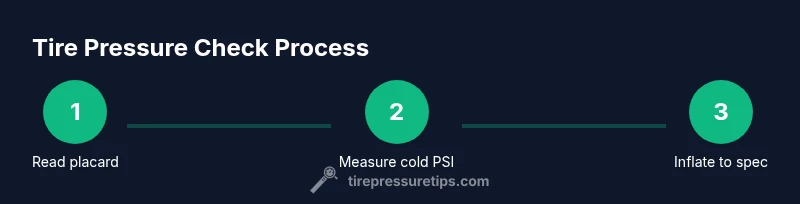
Check tire pressure when the tires are cold, ideally after the car has been parked for at least three hours. Remove the valve stem cap, press the gauge onto the valve, and note the reading. If the pressure is below the recommended level, inflate using an air compressor until you reach the target. If it’s above, release air gradually and recheck until you’re at the correct PSI. Replace the valve caps securely to prevent air leaks.
Tools and materials you need
Before you start, gather a reliable tire pressure gauge (digital or analog), an air pump or access to a gas station air compressor, the Honda Fit owner’s manual or placard, and a notebook to record readings. A flashlight can help in low light, and a small mirror can assist with inspecting valve stems for damage. Keeping a spare gauge is also handy in case your primary tool fails.
How weather and temperature affect tire pressure
Air pressure in tires changes with temperature. Colder weather can lower tire pressure, while hot conditions can raise it. Because of this, readings are most accurate when tires are cold. If you experience a rapid temperature drop, check pressure after the car sits for a bit or in the morning. Seasonal adjustments may be necessary to maintain consistent performance.
Understanding TPMS and readings
Tire Pressure Monitoring System (TPMS) uses sensors inside the wheels to alert you when pressure is too low or too high. A TPMS warning light on the dash means you should check your tires promptly. After adjusting pressures, the light may stay on until the system recalibrates, which can happen after a short drive. If the TPMS reads an unusual value, verify with a manual gauge to rule out sensor errors.
Adjusting tire pressure for load and driving conditions
The Honda Fit carries passengers and cargo that can change the required tire pressure. For extra cargo, increase pressure according to the placard guidance, not to the maximum listed on the tire. For sporty or high-speed driving, maintain the manufacturer’s recommended level and avoid underinflation, which reduces traction and increases heat buildup. Always inspect tires for damage during adjustments and check wheel alignment if you notice uneven wear after changes.
Common mistakes and how to avoid them
Not checking cold tires is a frequent error. Over-relying on the number printed on the tire sidewall leads to overinflation risk. Using a worn-out gauge yields inaccurate readings. A rushed inflation session can skip the recheck step, leaving under- or overinflation undetected. Never inflate beyond the placard numbers and replace damaged valve caps if they’re missing or cracked. Take your time and cross-check with a second gauge if you’re unsure.
Maintenance routine: checking and maintaining pressure over time
Set a monthly reminder to check all four tires and the spare. Record trends in your notebook or a maintenance app, noting seasonal changes. After long trips or rapid weather shifts, recheck as soon as possible. Treat the tires as part of a regular vehicle maintenance cycle for optimal fuel efficiency and tire life. Keeping the pressure steady also helps protect the TPMS system from false alarms.
Honda Fit-specific tips: tires, wheels, and safety
Choosing the right tire type and size is important; always match the tire size to what the vehicle and your trim require. Use a gauge you trust and keep it calibrated. If you change tire sizes or go from summer to winter tires, revisit the placard for updated pressures. Regular tire maintenance, including rotation and balance, complements proper inflation and supports even tread wear and safe handling.
Tools & Materials
- Tire pressure gauge (digital or analog)(A digital gauge is typically easier and more accurate.)
- Air pump or access to a gas station air compressor(Prefer a built-in gauge on the compressor; ensure it can reach the target PSI.)
- Owner's manual or driver door placard(Used to confirm the exact PSI for front and rear tires.)
- Notebook or digital log(Record readings to track trends and seasonal changes.)
- Flashlight(Helpful for night-time checks.)
Steps
Estimated time: 15-25 minutes
- 1
Gather tools and locate PSI
Assemble your gauge, air source, and the placard or manual. Confirm whether your Honda Fit requires different front and rear pressures. This ensures you start with correct targets before touching any tires.
Tip: Double-check the placard for each axle; the front may differ from the rear. - 2
Check tires when cold
Park the car for several hours so tires are cold. This avoids readings inflated by recent driving heat, giving you a true baseline.
Tip: If you’ve just driven, wait several hours or cool the tires before measuring. - 3
Read each tire with the gauge
Remove the valve stem cap, press the gauge onto the valve, and note the pressure. Do this for all four tires and the spare if applicable.
Tip: Keep the gauge perpendicular to the valve stem for an accurate reading. - 4
Inflate or deflate to spec
If a tire is below the recommended PSI, inflate until it matches the placard. If above, release air gradually and recheck until at the target.
Tip: Avoid overinflating; small changes can make a big difference on a compact car. - 5
Recheck and cap the valves
After adjusting, recheck all tires to confirm consistency and reinstall valve caps securely to prevent leaks.
Tip: Replace any cracked or missing valve caps promptly. - 6
Summarize and monitor
Log the final readings and note any weather or load changes since the last check. Plan monthly checks as part of routine maintenance.
Tip: A simple log helps you spot gradual pressure drift over time.
Frequently Asked Questions
Where can I find the Honda Fit tire pressure specification?
The cold tire pressure specification is listed on the driver’s door placard and in the owner’s manual. If the placard is missing, consult the manual or a dealer. Do not rely on the tire sidewall max PSI as a target.
Check the door placard on the driver's side or the owner's manual for the exact cold PSI. Do not use the sidewall maximum as your target.
Should I check tire pressure when tires are cold?
Yes. Measuring cold tires yields the most accurate reading. If you’ve driven recently, wait several hours before checking or recheck after the tires have cooled.
Always check tires when they’re cold to get an accurate reading.
What is the effect of weather on tire pressure?
Temperature changes affect air pressure. Colder weather lowers pressure, hotter weather raises it. Recheck after significant temperature shifts to maintain target PSI.
Temperature changes affect pressure; recheck after big weather shifts.
Do TPMS alerts require immediate action?
If the TPMS light comes on, check all tires with a gauge and adjust to the spec. If the light remains after inflation, consult a professional to inspect sensors.
If TPMS lights up, check pressures first and adjust. If it stays on, seek service.
Is it safe to drive with underinflated tires?
Driving with underinflated tires can reduce traction and tire life. Inflate promptly to the recommended PSI and recheck after a short drive.
No, underinflated tires can be dangerous. Inflate to spec before driving long distances.
Can I use the spare tire to maintain wheel pressure?
Spare tires have their own pressure specification. Check the spare per the manual and maintain appropriate pressure for safe temporary use.
Check the spare’s pressure per the manual and only use it temporarily if needed.
Watch Video
What to Remember
- Check cold tires first.
- Inflate to the manufacturer’s PSI, not the max on the sidewall.
- Verify readings with a second gauge if unsure.
- Document changes over time to catch gradual drift.
- Account for load and weather in every check.