Hilux Tyre Pressure: Practical Guide for 4x4 Owners
Learn how to check and set the correct hilux tyre pressure for front and rear tires, understand TPMS, and maintain safety and fuel efficiency with practical steps.


Learn how to check and set the correct hilux tyre pressure for front and rear tires, understand TPMS, and adjust for load and terrain. This guide covers identifying official cold pressures, measuring accurately with a reliable gauge, and making safe adjustments. You’ll also learn about TPMS, seasonal effects, and getting the most life from your Hilux tires.
Why correct Hilux tyre pressure matters for performance and safety
Maintaining the correct tyre pressure on your Toyota Hilux isn't just about following a number on a sticker. It shapes how the vehicle handles on-road and off-road, affects fuel economy, tread wear, braking distance, and ride comfort. For drivers who rely on their Hilux for work or adventures, getting tyre pressure right is a straightforward, high-impact habit. According to Tire Pressure Tips, keeping tires properly inflated at the recommended cold pressures improves tire life and can help stabilize steering, braking, and traction. The Tire Pressure Tips Team emphasizes that front and rear tires are not always inflated to the same value; load distribution between axles and the type of driving you do will influence the ideal pressures. Start with the official cold values published on the door jamb placard or in the owner's manual. Then, if you regularly carry heavy loads, tow a trailer, or run on rough terrain, adjust carefully in small increments and re-check with a reliable gauge.
- Benefits span safety: correct pressure maintains maximum contact with the road and predictable handling.
- Benefits span efficiency: correct pressure minimizes rolling resistance, which can improve fuel economy modestly.
- Benefits span tire life: even wear and reduced heat buildup extend tread life.
Remember: while it’s tempting to eyeball pressure, a quality gauge and a calm measurement environment deliver the right numbers every time. This approach reduces the likelihood of over-inflation that can lead to a harsher ride or under-inflation that increases heat and wear. By treating tyre pressure as a regular maintenance task, Hilux owners protect the investment in their vehicle and keep it performing reliably in weather and terrain.
How to find the recommended Hilux tyre pressure
The starting point for any tyre pressure task on a Hilux is the official recommendation for your vehicle’s model, wheel size, and load. Look at the door jamb placard on the driver’s side, or consult the Hilux owner’s manual for the exact figures. Do not rely on generic targets; the numbers differ by trim level, tire aspect ratio, and whether you typically drive with a light or heavy load.
Once you locate the values, note the front and rear pressures separately. Some Hilux configurations use different numbers for front and rear tires to account for axle load differences. If you frequently carry heavy cargo, tow, or drive on rough roads, you may be advised to adjust from the standard figures; always confirm any changes with the manual or a dealer.
To perform a precise check, ensure tires are cold: parked for at least three hours or driven less than a few miles since the last ride. Use a reliable gauge and record the readings to help track trends over time. If your vehicle has a TPMS indicator, use it as a supplementary check, but never substitute it for a manual measurement with a gauge.
- Write down the official cold psi values and check them against each tire.
- Remember that the recommendations may differ between front and rear tires.
- For off-road or heavy-duty use, follow the vehicle-specific guidance rather than improvising.
Checking tires: cold readings and proper technique
Before you read any pressure, confirm the tires are cold. A hot tire will show artificially high numbers and mislead you about the true pressure. Begin by removing the valve cap, holding the gauge on the valve stem firmly straight, and pushing until the gauge reads steady. If you’re using a digital gauge, wait for the display to settle; with a dial gauge, note the position when the needle stops moving.
Record each tire’s measurement and compare it to the corresponding door placard value. If a reading is below the recommended level, add air in small increments, then recheck. If you overshoot, release air slowly through the valve until you’re back at the target. Never assume “close enough” is acceptable; precise readings prevent uneven wear and unpredictable handling.
After inflating, recheck all tires, including the spare if you rotate or tow. Make sure the valve stem cap is replaced securely to protect the valve from dirt and moisture. Finally, drive slowly for a mile or two and recheck if you expect seating or significant changes in temperature.
- Use a single, unified gauge across all tires for consistency.
- Read at eye level and in good lighting to reduce misreadings.
- If the gauge reading is inconsistent, recalibrate or replace the gauge.
Adjusting pressure for load, terrain, and season
Hilux owners frequently adjust tire pressures to match their typical use. Heavier loads, towing, or rough or off-road terrain can justify higher pressures to maintain the tire’s shape and reduce sidewall pinch. Start from the placard values and tweak in small steps, rechecking with a gauge after each adjustment. If you regularly operate with a light load, you may keep closer to the base numbers to preserve ride comfort and tire longevity. For desert or sand driving, some drivers increase pressure slightly to resist tire burrowing, but this should always follow the vehicle’s official guidance and, if possible, professional advice.
Seasonal changes also affect tire pressure. Air expands in heat and contracts in cold, so hot days can raise pressures and cold days can lower them. When temperatures swing, recheck and adjust before long trips or when the vehicle is loaded. If you tow or carry weight on the rear axle, prioritize the rear inflation to help balance load distribution.
- Make adjustments in small increments (1-2 psi) and re-check after seating.
- If you plan heavy-duty work or off-road, consult Toyota’s guidance or a dealer for model-specific adjustments.
- Avoid underinflation on the front axle; it affects steering feel and braking.
TPMS basics and care for Hilux
TPMS alerts are helpful but not exhaustive; your vehicle may have two types: direct TPMS using sensors in the wheel and indirect TPMS using wheel speed sensors. The warning light indicates low pressure in at least one tire and prompts you to measure with a gauge. If you see a TPMS warning but readings appear normal, check for a sticky valve stem, sensor fault, or recent temperature fluctuations.
Proper TPMS maintenance includes checking sensor batteries and ensuring that sensors remain properly mounted. If the tire is rotated, ensure the TPMS sensor hasn't moved and that the wheel is balanced. In case of inconsistent TPMS readings, consult the service manual or a trained technician.
- TPMS is a complement to, not a replacement for, manual tire pressure checks.
- A failing TPMS sensor may give false readings; consider testing or replacing the sensor if readings drift.
- Regularly rotate tires following Hilux maintenance schedules to preserve sensor accuracy.
Temperature effects on tyre pressure in different climates
Temperature changes can affect tyre pressure, as air expands with heat and contracts with cold. In hot climates or after long highway runs, pressures can rise; in cold mornings or winter conditions, pressures can fall. This means you should recheck pressures after significant temperature changes or season transitions, especially before long trips and when adding or removing cargo. It's helpful to check when the tires are cold, because the gauge will reflect the baseline pressure rather than inflated numbers caused by recent driving.
- If you live in areas with significant daily temperature swings, check pressure weekly during transition months.
- Always reference the door placard for the recommended values to know what target you’re aiming for.
- Temperature-related changes affect all tires, including the spare; keep spare properly inflated.
The Tire Pressure Tips team notes that daily temperature cycles can cause slow, cumulative differences in tire pressure; your routine should reflect that reality by checking monthly or before critical journeys.
Maintenance routine and common mistakes
Regular maintenance plan: check tyre pressures monthly, before long trips, and after noticeable load or temperature changes. Always check the tires when cold; keep a small gauge in your vehicle for quick checks. Avoid these common mistakes: inflating to either all-too-high or all-too-low numbers because you read a chart incorrectly; ignoring the spare tire; neglecting TPMS; failing to recheck after driving or after tire rotation.
Pro tips:
- Keep a log of readings for each tire including date and ambient temperature.
- Use the same gauge across all checks for consistency.
- If you notice persistent pressure drift, check for leaks, punctures, or damaged valves; consult a professional if you suspect a leak.
The Tire Pressure Tips team would like you to maintain consistent checks, particularly with Hilux’s mix of highway, off-road, and work duties. A well-maintained tyre pressure regime protects your vehicle, passenger safety, and the life of your tires.
Tools & Materials
- Digital tire pressure gauge(Choose accuracy ±0.5 psi; backlit display helps in low light.)
- Portable air compressor or access to a gas station air pump(Prefer units with built-in gauge and auto shutoff.)
- Toyota Hilux owner’s manual or door jamb placard(Contains model-specific cold tire pressures for front and rear.)
- Tire tread depth gauge(Helpful to assess when tires should be replaced; not essential for pressure checks.)
- Valve caps(Keep caps in place to protect valves from dirt and moisture.)
- Notebook or mobile notes app(Record readings and dates to track changes over time.)
Steps
Estimated time: 15-25 minutes
- 1
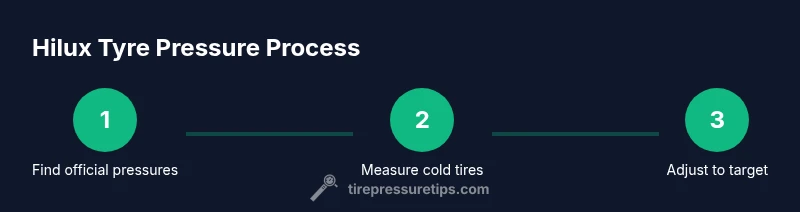
Find the official Hilux pressures
Locate the front and rear cold tire pressures on the door placard or in the owner’s manual. Note that these values differ by trim, wheel size, and load. This is your target baseline.
Tip: Note both front and rear values; some models require different numbers per axle. - 2
Measure cold tires
Ensure tires are cold, remove valve caps, and press the gauge straight onto the valve stem until the reading stabilizes. Record each tire’s measurement.
Tip: Use the same gauge for all tires for consistency. - 3
Adjust to target pressure
If readings are low, add air in small increments and re-check after each adjustment. If readings are high, release air slowly until you reach the target.
Tip: Make changes in 1–2 psi increments to avoid overshooting. - 4
Re-check after seating
Drive 1–2 miles to allow tires to seat, then re-check while cold. Repeat if necessary to stabilize the pressure.
Tip: Recheck the readings after a short drive to confirm stability; cold readings are most accurate. - 5
Check spare and TPMS
Don’t neglect the spare; ensure it’s inflated to an appropriate level. If your Hilux has TPMS, verify the system status and address any warning.
Tip: Rotations can affect TPMS; re-check after service. - 6
Record results
Log date, tire positions, readings, and ambient temperature. Use this log to spot trends and plan future checks.
Tip: Keep the log in the vehicle or a digital note for quick reference.
Frequently Asked Questions
Where can I find the Hilux tyre pressure values for my model?
Check the door jamb placard on the driver's side or refer to the Hilux owner's manual for the exact cold tire pressures. Values vary by trim, wheel size, and load.
Check the door placard or owner's manual for your Hilux's exact cold tire pressures.
Can I drive with low tyre pressure?
Driving with low pressure increases heat, wear, and the risk of a blowout. Refill to the recommended pressure as soon as possible, using a gauge.
No, drive carefully to reach the recommended pressure and recheck with a gauge.
How often should I check Hilux tyre pressure?
Check at least monthly and before long trips, and whenever you notice a temperature shift or load change.
Check at least monthly and before long trips.
Does TPMS replace manual tire pressure checks?
No. TPMS helps by alerting you to changes, but you should still verify pressures with a gauge.
TPMS helps, but you should still measure with a gauge.
Should tyre pressure change with load or terrain on a Hilux?
Yes, heavier loads or off-road use may require higher pressures per placard guidance; adjust carefully and verify.
Yes, load and terrain can change the needed pressure.
Watch Video
What to Remember
- Locate the Hilux’s official cold tire pressures from placard.
- Measure cold tires with a reliable gauge before driving.
- Adjust in small increments and re-check to maintain accuracy.
- Include the spare and monitor TPMS status.
- Account for load, terrain, and temperature when planning checks.