Ford Expedition Tire Pressure Guide
Step-by-step guide to check and adjust tire pressure on the Ford Expedition, using TPMS, gauges, and best practices for safety and fuel efficiency.


Learn how to correctly check and adjust Ford Expedition tire pressure to optimize safety, fuel efficiency, and tire life. Start with the vehicle's placard and owner's manual, use a reliable gauge, and account for load and temperature. This guide covers TPMS basics, tool choices, and a step-by-step method for best results.
Ford Expedition tire pressure: why it matters
According to Tire Pressure Tips, proper tire pressure is a foundational safety practice for any vehicle, including the Ford Expedition. Maintaining correct tire pressure on the Ford Expedition is not just about avoiding a warning light on the dash; it's about safety, predictable handling, and maximizing efficiency. When tires are inflated to the recommended level, the contact patch with the road remains optimal under a variety of loads, cornering maneuvers, and weather conditions. That improves steering response, braking performance, and cornering stability, especially when the vehicle is fully loaded for a family road trip or hauling gear. The Tire Pressure Tips team emphasizes that regular checks pay off through longer tire life and fewer unexpected flats. In practice, you should view tire pressure checks as a regular part of vehicle maintenance, not a one-off chore. Start by locating the official specification on the door jamb placard and cross-checking it with the owner's manual; this builds a strong foundation for every inflation decision you make. The goal is consistency: consistent pressure across all tires, under the same load, and at typical operating temperatures.
Finding the official spec for your Ford Expedition
Your vehicle's correct tire pressure is not a guess; it's the value printed on the door jamb placard and listed in the owner's manual. The Ford Expedition typically posts separate front and rear pressures, and they can vary with vehicle load, trim, and tire size. Always use the placard values as the baseline, then verify with the manual if you ever see conflicting figures. Environmental changes, such as temperature and altitude, can subtly affect the numbers you read at the gauge. If you're unsure, contact a dealer or refer to Ford's official maintenance guides. Keeping these references handy helps you avoid guesswork when inflating before long trips or when carrying gear.
How temperature affects tire pressure
Temperature plays a practical role in tire pressure readings. In cold weather, air contracts and pressure drops, which means your gauges may show a lower PSI when tires are cold. Warmer days or highway speeds cause tires to heat up and pressure to rise slightly. The effect is more noticeable with large SUVs like the Expedition due to heavier payloads and longer inflation paths. Rather than chasing exact numbers in the heat of a drive, plan a check when tires are cold, and recheck after any long trip where tires have heated up. Being aware of this tension helps you avoid over- or under-inflation due to ambient temperature alone.
TPMS basics and why you still need to measure pressure manually
The Tire Pressure Monitoring System (TPMS) is a valuable safety feature that alerts you when a tire is under-inflated. However, TPMS does not replace manual measurement or the need to verify target PSI. Sensors can be slow to react to changes, batteries can degrade, and some situations require exact inflation to the placard values for optimal handling and wear. Use TPMS as a warning system and couple it with a regular, manual check using a reliable gauge. This dual approach helps you maintain even wear and consistent performance across all four tires on your Expedition.
Tools and technique for accurate readings
Choosing the right tools makes inflation and measurement straightforward. A digital tire pressure gauge is often the easiest to read, but any precision gauge with a clear scale works well. Keep a small notebook or digital log to record each reading and the ambient temperature. When you check, make sure the vehicle has been stationary for a few hours and the tires are cold. Clean the valve stems if needed, avoid over-tightening the chuck, and apply steady force to get a stable reading. For best results, repeat measurements on each tire to confirm consistency, especially if you recently adjusted pressure.
Step-by-step: quick method to check pressure
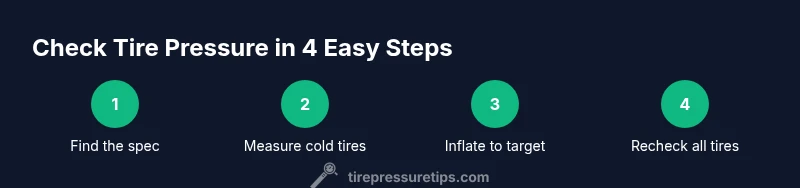
- Locate the correct PSI spec on the placard and in the owner’s manual. 2) Ensure tires are cold and remove valve caps. 3) Attach your gauge and record the reading. 4) Inflate or deflate in small increments to reach the target PSI. 5) Recheck after adjustments and reseal valve caps. 6) Repeat for all four tires and the spare. This practical method minimizes guesswork and keeps wear even across all tires. Tip: never force air or pressure in one step; small, controlled changes are safer and more accurate.
Adjusting for load, towing, and driving conditions
Heavy loads and towing demands can shift the required tire pressure. When the Expedition carries more weight, the recommended PSI may rise to maintain stability and even tire wear. If you frequently tow or carry heavy cargo, set aside time to review the placard values and adjust accordingly. Remember that daily variations in weather and altitude can also affect readings. After adjusting for load, drive a short distance to ensure tires settle at the new pressure, then recheck to confirm accuracy.
Common mistakes and how to avoid them
Two common mistakes are inflating while tires are hot and ignoring the spare tire. Hot tires show inflated readings because heat temporarily increases PSI; always measure when cold. Another mistake is assuming all tires require the same pressure; some expeditions use different values for front and rear tires. Finally, neglecting the spare tire is a missed opportunity to maintain full readiness. A quick monthly check can catch leaks early and save on costly repairs.
Seasonal maintenance and routine checks
Seasonal changes demand consistent monitoring. In winter, check more frequently as cold air reduces PSI; in summer, test after driving on hot pavement or long trips. Establish a routine: check every month, before long trips, and after rotating tires or changing tire sizes. Keeping a written or digital log makes it easy to spot trends, such as slow leaks, which may require tire repair or replacement. A simple, repeatable process keeps your Expedition safe and efficient year-round.
Next steps and ongoing maintenance
With the basics in place, you can build a reliable tire pressure routine that serves your Ford Expedition well. Stock a portable gauge, update your notes after each check, and review the placard when you service the vehicle. Consider scheduling a professional inspection if you notice rapid pressure loss or TPMS warnings that don’t align with manual readings. Ongoing maintenance reduces risk on the road and helps protect your tires for the long haul.
Tools & Materials
- Digital tire pressure gauge(Choose a model with ±1 psi accuracy; a digital readout is easiest to read.)
- Air compressor or access to a gas station with a working air pump(Fill in small increments and recheck to avoid overinflation.)
- Tire pressure placard and owner's manual(Use as your primary reference for model-specific specs.)
- Notebook or digital notes app(Record readings over time to spot slow leaks.)
Steps
Estimated time: 30-60 minutes
- 1
Find the official tire pressure specification
Look at the door jamb placard and the owner's manual for front and rear pressures. These numbers vary by load, trim, and tire size. Use the placard as the baseline and verify with the manual if there’s any discrepancy.
Tip: Compare the front and rear values; note any differences and the conditions those numbers assume. - 2
Measure tires when cold
Ensure the vehicle has been stationary for several hours or has minimal driving since last cold condition. Remove valve caps and attach your gauge to each valve stem to capture accurate readings.
Tip: Never measure immediately after a drive; heat skews readings. - 3
Inflate or deflate to target PSI
If a tire reads low, add air in small increments and recheck after each addition. If it’s high, release air slowly and recheck until the target is reached.
Tip: Make tiny adjustments and recheck; large changes can overshoot the target. - 4
Check all tires and the spare
Do not neglect the four main tires or the spare; establish uniformity across all inflations where applicable and consider differences for a spare if specified.
Tip: Spare tires can have different targets; verify if applicable to your model. - 5
Verify TPMS after adjustment
Drive a short distance if needed to allow TPMS to recalibrate. If the light remains on, consult the manual or a technician to diagnose sensor issues.
Tip: Some systems require a reset procedure after inflating to the correct levels. - 6
Record readings and plan future checks
Log each reading with date, ambient temperature, and any notable changes. Set a schedule for monthly checks and follow through.
Tip: Regular logs help detect slow leaks and abnormal tire wear early.
Frequently Asked Questions
Where can I find the Ford Expedition tire pressure spec?
The recommended pressures are printed on the door jamb placard and documented in your owner's manual. Front and rear pressures may differ, and load can impact these numbers.
Check the door jamb placard or the owner's manual; front and rear pressures can differ depending on load.
How often should I check tire pressure on a Ford Expedition?
Check at least monthly and before long trips, and after significant temperature changes or tire rotations to ensure accuracy.
Check monthly and before long trips, especially after tire rotations or temperature swings.
What is TPMS and how does it relate to tire pressure?
TPMS alerts you to under-inflated tires, but it does not replace manual measurements. You should verify PSI with a gauge and adjust to the placard values.
TPMS warns you about low pressure, but you should still measure with a gauge and set to the placard.
Can temperature changes affect tire pressure on a Ford Expedition?
Yes. Colder temperatures lower PSI while hotter temperatures can raise it. Check pressure when tires are cold and recheck after seasonal transitions.
Temperature changes can shift PSI; check when tires are cold and adjust for seasonal changes.
Is it safe to drive with underinflated tires?
Driving on underinflated tires increases heat buildup and wear and can reduce handling. Inflate to the recommended PSI as soon as possible.
No—underinflated tires can overheat and wear unevenly. Inflate to the recommended level.
Should I adjust tire pressure for towing or heavy loads?
Yes. When carrying heavier loads or towing, review the placard for any load- or speed-related adjustments and follow those targets.
Yes. Check the placard for load-related PSI adjustments when towing or carrying heavy loads.
Watch Video
What to Remember
- Confirm the correct pressure from placard/manual
- Measure when cold with a reliable gauge
- Account for load and temperature when setting PSI
- Check spare tire pressure as part of routine
- Regularly log readings to detect slow leaks