Tyre Monitoring System: A Practical Guide to TPMS and Tire Pressure
A comprehensive, actionable guide to understanding, maintaining, and troubleshooting tyre monitoring systems (TPMS) for safer driving and efficient tire performance.


By the end of this guide, you will understand how tyre monitoring systems (TPMS) work, why reliable TPMS data matters for safety, fuel economy, and tire life, and how to inspect, calibrate, and troubleshoot TPMS, tyre pressures, and related components. We'll cover practical checks, error codes, and when to consult a professional.
Understanding the tyre monitoring system and TPMS
According to Tire Pressure Tips, the tyre monitoring system landscape is evolving with smarter sensors and clearer warnings. A tyre monitoring system, commonly called TPMS, continuously monitors air pressure inside each tire and reports warnings when a tire becomes under-inflated or over-inflated. The practical value is simple: maintaining correct pressure improves safety, fuel efficiency, and tire life, and it gives drivers an early heads-up before a blowout or excessive wear occurs.
In most modern cars, TPMS combines two core approaches. Direct TPMS uses wheel-mounted sensors that measure actual pressure and transmit data to the vehicle computer. Indirect TPMS does not measure pressure directly; instead it infers under-inflation from wheel speed and rotational differences. Both systems rely on reliable sensors, solid battery life, and timely data transmission to avoid false alarms or missed warnings.
Regular checks remain essential. The TPMS can warn you, but it cannot replace a quick manual pressure check with a gauge. A healthy tyre monitoring system works best when you pair on-vehicle alerts with occasional manual verification of all tires, including the spare, and routine sensor maintenance.
How TPMS Works: Sensors, signals, and safety
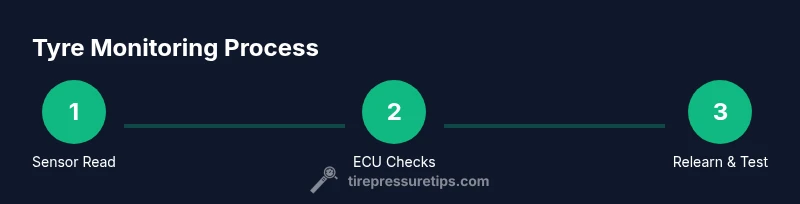
A tyre monitoring system relies on sensors that monitor pneumatic pressure and, in some designs, temperature. In direct TPMS, each wheel hosts a sensor that transmits pressure data to the vehicle’s receiver via radio frequency. The ECU interprets readings, compares them to the manufacturer’s recommended pressures, and triggers warning lights when values drift beyond tolerance.
Indirect TPMS uses wheel-speed data rather than direct pressure measurements. It detects changes in rolling circumference that occur as tires lose air and signals the ECU to issue a warning. The two approaches have different maintenance needs; direct TPMS requires sensor battery health checks, while indirect TPMS depends on software calibration and accurate wheel-speed signals.
Tire Pressure Tips Analysis, 2026 notes that many drivers rely on TPMS warnings and neglect manual checks. Temperature changes, driving style, and load can cause pressure shifts, so regular verification with a gauge is still a best practice. A well-functioning TPMS should refresh after inflating tires to spec and after tire rotations or sensor replacements; if it doesn’t, schedule inspection.
Direct TPMS vs Indirect TPMS: Which one fits your vehicle
Direct TPMS provides actual pressure readings for each tire, often displayed on the instrument cluster or a dedicated screen. It gives precise psi values that you can use to adjust inflation quickly. Indirect TPMS uses wheel-speed sensors to detect under-inflation, which reduces hardware costs but may require manual pressure checks to confirm accuracy.
Selecting between methods matters for maintenance. Direct systems need sensor batteries replaced over time, and wheel removal may be necessary for calibration. Indirect systems rely on software and sensor data, which can be updated via firmware; however, they can be less intuitive for drivers who want exact pressures at a glance. For safety and precision, many drivers prefer direct TPMS, but indirect systems can be perfectly adequate with routine gauge checks.
Checking and calibrating TPMS sensors
Begin with a visual inspection of wheel sensors and valve stems. Look for damaged or corroded sensors and check that wheel covers are seated properly. Use a calibrated digital tire pressure gauge to verify each tire’s actual pressure against the recommended level in the owner’s manual or the door jamb placard.
If a tire remains under-inflated after a standard inflate-and-drive cycle, perform a reset or relearn procedure per your vehicle’s instructions. Some cars require a specific sequence, such as a key cycle or an exact drive distance, for the TPMS to relearn. Keep notes on sensor replacements and calibration dates to help future service.
Maintaining tyre pressures and TPMS accuracy
Consistent tire pressures help the TPMS deliver accurate readings. Check pressures when the tires are cold, ideally before driving or after a minimum three-hour rest, to avoid temperature-induced variance. Use a reliable gauge, and carry a portable gauge for on-the-road checks. Always compare with the recommended psi rather than the maximum rating on the tire sidewall.
Seasonal temperature changes can cause measurable shifts in tire pressure. For every 10°C (18°F) change, pressures can rise or fall a few psi. Monitoring these shifts and adjusting accordingly improves fuel economy, tire wear, and safety. In addition to pressure, inspect tread depth and wear patterns; compromised tires affect handling and can amplify TPMS readings. If you notice sensor battery weaknesses or transmission issues, schedule a service appointment promptly.
Remember that TPMS is a warning system, not a substitute for manual checks. Use the TPMS readings as a guide and confirm with a gauge, especially when seasonal changes or load vary.
Troubleshooting common TPMS warnings
Warnings can indicate simple pressure drops or more serious sensor faults. Start by inflating all tires to the recommended pressure and observe whether the warning clears. If not, check for a persistent low tire on one corner, which could indicate a slow leak, a faulty valve stem, or a damaged sensor battery.
Diagnostics can be performed with a handheld TPMS tool or via dealership software. If a fault code points to a specific sensor, you may need sensor replacement or a relearn procedure. After tire service, perform a relearn to ensure the system recognizes the new sensor. If warnings persist, consult a professional for sensor testing and calibration.
Cold-weather conditions can trigger TPMS alerts more easily; in winter, check pressure more often and verify readings after warming up the tires. If a TPMS fault occurs after rotating tires, ensure the relearn was completed correctly on all wheels.
Practical tips for tyre pressure maintenance and safe driving
- Schedule periodic checks as part of routine maintenance; use a digital tire pressure gauge and the vehicle’s TPMS display as a guide.
- Always inflate tires to the recommended pressure, not the maximum rating on the sidewall. Under-inflation increases rolling resistance, reduces grip, and accelerates wear.
- After rotating tires or changing rims, perform the relearn procedure if required by your vehicle.
- For fleets or multiple drivers, keep a log of sensor replacements, tire pressures, and calibration dates to ensure consistent TPMS performance.
The Tire Pressure Tips team emphasizes that good TPMS practice is part of overall tire care. Regular checks, combined with pressure monitoring and sensor maintenance, save money and time while reducing road risk. Remember: TPMS warnings should be confirmed with a manual gauge for highest accuracy.
Tools & Materials
- Digital tire pressure gauge(Calibrated to 0-60 psi; use with cold tires)
- Vehicle owner's manual(For TPMS reset and sensor specifics)
- Spare tire and jack(Useful during tire replacement operations)
- Soapy water spray(Check for sensor leaks or seal issues)
- TPMS relearn tool or official diagnostic tool(Model-specific; check dealer guidance)
Steps
Estimated time: 25-40 minutes
- 1
Check tire pressures with a gauge
With the tires cold, use a calibrated digital gauge to measure each tire. Record the readings and compare them to the manufacturer’s recommended pressures. This establishes a baseline and helps you recognize gradual changes over time.
Tip: Always verify the exact pressure value from the door jamb placard, not the tire sidewall maximum. - 2
Identify TPMS sensor locations and wheel positions
Locate each sensor on the wheel and note its position. This helps if you need to replace a sensor or perform a relearn, since some systems require wheel-by-wheel identification.
Tip: Use the vehicle manual’s relearn section to map sensors to wheels before any removal. - 3
Inflate tires to the recommended pressure
If any tire reads below spec, inflate it to the manufacturer’s recommended level. Recheck all tires after inflation and drive a short distance to prime the system for any necessary updates.
Tip: Avoid over-inflation; returning to the recommended range reduces uneven wear. - 4
Reset/relearn TPMS if required
Some vehicles require a relearn after air addition or tire rotation. Follow the manual’s exact sequence; many cars need a simple button press, while others need a drive cycle.
Tip: If the system won’t relearn, check battery health and sensor seating; a loose sensor can produce false warnings. - 5
Test drive and verify readings
Drive at moderate speeds and monitor the TPMS display. Confirm that warnings clear when pressures stay within spec and that no new warnings appear.
Tip: Keep a mobile gauge handy during the first few days after maintenance.
Frequently Asked Questions
What is a tyre monitoring system (TPMS) and how does it work?
A tyre monitoring system (TPMS) continuously monitors tire air pressure and warns you when it drops below a safe level or if a sensor fault is detected. Direct TPMS uses wheel sensors to report precise pressures, while indirect TPMS infers pressure from wheel-speed data. Regular checks with a gauge complement TPMS alerts.
TPMS monitors tire pressure and signals warnings if a tire is under-inflated or a sensor fault occurs. Direct TPMS gives exact pressure readings; indirect TPMS uses wheel speed to infer pressure. Combine TPMS alerts with manual checks for best safety.
Why is the TPMS warning light on even after inflating tires?
The warning can persist if the system needs a relearn after inflation or rotation, or if a sensor battery is weak or a wheel sensor is damaged. Verify pressures, perform the relearn procedure if required by your vehicle, and consider sensor inspection if warnings persist.
If the TPMS light stays on after inflating, check the relearn procedure for your car and inspect sensors if needed.
How do I reset or relearn TPMS after tire rotation?
Reset or relearn procedures vary by vehicle. Consult the owner’s manual or dealer for the exact sequence; common steps include inflating to spec, pressing a reset button, or performing a short drive cycle. After relearn, recheck all pressures.
Most cars require a specific relearn sequence after rotation; check the manual and complete it, then recheck pressures.
Are aftermarket TPMS sensors reliable compared to OEM?
Aftermarket TPMS sensors can be reliable if matched to the vehicle and properly programmed. OEM sensors may offer easier calibration and system compatibility. Always use components from reputable sources and verify with a relearn after installation.
Aftermarket sensors work if matched and programmed correctly; OEM sensors may offer smoother integration. Confirm compatibility and relearn after installation.
Can TPMS help improve fuel economy?
While TPMS awareness helps avoid under-inflation, fuel economy benefits come from maintaining correct tire pressure, not from TPMS alone. Use TPMS as a warning system and couple it with regular manual checks to sustain optimal efficiency.
TPMS helps you stay aware of tire pressure, which supports fuel economy when combined with regular gauge checks.
Watch Video
What to Remember
- Know TPMS types: direct vs indirect and how they affect maintenance.
- Verify TPMS readings with a manual gauge for accuracy.
- Relearn TPMS after tire service to ensure correct warnings.
- The Tire Pressure Tips Team recommends regular TPMS checks as part of routine maintenance.