TPMS Mercedes Troubleshooting: Quick Guide
Urgent, practical guide to diagnose and fix TPMS issues on Mercedes. Learn quick checks, a diagnostic flow, and step-by-step fixes to keep tires properly inflated and sensors functioning.


If your tpms mercedes warning is on, start with a quick check: verify tire pressures, inspect the sensors, and reset via the vehicle’s TPMS menu. Tire Pressure Tips guides you through the most common Mercedes TPMS faults and practical, safe fixes.
Why TPMS Matters for Mercedes Drivers
As a Mercedes owner, you rely on accurate tire pressure to maximize safety, tire wear, and fuel efficiency. According to Tire Pressure Tips, TPMS helps you avoid under- or over-inflated tires that can affect handling on high-performance models. Modern Mercedes vehicles integrate direct TPMS sensors with the ABS/DSC system, alerting you when a tire deviates from its target pressure. Understanding TPMS reduces unexpected flats and improves winter traction, load management, and ride comfort. In this section, we explain the fundamentals of TPMS and why Mercedes users should keep it healthy.
TPMS is not just a light on the dashboard—it’s a dynamic system that monitors each tire’s pressure and, in many Mercedes models, temperature. Direct TPMS uses wheel-mounted sensors with batteries, while indirect TPMS relies on wheel-speed data from the ABS system to infer pressure differences. For Mercedes drivers, a healthy TPMS means more consistent grip, predictable steering, and better fuel economy. Keeping the system accurate also protects rims and tires from uneven wear and premature failure, especially under load or during aggressive cornering.
Common Mercedes TPMS Triggers and Symptoms
The TPMS warning light can appear for several reasons, and Mercedes models vary slightly in how the system signals issues. Common triggers include a genuinely low tire pressure in any tire when cold, a dead or weak direct TPMS sensor battery, a leaking valve stem, or a sensor that has lost its relearn data after a tire change. Indirect TPMS can misread if ABS wheel-speed sensors are dirty or if software calibration drifts. When the light comes on, start with the simplest checks: confirm all tires are within the recommended range, inspect for obvious leaks, and ensure wheel valves are undamaged. If the light stays on after inflating to spec, you may be facing a battery issue in a direct sensor or a need for a relearn.
How TPMS Works in Mercedes-Benz Vehicles
Mercedes integrates TPMS as part of the vehicle’s safety and efficiency ecosystem. Direct TPMS uses sensors in each wheel to transmit real-time pressure data to the ECU, often triggering the instrument cluster warning if a number falls outside the set window. Indirect TPMS, on the other hand, uses ABS wheel-speed data to infer under- or over-inflation. Regardless of the method, Mercedes owners should know how to access the TPMS relearn or reset function, which is usually in the vehicle’s settings menu. After inflating tires or rotating wheels, a relearn may be required to synchronize sensors with the car’s computer and restore accurate readings.
Quick Wins: Easy Fixes You Can Try Today
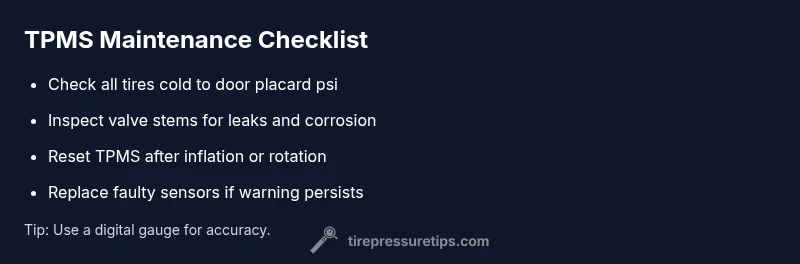
- Verify all tires are cold and inflated to the recommended pressure listed on the door placard. Do not rely on a single tire reading—check all four tires.
- Inspect valve stems and wheels for signs of damage, corrosion, or puncture seals that could cause slow leaks.
- If you’ve serviced tires or rotated wheels, perform a TPMS relearn using the Mercedes onboard menu or the appropriate OBD tool as described in the owner’s manual.
- If the light persists after inflation and relearn, consider sensor battery health or a faulty sensor, which may require sensor replacement.
When to Replace TPMS Components and How to Plan
Sensor batteries in direct TPMS typically outlast the tires but can fail after several years of service. If readings are inconsistent, or an individual sensor repeatedly fails relearn, replacement is often the best option. For Mercedes vehicles, battery replacement may necessitate pairing with the vehicle’s software and may require dealer tools or a qualified technician. Before replacing sensors, confirm compatibility with your model year and wheel size to ensure correct relearn procedures and avoid needless road calls.
Steps
Estimated time: 40-60 minutes
- 1
Confirm warning and gather details
Note the exact TPMS warning symbol, which tire it references, and when you observed the issue. Check vehicle settings and recent service notes. This helps you avoid unnecessary steps and speeds up the diagnostic process.
Tip: Write down the tire locations and observed pressures before changing anything. - 2
Check all tires cold to target pressures
Use a reliable gauge to measure each tire when cold. Compare results to the door placard values. If any reading is off, adjust to the recommended pressure and recheck after a few minutes, as heat can cause readings to change.
Tip: Inflate to the cold pressure; recheck after a 10-minute cooldown. - 3
Inspect for leaks and valve integrity
Visually inspect each tire for nails, cuts, and external leaks. Check valve stems for cracks or corrosion. Tighten caps snugly and replace damaged stems to stop slow leaks that trigger TPMS warnings.
Tip: If you hear a hissing sound, stop driving and address the leak immediately. - 4
Perform TPMS relearn/recalibration
Access the TPMS relearn option via the Mercedes instrument cluster or steering wheel menu. Inflate to spec, select relearn, and follow prompts. If your model requires a dealer tool, schedule service.
Tip: Ensure all four tires meet the target pressure before relearning. - 5
Test after relearn and driving
Drive for 10-15 minutes at moderate speeds to allow the system to recalibrate. Confirm the TPMS indicator stays off unless there truly is a pressure change. If it returns, a sensor or module fault is likely present.
Tip: Reset only after successful inflation and relearn. - 6
Plan sensor maintenance or replacement
If a clean relearn doesn’t resolve the warning, assess sensor health. Direct TPMS sensors may need battery replacement or replacement of the unit. Schedule professional inspection if you are unsure.
Tip: Warranties often cover sensor replacement; check your policy.
Diagnosis: TPMS warning light stays on or sensor data appears unreliable on a Mercedes
Possible Causes
- highWeak or dead battery in a direct TPMS sensor
- mediumExpired calibration after tire service or rotation
- lowSoftware fault or ABS/ESP integration issue
- lowPhysical damage or corrosion at valve stems or sensors
Fixes
- easyReplace the TPMS sensor battery or sensor unit; confirm compatibility with your Mercedes model
- easyReset or reinitialize TPMS via instrument cluster or OBD-II tool according to the owner's manual
- mediumRecalibrate all sensors after tire service; perform relearn procedure using Mercedes data screen
- mediumInspect wheel valves, clean corrosion, and confirm proper seal; replace damaged valve stem if needed
Frequently Asked Questions
What is TPMS and how does it work on Mercedes?
TPMS stands for Tire Pressure Monitoring System. On Mercedes, it uses direct sensors or indirect wheel-speed data to alert you when a tire isn’t at the proper pressure. The system helps maintain safety and efficiency by preventing under- or over-inflated tires.
TPMS monitors tire pressure and alerts you when it’s off, helping you stay safe.
How do I reset TPMS on a Mercedes after inflating tires?
Most Mercedes models offer a relearn option in the instrument cluster or steering wheel controls. Inflate all tires to the recommended pressure, access the TPMS relearn menu, and follow the prompts.
Inflate to the right pressure, then use the car’s TPMS relearn menu.
Can TPMS batteries die and trigger false warnings?
Yes. Direct TPMS sensors have batteries that can wear out over time, causing weak readings or faults. If you notice frequent warnings, battery health is a likely factor.
Yes, sensor batteries wear out over time.
Will driving with a TPMS warning cause tire damage?
Running with a TPMS warning usually means under-inflated tires, which can wear tires unevenly and raise the risk of a blowout. Stop and check pressures promptly.
Driving while the warning is on can wear tires.
When should I replace a TPMS sensor?
Replace a TPMS sensor when the battery is dead, the unit is damaged, or relearn attempts fail. A professional can advise on model-compatible replacements.
Replace a dead sensor; a pro can confirm the best option.
Do all Mercedes models require relearning after tire rotation?
Some Mercedes models require relearning after tire rotation. Check your owner’s manual or contact a dealer for model-specific steps.
Some models need relearning after rotation.
Watch Video
What to Remember
- Check all tires when cold to the recommended psi
- Learn your Mercedes TPMS relearn steps for quick resets
- Inspect valves and sensors for wear and corrosion
- Replace faulty sensors promptly to avoid repeated warnings