How Tire Pressure Sensors Connect to Your Car: A Practical How-To
Explore how tire pressure sensors connect to your vehicle, from wheel-mounted transmitters to the TPMS control module. Learn data flow, calibration, troubleshooting, and maintenance for safer, more accurate tire monitoring.


Learn how tire pressure sensors connect to your car and how the TPMS reads your tire pressure. This quick guide outlines wheel-mounted sensors, the communication path to the TPMS control module, and typical maintenance steps to keep warnings accurate. It also highlights safety considerations and when to seek professional calibration.
What is TPMS and how sensors connect
TPMS, or tire pressure monitoring system, helps keep tires inflated to recommended levels. In modern vehicles, the connection between tire pressure sensors and the car involves two main approaches: direct TPMS with wheel-mounted sensors and indirect TPMS that uses ABS wheel speed data. The question how do tire pressure sensors connect to car is central to understanding why you see warnings on the dash. Direct TPMS sensors are physically mounted at the valve stem or inside the tire and measure pressure in real time; the data is transmitted wirelessly to a central receiver in the vehicle. Indirect TPMS, by contrast, relies on wheel speed measurements from the ABS system to infer low pressure when rotation characteristics change. Both systems share the goal of alerting the driver before a tire becomes unsafe.
Direct TPMS sensors are small, rugged devices that include a pressure sensor, a radio transmitter, a battery, and a microcontroller. They live in the tire and connect to a valve stem assembly, sometimes integrated with the wheel rim. Indirect TPMS uses the ABS/ESC wheel-speed sensors to estimate pressure changes based on how quickly a wheel accelerates or decelerates. Understanding which type your car uses helps you interpret warnings and plan maintenance.
In this guide you will learn the data path, maintenance steps, and practical checks you can perform at home to ensure the system remains reliable. The Tire Pressure Tips team emphasizes that knowledge about sensor connections empowers drivers to act quickly when a warning pops up and to coordinate service with confidence.
Anatomy of a tire pressure sensor system
A direct TPMS setup consists of wheel-mounted sensors (one per wheel), each containing a pressure sensor, a temperature sensor, a tiny battery, and a wireless transmitter. These sensors transmit unique IDs and real-time pressure readings to a TPMS receiver in the vehicle. The receiver passes the data to the TPMS control module, which then reports status to the vehicle’s ECU and the instrument cluster. When you rotate tires, the system must recognize each sensor’s ID to avoid misreads.
In indirect TPMS configurations, there is no wheel-mounted sensor. Instead, the vehicle uses the ABS wheel-speed sensors to detect changes in wheel rotation that indicate underinflation. The indirect approach is cheaper to implement but generally less precise and more sensitive to tire wear patterns and driving style. Regardless of approach, every TPMS system ultimately ties into the vehicle’s central computer to trigger warnings and guide you toward corrective action.
Common components across both systems include the TPMS warning light, the diagnostic interface, and the user manual guidance. Many vehicles store sensor IDs in memory, so the relearn or initialization process after tire service is critical to ensuring accurate readings. A well-maintained TPMS reduces the risk of running on underinflated tires and helps protect fuel economy and tire life.
This section explains the core building blocks so you can visualize how data travels from the tire to your dashboard and beyond. The goal is to make the connection—from the wheel to the ECU—transparent and actionable for everyday driving.
How sensors communicate: wireless vs direct TPMS
Direct TPMS relies on radio frequency signals emitted by each wheel sensor. When the vehicle starts or the wheel turns, sensors wake up, measure pressure (and sometimes temperature), and transmit a signal that is matched to its unique ID. The receiver in the vehicle decodes these messages and updates the TPMS module. This data is then used by the ECU to evaluate whether readings are within spec and to trigger warnings if necessary.
Indirect TPMS uses the ABS wheel-speed data to infer underinflation. If a tire’s effective diameter changes due to low pressure, its rotation rate differs from the other wheels. The system flags potential underinflation and triggers the dash warning, even though there’s no physical pressure sensor on the wheel. Both methods rely on periodic wake-ups and consistent data streams to stay accurate. Wireless communication means the system can function without physical wiring to each wheel, but it also means battery health and sensor integrity are essential for reliable readings.
In practice, the exact signaling protocol and frequency are built into the vehicle’s software and the sensor hardware. Vehicle manufacturers implement security features to prevent spoofing or interference, and many scanners can read sensor IDs to confirm they match the vehicle’s memory. Understanding this distinction helps you diagnose why a sensor may not be reporting correctly and what to check during service.
From a practical standpoint, the key takeaway is that you don’t need to hear a wheel sensor to know whether the system is working—the dashboard alert and the scan-tool readings tell the full story. This section reveals how the wireless link underpins the reliability drivers expect from modern TPMS.
From wheel to car: data flow and ECU integration
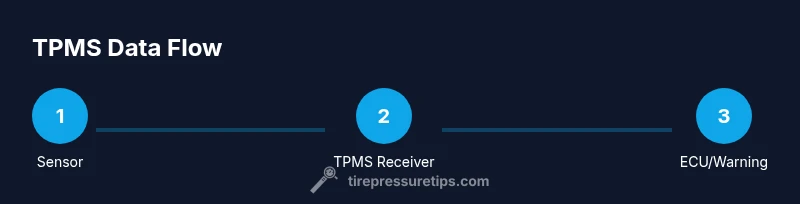
The data path begins at the wheel, where the sensor continuously monitors pressure and temperature. When readings change beyond preset thresholds, the sensor transmits an encrypted message containing the tire ID, pressure, and temperature. The TPMS receiver gathers these messages and forwards them to the TPMS control module, which sits in the vehicle’s networked control system. The ECU then uses this data, along with wheel-speed data, to determine the overall tire status and whether a warning needs to be shown on the instrument cluster.
During a typical drive, the TPMS may update readings at regular intervals, and the ECU can trend data to detect gradual leaks or slow losses. When a tire is serviced, the system may require a relearn or initialization procedure so the new or relocated sensor IDs are matched to their wheel positions. If the IDs don’t align, the ECU may report erroneous warnings or fail to trigger warnings when needed. This flow—from wheel to receiver, to TPMS module, to the ECU—explains why a single wheel change can cause TPMS warnings if relearn steps aren’t completed.
Understanding the flow helps you diagnose issues at home. If you notice a warning without any obvious loss of pressure, consider rechecking the relearn status, confirming sensor IDs, and ensuring the vehicle software has the latest updates. A reliable data flow depends on sensor health, proper installation, and correct ECU programming.
Instrument cluster and TPMS warnings
Your instrument cluster is the primary user interface for TPMS. When the TPMS control module detects a problem—either a steady underinflation reading or a sensor that isn’t reporting—the dash light illuminates. Depending on the vehicle, you might see a dedicated TPMS warning, a “Service TPMS” message, or a general tire warning light. Some vehicles also display the exact tire position with the identified underinflated tire.
Interpreting these warnings starts with a simple check: verify tire pressures with a gauge, compare to the vehicle’s recommended maximum pressures in the owner’s manual, and then scan for sensor IDs to confirm which wheel may be reporting incorrectly. If a sensor is dead or the battery is failing, you’ll typically see a persistent warning or no RSSI signal in a diagnostic scan. Your service manual will provide the exact relearn sequence and safety precautions for your model.
For owners, the practical approach is to treat TPMS warnings as urgent reminders rather than optional messages. Regular checks with a gauge help you validate the dashboard reading, while a professional scan can confirm sensor health and ECU programming. This layer of verification keeps you safe on the road and helps protect tire life and fuel efficiency.
Common failure modes and signs of trouble
TPMS reliability hinges on sensor health and software integrity. Common failure modes include a dead battery in a direct TPMS sensor, physical damage to the sensor during tire service, a mislearned ID after a tire rotation, or an aging sensor that intermittently loses signal. Indirect TPMS suffers when ABS wheel-speed sensors or their wiring degrade, producing inaccurate readings without a warning light.
Early signs of trouble include inconsistent readings (pressure varies significantly while parked), a warning light that remains on without a measurable pressure change, or a sudden dash alert after a tire service. A slow leak in a tire can also stress the system if the sensor needs to relearn after the tire is brought back to its nominal pressure. If you observe any of these signs, test tire pressure with a gauge, inspect the valve stem for damage, and perform a sensor relearn using a scan tool.
Addressing failures promptly reduces the risk of driving on underinflated tires and helps preserve tire longevity. Always verify that the issue isn’t a simple gauge misreading before replacing sensors, and use a professional diagnostic if you are unsure about the sensor status.
Maintenance tips to keep sensors healthy
Healthy TPMS sensors rely on careful handling during tire service and regular checks. Avoid striking wheels or valve stems with tools, as damage to the sensor housing or the valve can disable readings. When mounting or demounting tires, use proper equipment and torque to the manufacturer’s specifications to protect the sensor and the wheel.
Regular software or firmware updates through the vehicle’s dealership or certified shops help ensure the TPMS control module interprets sensor data correctly. If you rotate tires or replace a tire, plan for a relearn unless the procedure is clearly automated in your vehicle. Keep a record of sensor IDs and their positions to expedite future service. Finally, consider replacing direct TPMS batteries as part of scheduled maintenance when the manufacturer recommends; a failing battery reduces signal strength and sensor range, increasing the chance of warnings while driving.
These practices keep the system accurate and reduce the chance of nuisance warnings, improving safety and fuel efficiency. The Tire Pressure Tips team notes that proactive TPMS maintenance pays off in reliability and peace of mind.
When to replace sensors or calibrate
Sensors have a finite life, primarily determined by battery health and mechanical stress. If a direct TPMS sensor fails to report consistently, or a relearn cannot complete after tire service, replacing the sensor is often the best option. Indirect TPMS may require ABS sensor servicing or software recalibration rather than a hardware change. Calibrating or relearning is typically required after tire rotation, replacement, or if a sensor ID is changed.
The recommended approach is to perform a relearn after any tire service, check the battery health with a compatible scan tool, and replace sensors only when diagnostics indicate failure. This process ensures that the TPMS continues to provide accurate warnings and that corresponding dashboard indicators reflect the wheel’s actual status.
Quick-start checklist for owners
- Confirm your vehicle uses direct or indirect TPMS and review the relearn procedure in the owner’s manual.
- Gather a TPMS-compatible scan tool and a digital tire pressure gauge.
- Check all tires for proper inflation, including the spare if your vehicle has a spare TPMS sensor.
- Perform a sensor relearn after tire rotation or replacing a tire or sensor.
- Record sensor IDs and positions to expedite future service and calibration.
],
toolsMaterials
Tools & Materials
- Digital tire pressure gauge(For accurate at-a-glance checks and cross-verification with TPMS readings)
- TPMS relearn tool or OBD2/OEM scan tool(Used to read sensor IDs and perform relearn/calibration)
- Owner’s manual or OEM procedure reference(Consult for model-specific relearn steps and safety precautions)
- Wheel torque wrench(Useful if you remove wheels for sensor inspection; follow torque specs)
- Replacement TPMS sensors (if needed)(Only if diagnostics show sensor failure)
Steps
Estimated time: 60-90 minutes
- 1
Identify TPMS type
Check whether your vehicle uses direct TPMS (wheel-mounted sensors) or indirect TPMS (ABS-based). The owner’s manual or a scan tool can confirm the type. Understanding the type guides your relearn and maintenance steps.
Tip: If you’re unsure, start with a quick scan to read sensor IDs and confirm the system type. - 2
Access and read sensor IDs
Use a TPMS scanner to read the sensor IDs from each wheel and note their corresponding positions. Record current pressures and temperatures if your tool provides that data. This establishes a baseline for future reference.
Tip: Save the IDs in a mobile note or file for quick reference during service. - 3
Check battery health and visual condition
Inspect the wheel sensors for any signs of corrosion, cracking, or missing battery caps. In direct TPMS, a weak battery can reduce signal strength and accuracy. If you notice nonuniform readings, consider battery health as a potential cause.
Tip: Handle with care; damaged sensors must be replaced to avoid leaks or misreads. - 4
Relearn/initialize sensors
Follow the vehicle-provided relearn procedure with your scanner, ensuring each wheel’s ID is mapped to the correct position. This step is essential after tire removal, rotation, or sensor replacement.
Tip: Often requires the car to be in a specific mode or the engine on for a short period. - 5
Verify data flow and dash warnings
Drive a short distance and recheck all sensor readings with the scanner. Confirm the dash warning lights behave as expected and that the reported pressures align with a trusted gauge.
Tip: If warnings persist, recheck IDs and reseat sensors. - 6
Document and plan ongoing maintenance
Create a simple maintenance schedule: regular tire pressure checks, sensor health checks, and relearn triggers after tire service. This reduces future surprises and keeps TPMS reliable.
Tip: Set a reminder for tire rotations and sensor checks.
Frequently Asked Questions
What is TPMS and why does it matter?
TPMS stands for Tire Pressure Monitoring System. It helps ensure tires stay within recommended pressure, improving safety, fuel efficiency, and tire wear. The system relies on sensors and ECU logic to warn you if pressure drops.
TPMS helps you stay safe by warning you when a tire is underinflated. It uses sensors and vehicle software to monitor pressure and alert you promptly.
What are the signs of a failing TPMS sensor?
Common signs include inconsistent readings, the warning light staying on without a real pressure change, or a sensor ID not showing in a scan tool. A weak battery in a direct TPMS sensor is another frequent cause.
Look for inconsistent readings or a stubborn warning light. A weak battery or failed sensor is often the culprit.
Can I relearn TPMS sensors myself?
Many vehicles support DIY relearn with a compatible scan tool. Always follow the manufacturer’s sequence, as improper relearns can cause false warnings or misreads.
Some cars let you relearn TPMS at home with the right tool. Check your manual for the exact steps.
How long do TPMS sensors last?
Direct TPMS sensors typically last several years, but battery life varies by model and driving conditions. Indirect TPMS doesn’t involve sensor replacements, but ABS components may wear over time.
Sensor life varies; direct sensors have a battery that can wear out, while indirect TPMS depends on ABS sensors.
Do TPMS sensors require wheel removal?
Yes, most procedures require removing wheels to access valves, read IDs, and perform relearns. Some vehicles offer a more automated relearn process that can be done without fully removing tires.
Often you need to remove wheels to service TPMS, but follow your car’s specific procedure.
What tools do I need to relearn TPMS?
A compatible TPMS scan tool or OEM relearn tool is needed. Basic code readers may not support TPMS relearning, so verify tool compatibility before starting.
A TPMS relearn tool is usually required to map sensor IDs to wheel positions.
Watch Video
What to Remember
- Know whether your car uses direct or indirect TPMS
- Direct TPMS relies on wheel-mounted sensors for real-time data
- Relearn sensors after tire service to avoid false warnings
- Regularly check tire pressures with a gauge to validate TPMS readings
- Use a proper scan tool to read IDs and verify ECU integration