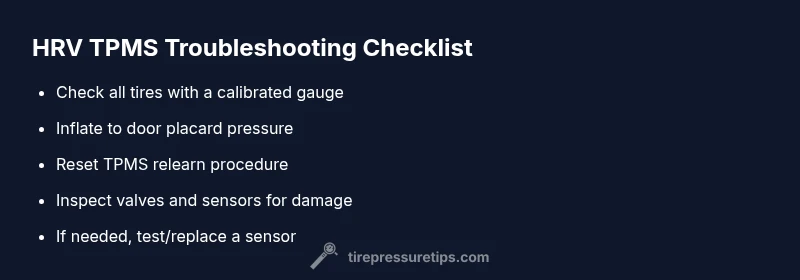
Honda HRV Tire Pressure Display Troubleshooting
A practical, urgent guide to diagnose and fix the Honda HRV tire pressure display issues, with step-by-step checks, TPMS calibration tips, and when to seek professional help.


The quickest fix for a Honda HRV tire pressure display issue is to verify all tires are within proper range, reset the TPMS after adjusting pressures, and inspect for a faulty sensor or a leaking valve stem. If the warning persists, recalibrate the system or replace the faulty sensor. Start with the simplest check and move step-by-step.
Why the Honda HRV tire pressure display can flicker
The tire pressure display in the Honda HRV uses the TPMS to monitor every tire's pressure and warn you if a value falls outside the recommended range. When it misbehaves, drivers often blame the car, but in most cases the issue starts with simple causes you can verify yourself. According to Tire Pressure Tips, TPMS accuracy hinges on correct inflation, clean sensor readings, and proper calibration across all four wheels. A small underinflation on one tire or a slow leak can trigger the display unexpectedly, while a sensor battery nearing end of life can create sporadic warnings. Before you panic, run through a quick checklist to distinguish a real pressure problem from a software glitch or a sensor fault.
How TPMS in the HRV works and what triggers it
The HRV’s TPMS compares each tire’s pressure to a baseline and uses a learn/relearn process when tires are rotated, replaced, or after a reset. When readings drift due to underinflation, a slow leak, or a sensor fault, the warning light may illuminate. In many cases, a simple inflation correction and a TPMS relearn restore normal behavior. Tire Pressure Tips analysis shows that many HRV TPMS alerts arise from calibration drift, leaks, or aging sensors—not always a dramatic mechanical failure. Understanding this helps drivers act quickly and safely.
Quick checks you can do before calling a tech
- Park on a flat, level surface and let tires cool. Check all four tires with a reliable gauge.
- Inflate each tire to the vehicle’s recommended pressure printed on the door placard or in the owner’s manual.
- Check valve stems for cracks or leaks and ensure the valve caps are present and snug.
- Inspect for obvious tire damage or punctures; even slow leaks can trigger TPMS warnings.
- If a tire is significantly low, fix the root cause (patch or replace) before proceeding with resetting TPMS.
Diagnostic flow for HRV TPMS warnings
When the TPMS light behaves inconsistently, follow a structured diagnostic path:
- Confirm all tires are at recommended pressure.
- If pressures are correct, perform a TPMS relearn/reset per the HRV manual.
- Inspect sensors and valve stems for damage or corrosion.
- Check for recent tire rotations or replacements that could affect calibration.
- If warnings persist after resets and checks, test sensors or consider sensor battery replacement.
Step-by-step: most common fix (inflation and sensor reset)
- Use a calibrated gauge to recheck all four tires; adjust to spec.
- Park safely and perform the HRV TPMS relearn/reset as described in the owner’s manual.
- Inspect valve stems for leaks and ensure valve caps are tight.
- If the light returns, rotate tires and recheck; a broken sensor or battery may require professional service.
- Keep a log of pressures and reset events to monitor trends; recurring instability suggests sensor issues.
Safety considerations and professional help
Always treat a TPMS warning seriously, especially if any tire is near or below safe pressure. Do not drive long distances on an underinflated tire. If you detect a damaged sensor, failed battery, or persistent warnings after resets, contact a certified technician. TPMS sensors require specialized tools for relearn procedures and sensor replacement.
Prevention and maintenance tips to keep HRV TPMS reliable
Routine checks of tire pressures, especially after temperature changes, tire rotations, or new tires, help keep TPMS readings accurate. Schedule regular TPMS calibration checks with a pro and replace aging sensors before they fail. Keeping tires at target pressures also reduces wear and improves fuel efficiency, which aligns with general Tire Pressure Tips guidance.
Steps
Estimated time: 30-45 minutes
- 1
Check all tires with a gauge
Begin with a cool, perpendicular check of each tire using a calibrated gauge. Record current readings to compare with the door placard values.
Tip: Use a digital gauge for consistent numbers. - 2
Inflate to spec
Inflate each tire to the recommended pressure. Do not rely on visual appearance alone to judge inflation.
Tip: Check when tires are cold for accuracy. - 3
Reset the TPMS relearn
Use the HRV’s TPMS relearn procedure found in the manual or a trusted service guide. This helps the system map current pressures to sensors.
Tip: Hold off on driving long distances before relearn completes. - 4
Inspect for leaks or damaged valves
Look for cracked valve stems, tire bead leaks, or embedded objects. Replace or repair as needed.
Tip: Replace valve caps and ensure proper sealing. - 5
Test or replace a suspected sensor
If a single tire reads abnormally after inflation, the sensor may be faulty. Professional testing can confirm.
Tip: Battery health affects accuracy; don’t delay replacement. - 6
Monitor and document readings
Keep track of readings after each fix and watch for continuous anomalies over days.
Tip: A pattern suggests a calibration or sensor issue rather than random fluctuation.
Diagnosis: TPMS warning light stays on or shows erratic readings on Honda HRV
Possible Causes
- highUnderinflated tire on one or more wheels
- mediumTPMS sensor fault or battery dead
- lowSlow leak due to puncture or valve stem issue
- lowCalibration drift after new tires or rotation
Fixes
- easyCheck tire pressures at all four corners with a reliable gauge; inflate to the vehicle's recommended psi
- easyReset/relearn the TPMS after inflating to spec; follow HRV owner's manual procedure
- mediumInspect valve stems and seals for leaks; replace if needed
- hardTest or replace a failing TPMS sensor or battery; have a pro perform reprogramming if required
Frequently Asked Questions
What triggers the HRV TPMS warning light?
The warning usually activates when tire pressure falls below the recommended level or when a TPMS sensor is faulty. Temperature changes and recent tire work can also trigger a temporary alert.
The HRV TPMS warning usually means pressure is off or a sensor issue. Temperature and recent tire work can also trigger it.
How do I reset HRV TPMS after inflating tires?
Follow the HRV manual's relearn procedure, which typically involves a sequence in the menu or a specific button hold with the vehicle on. Ensure all tires are properly inflated before starting.
Reset TPMS using the manual's relearn sequence after inflating all tires to spec.
Why might my TPMS reading differ from my gauge?
TPMS readings account for heat, sensor position, and calibration. Small discrepancies are common; persistent large gaps usually mean a sensor issue or calibration drift.
TPMS readings can differ from a gauge due to temperature and calibration; persistent large gaps may indicate sensor problems.
Can a puncture cause TPMS failure?
A puncture can cause a slow leak that triggers TPMS. If you notice loss of pressure from one tire, inspect for puncture and repair as needed.
Yes, a puncture can trigger TPMS by letting air out slowly.
When should I replace a TPMS sensor?
Sensor batteries wear out over time and sensors can fail. If readings are inconsistent after checks and resets, servicing or sensor replacement may be necessary.
Replace a TPMS sensor if readings stay inconsistent after checks and resets.
Is it safe to drive with a TPMS warning?
If tires are at or near the recommended pressure, a short trip to a nearby service center can be safe. Do not drive long distances with underinflated tires.
Only drive short distances if pressures are near the target; avoid long trips with low pressure.
Watch Video
What to Remember
- Verify all tires are at the recommended pressure first
- Reset the TPMS after inflation and rotation
- Inspect sensors and valves if warnings persist
- When in doubt, seek professional TPMS service