Chevy Equinox TPMS Troubleshooting Guide
Urgent, practical guide to diagnosing and fixing the Chevy Equinox tire pressure monitoring system (TPMS). Learn quick checks, resets, sensor basics, and when to seek professional help.


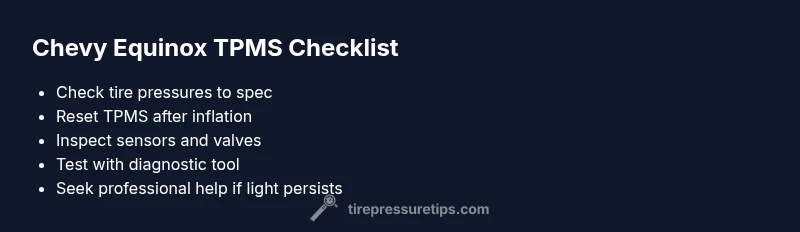
1) Check all four tires with an accurate gauge. 2) Inflate each tire to the Chevy-recommended PSI listed on the door jamb. 3) If all tires read correctly, perform the TPMS reset per the owner's manual. 4) If the light persists, sensors or wiring may be faulty and require professional testing.
Understanding the Chevy Equinox Tire Pressure Monitoring System
The Chevy Equinox tire pressure monitoring system (TPMS) is a safety feature designed to prevent underinflation-related issues by signaling you when tire pressures fall outside safe ranges. In most models, the system collects data from wheel-mounted sensors and the vehicle’s central computer to trigger a dashboard warning whenever a tire drops below the manufacturer’s recommended pressure. That recommended pressure is typically shown on the driver’s door placard, and it’s important to follow those specs rather than relying on generic values. The Chevy Equinox TPMS can be direct (with sensors in each tire sending real readings) or indirect (using wheel-speed data to infer pressure changes). Knowing which type your model uses helps you troubleshoot more efficiently, because a failing sensor is not the same as a briefly low tire due to cold weather. Keep in mind that weather and temperature shifts can temporarily affect readings, so recheck pressures after a cold night or a long trip in cold air. This section lays the groundwork so you can distinguish between a simple inflation issue and a true TPMS fault.
analysisSummaryMarkdownFlags0L1
Steps
Estimated time: 30-60 minutes
- 1
Verify tire pressures
Use a high-quality pressure gauge to measure each tire when cold. Compare to the door placard value and adjust any tire that’s below or above spec. Make sure the valve stems are clean and seals tight.
Tip: Record each tire’s current PSI so you can quickly compare after a drive. - 2
Inflate to spec
Inflate all tires to the manufacturer-recommended PSI. Do not rely on a single tire to set the system — the TPMS accounts for all four tires."
Tip: If you’re near a dealership or shop, consider having a portable air compressor with a gauge handy. - 3
Reset the TPMS
Follow the Chevy Equinox owner’s manual procedure to reset the TPMS. This may involve turning the ignition to the ON position, navigating menus, or pressing a reset button until the light blinks then stays steady.
Tip: A proper reset often requires driving 10–20 minutes at speed for relearning to occur. - 4
Inspect sensors and valves
Look for visible damage on valve stems and wheels. Corrosion around sensor mounts can affect readings. If you recently rotated tires or serviced wheels, recheck sensor seating.
Tip: Handle sensors gently to avoid damaging delicate electronics. - 5
Call for professional help
If uneven readings persist after inflation and a reset, the TPMS sensors or their wiring may be faulty. A technician can diagnose via diagnostic tools and replace sensors if needed.
Tip: Ask for a TPMS sensor health check and battery test to avoid unnecessary replacements.
Diagnosis: TPMS warning light on dashboard or inconsistent tire-pressure readings on Chevy Equinox
Possible Causes
- highLow tire pressure in one or more tires
- mediumFaulty TPMS sensor battery or sensor wiring
- lowSensor location corrosion or damaged valve stem
Fixes
- easyCheck all tires with a precise gauge and inflate to the door placard pressure.
- easyReset the TPMS after correcting pressures according to the owner’s manual.
- mediumIf readings remain abnormal, test or replace affected TPMS sensor(s) and inspect valves.
Frequently Asked Questions
Why is the TPMS warning light on even after I inflate the tires?
If the warning remains after inflation, it could indicate a faulty TPMS sensor, a sensor battery issue, or a problem with valve stems. A reset may also be required. If the light stays on, have a technician inspect the TPMS system.
If the light stays on after inflating, a sensor or wiring issue is likely. A reset might fix it, but professional testing is advised if the warning returns.
How do I reset the Chevy Equinox TPMS?
Reset procedures vary by model year. Generally, inflate tires to spec, turn the ignition on, and perform the reset via the instrument cluster or a dedicated button, then drive for relearn. Always consult the owner's manual for the exact steps.
Use the manual’s TPMS reset steps and drive for relearn after inflation.
Should I replace TPMS sensors if the light keeps flashing?
Persistent warnings after inflation and reset often mean a faulty sensor or battery. A professional should test all sensors and replace if necessary.
If the warning keeps coming back, sensors likely need testing and possibly replacement.
Can temperature affect TPMS readings?
Yes. Cold temperatures can temporarily lower tire pressure and trigger TPMS. Recheck pressures after temperature changes and before replacing sensors.
Temperature can make readings dip, so recheck after weather shifts.
What tools do I need to check tire pressure accurately?
A reliable tire pressure gauge (digital preferred), access to a compressor, and the vehicle’s owner’s manual for reset instructions.
Grab a good gauge and follow the manual’s reset steps.
When is professional TPMS service required?
If the TPMS light remains on after inflation, reset, and sensor inspection, professional service is advised to diagnose and replace sensors or fix wiring.
If resets don’t help, it’s time to get a professional TPMS check.
Watch Video
What to Remember
- Check all tires with a precise gauge before blaming sensors
- Inflate to door-placard PSI and reset TPMS per manual
- If light persists, inspect sensors, valves, and wiring
- Professional TPMS diagnosis is recommended for persistent faults