TPMS Sensor Replacement: A Clear Step-by-Step Guide
Learn how to replace a TPMS sensor safely, including tools, steps, calibration, and maintenance tips from Tire Pressure Tips. Includes DIY guidance and when to seek professional help.


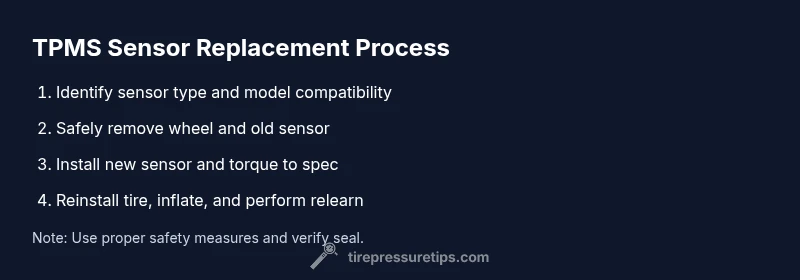
You will replace a TPMS sensor to restore accurate tire monitoring and prevent false warnings. You’ll need a replacement sensor compatible with your vehicle, a tire tool, a torque wrench, and a relearn method for your make/model. According to Tire Pressure Tips, correct installation and calibration are crucial for reliable TPMS readings and to prevent leaks or false warnings.
Understanding TPMS and Sensor Replacement
Tire Pressure Monitoring Systems (TPMS) are designed to alert you when tire pressure falls outside a recommended range. Direct TPMS uses sensors mounted in each wheel to measure pressure, while indirect TPMS estimates pressure from wheel speed data. A sensor may need replacement if it reports inaccurate readings, fails to communicate, or the battery inside the sensor dies. Replacing a sensor is not merely a swap of parts; it requires correct tire removal, sensor installation, torque on the mounting hardware, and a proper relearn to synchronize the system with the vehicle’s ECU. The Tire Pressure Tips team emphasizes that understanding whether you have direct or indirect TPMS will guide your approach and tooling needs. As you progress, keep your vehicle’s manual handy for any model-specific steps.
Understanding Sensor Signals and Compatibility
- Direct sensors: integrated battery-powered units embedded in a valve stem. They send pressure data to the ECU via RF signals. When failing, they may show incorrect pressure readings or trigger the TPMS warning light constantly. Replacement requires a compatible sensor that matches the vehicle’s horn frequency and wheel position mapping.
- Indirect sensors: rely on wheel speed sensors and ABS data to infer pressure. These do not contain a battery; replacement is less common but may involve caliper or wheel-speed sensor checks. Always confirm your vehicle’s TPMS type before purchasing parts.
Compatibility matters: sensors vary by vehicle make, model, and wheel size. An incorrect sensor can lead to poor readings or system faults. Before purchasing, verify the sensor part number and compatibility with your vehicle’s software and wheel configuration. According to Tire Pressure Tips, selecting the right sensor from the outset reduces repeat visits to the shop and minimizes maintenance downtime.
Tools, Parts, and Safety Considerations
Preparing for a TPMS sensor replacement involves gathering the right tools and observing safety protocols. You’ll typically need a replacement TPMS sensor, a valve stem core tool, a torque wrench, a bead seating tool or a service tire machine, soapy water for bead seating checks, and a relearn tool or access to a relearn procedure in your vehicle’s manual. Safety first: work on a cool tire, use wheel chocks, and never work under a raised vehicle supported only by a jack. If you’re unsure about the tire bead or wheel protection, consider professional service to avoid damage.
- Shield the wheel and tire from scratches when removing the tire bead.
- Do not reuse damaged valve cores or gaskets; replace them with every sensor installation.
- Ensure you have a clear area to operate and all components accounted for before reassembly.
Replacing the Sensor: What Changes in Your Vehicle
Replacing a TPMS sensor is more than installing a new part. It involves correctly removing the wheel, deflating the tire, detaching the old sensor, installing the new sensor and bead seating, and reassembling the tire. The new sensor must be torqued to specification to prevent loosening, and the tire bead must seal properly to avoid air leaks. Vehicle-specific considerations include whether you need to loosen the rim, the type of valve stem, and any special locking rings. If the wheel is alloy, extra care is needed to avoid cosmetic or structural damage. After installation, check for leaks using soapy water and confirm the system recognizes the sensor via a relearn sequence.
Calibrating and Resetting TPMS After Replacement
Calibrating a TPMS after sensor replacement ensures your dashboard warning lights and tire-pressure readings align with the newly installed sensor. Many modern vehicles require a relearn procedure, which might involve using the onboard electronics, a scan tool, or a specific sequence (e.g., driving a prescribed distance with stabilizing pressures). Always follow the vehicle’s owner manual or service provider instructions for the relearn method. If your car uses a hand-held relearn tool, pair it with the sensor’s ID to ensure correct association with each wheel position. After relearn, drive the vehicle for 10-15 minutes at steady speeds to allow the system to register the changes and stabilize the readings.
Common Pitfalls and Troubleshooting
Even experienced DIYers can stumble during TPMS sensor replacement. Potential issues include incorrect sensor type, damaged wheel threads, stripped torque, or failing to properly seat the bead, which can cause leaks or a weak seal. Misaligned sensor IDs can cause the system to misreport tire pressures or fail to learn. Always double-check sensor compatibility, ensure proper torque on mounting hardware, and verify wheel position data. If the TPMS light remains on after relearn, recheck all steps, inspect the valve stem, and confirm there are no air leaks around the bead.
Maintenance to Extend Sensor Life
Maintenance is key to long sensor life. Regularly inspect tire condition, maintain recommended tire pressures, and rotate tires as prescribed by your vehicle manufacturer. Keep sensors clean and free of corrosion; store sensors away from moisture when not in use. If you notice frequent sudden warnings, consider checking the battery health in direct-sensor systems and monitor battery life as sensors age. A proactive maintenance routine reduces unexpected TPMS failures and helps you catch issues early.
Cost, Time, and Aftercare: What to Expect
TPMS sensor replacement costs and labor times vary by vehicle, sensor type, and the service provider. DIY replacement can save on labor but requires the right tools and knowledge. Factory OEM sensors generally come at a premium but can offer guaranteed compatibility and longevity, while aftermarket sensors may provide a more economical option with varying reliability. After replacement, plan for a relearn procedure and a short test drive to confirm proper system function. The Tire Pressure Tips team notes that proper installation and calibration are critical for reliable readings and safety on the road.
Tools & Materials
- Replacement TPMS sensor (valve stem sensor or wheel-mounted sensor)(Choose sensor compatible with vehicle make/model and wheel size)
- Valve core tool(For removing and replacing the valve core without leakage)
- Torque wrench(Use the vehicle’s specified torque for the TPMS sensor mounting hardware)
- Bead seating tool or service tire machine(Helpful for difficult bead seating; optional with ordinary tire services)
- Soapy water or leak detector spray(Check for air leaks around the bead after installation)
- TPMS relearn tool or access to relearn procedure(Needed for most modern vehicles to synchronize the new sensor)
- Jack and wheel chocks(Stabilize vehicle and protect against movement)
- Owner’s manual or vehicle service information(Vehicle-specific steps and torque specs may vary)
Steps
Estimated time: 60-90 minutes
- 1
Prepare and safety check
Park on a flat surface, engage parking brake, chock wheels, and ensure the tire is cool before starting. Gather all tools and verify sensor compatibility for your vehicle.
Tip: Never work under a raised vehicle supported only by a jack. - 2
Access the TPMS sensor
Loosen the lug nuts slightly, then lift the vehicle and remove the wheel. If your vehicle requires, deflate the tire and remove the bead with caution to access the TPMS sensor.
Tip: Keep track of wheel position to avoid confusion during reassembly. - 3
Remove old sensor and valve core
Carefully detach the old sensor from the valve stem, then use the valve core tool to remove the core. Inspect the rim and bead area for damage or corrosion.
Tip: Do not force the sensor; if the stem is damaged, replace the entire sensor assembly. - 4
Install new sensor and torque properly
Thread the new sensor into the valve stem by hand, then tighten with a torque wrench to the manufacturer’s specification. Replace the valve core and ensure there is no cross-threading.
Tip: Touch-test torque with a calibrated wrench to avoid overtightening. - 5
Reinstall wheel, inflate tire, and seat bead
Mount the wheel back on the hub, snug the lug nuts, lower the vehicle, and inflate the tire to the correct pressure. Use soapy water to verify the bead seats without leaks.
Tip: Check for any visible leaks around the bead before proceeding to relearn. - 6
Relearn/Calibrate TPMS
Initiate the relearn procedure using the vehicle’s method or a relearn tool. For many models, drive at a steady speed for a short distance to finalize the process.
Tip: If the light stays on, repeat the relearn and verify wheel position mapping.
Frequently Asked Questions
How long do TPMS sensors typically last?
TPMS sensor life varies by vehicle and driving conditions. Replacing a sensor is usually driven by failure signs such as inaccurate readings or intermittent signals rather than a fixed schedule. Always rely on diagnostic indications and manual guidance for your vehicle.
TPMS sensor life depends on use and conditions; replacement should be guided by symptoms and diagnostics.
Can I replace TPMS sensors myself, or should I go to a shop?
You can replace a TPMS sensor yourself if you have the right tools, sensor compatibility, and relearn procedure. Some steps, like bead seating and tire mounting, may require specialized equipment. For many drivers, a professional replacement ensures proper torque and relearn.
DIY is possible with the right tools, but a shop can ensure correct relearn and torque.
Do OEM sensors differ from aftermarket sensors?
OEM sensors are typically guaranteed to match your vehicle’s specifications and may offer broader long-term reliability. Aftermarket sensors can be cost-effective but vary in compatibility and longevity. Always verify fitment with your vehicle’s VIN and wheel type.
OEM sensors match your car, aftermarket options vary; check fitment carefully.
Will replacing a TPMS sensor require tire dismounting?
In most cases, yes. Replacing a sensor usually requires removing the tire from the rim to access the stem. Some systems can be accessed with the tire mounted, but that’s less common and model-dependent.
Replacing the sensor often means removing the tire from the rim.
Do I need to recalibrate ABS or other systems after TPMS replacement?
Recalibration is typically limited to the TPMS itself. Other systems like ABS do not usually require recalibration due to a TPMS change, but it’s best to follow the vehicle’s service manual.
Generally, only TPMS relearn is needed; ABS is usually unaffected.
What are signs of a faulty TPMS sensor after replacement?
Common signs include a persistent TPMS warning light, inconsistent readings, or a sensor that fails to communicate. If you notice these, recheck the installation, ensure the relearn was successful, and consider testing the sensor with a diagnostic tool.
If the warning stays on or readings seem off, recheck installation and relearn.
Watch Video
What to Remember
- Confirm TPMS compatibility before replacement
- Torque sensor mounting to spec to avoid leaks
- Perform relearn after installation for accuracy
- Inspect beads and wheel for damage during replacement