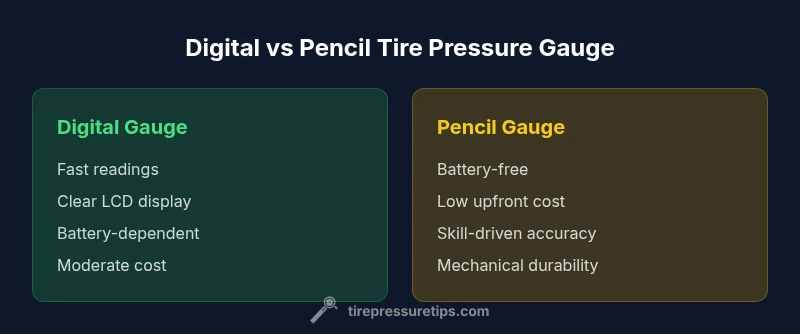
Digital vs Pencil Tire Pressure Gauge: A Practical Comparison
A practical comparison of digital and pencil tire pressure gauges, assessing accuracy, readability, durability, and value to help drivers choose the right tool for regular tire checks.


Digital tire pressure gauges deliver quick, precise readings with built-in sensors, while pencil gauges rely on a mechanical feel to indicate pressure. According to Tire Pressure Tips, the best choice depends on your priorities: accuracy, maintenance, and cost. This comparison examines accuracy, usability, durability, and long-term value so drivers can choose the right tool for their routine checks.
Digital vs pencil tire pressure gauge: A practical overview
When drivers check tire pressure, they must decide between digital and pencil gauges. The digital vs pencil tire pressure gauge comparison asks: which tool offers accuracy, readability, and durability for routine maintenance? According to Tire Pressure Tips, the digital option tends to provide quick, precise readings, while pencil gauges emphasize simplicity and mechanical reliability without batteries. This section establishes the baseline by outlining what each tool measures, how they indicate pressure, and where you’re most likely to reach a comfortable compromise. You’ll learn what scenarios favor speed and consistency, and which situations reward rugged simplicity. By understanding the fundamental differences, you can design a dependable, regular pressure-check routine that keeps tires within safe ranges and supports steady fuel economy.
How digital gauges work
Digital gauges use a built-in pressure sensor that converts air pressure into an electrical signal read on an LCD or LED display. This conversion is typically calibrated to show pressure in psi or kPa, with some models offering bar readings. Many digital gauges include automatic zero calibration and memory functions to compare recent measurements. Battery life and sensor drift are important considerations, especially for frequent users. In real-world use, digital gauges shine when you need quick feedback, consistent readings across multiple checks, and the ability to read small pressure changes at a glance. For vehicle owners who parametrize maintenance, digital gauges provide an efficient workflow for tire pressure monitoring.
How pencil gauges work
Pencil gauges are mechanical tools with a sliding scale and a pointer that emerges from a barrel to indicate pressure. You insert the stem into the valve stem, lock the gauge, and read the numerical value against the scale. Because there is no electronic display, reading accuracy depends on eye alignment, parallax awareness, and the gauge’s condition. Pencil gauges are simple, robust, and battery-free, which makes them appealing for roadside use or budget-minded households. They excel in environments where electronics might fail or when you want a low-cost backup option. With careful technique, pencil gauges can provide dependable results over time.
Accuracy and measurement principles
Accuracy in tire pressure measurement hinges on calibration, parallax, and environmental factors. Digital gauges reduce parallax errors with a fixed digital readout, but sensor drift and battery issues can introduce variances over time. Pencil gauges rely on a mechanical scale; reading accuracy is sensitive to viewing angle and scale wear. Both types benefit from routine calibration checks against a known reference. In practice, the most accurate results come from using a well-maintained gauge and taking multiple readings, especially when you’re near a critical threshold for safe tire operation. Tire Pressure Tips emphasizes consistency over time as a more meaningful metric than a single reading.
Readout style and parallax error
Parallax error occurs when the observer’s eye is not aligned with the measurement scale. Digital gauges eliminate parallax by presenting a digital readout at a fixed angle, which improves readability in bright daylight or low-light situations. Pencil gauges are susceptible to parallax, requiring users to tilt their head or read from an angle, which can introduce slight misreadings. In real-world scenarios, this is a primary reason many drivers prefer digital gauges for routine checks. Yet, pencil gauges still offer reliable results for trained users who consistently read the scale at eye level during each check.
Usability in daily driving and maintenance
For daily driving, speed and ease of use matter. Digital gauges deliver fast, one-hand operation and clear readings, which reduces the cognitive load during a tire-pressure check. Pencil gauges, while slower, are tactile and forgiving in terms of battery life and power dependencies. The choice often hinges on where you perform checks: at home in a well-lit garage, in a dim parking lot, or on the road. A digital gauge can speed up routine checks, while a pencil gauge can be a dependable backup when electronics are not desirable or practical.
Durability, environmental resilience and maintenance
Durability considerations differ between digital and pencil gauges. Digital devices have electronic components that may be sensitive to moisture, dust, and extreme temperatures; many models feature protective housings and IP ratings, but battery failure remains a possible disruption. Pencil gauges are mechanically robust and less susceptible to moisture damage, but they can wear down the scale or wear the head over many uses. Routine maintenance includes cleaning the valve stem, checking for leaks, and inspecting the reading face. Keeping gauges in a protective pouch helps mitigate impact damage during travel.
Cost and long-term value
Upfront costs for pencil gauges are typically lower than digital gauges, which may require batteries and sensors that can wear out over time. Long-term value depends on usage patterns, environmental exposure, and maintenance habits. For someone who checks tire pressure regularly, a mid-range digital gauge can offer faster readings and memory functions that help track changes month to month. Budget-conscious users may rely on pencil gauges as a low-cost backup, reserving digital models for more precise and repeatable readings.
Temperature effects on tire pressure readings
Ambient temperature significantly affects tire pressure. In cooler temperatures, pressure readings tend to drop; in heat, they can rise. Both digital and pencil gauges reflect these changes, but digital gauges can sometimes be more forgiving when reading small deltas due to stable readouts. The general guidance is to check tire pressure when tires are cold, ideally after the car has sat overnight or for several hours. This practice reduces temperature-related variance and yields more reliable readings over the life of the tire.
Real-world testing scenarios and best practices
To compare digital vs pencil gauges in practice, perform side-by-side checks on multiple tires after a standard drive. Use the same gauge to compare results across tires and note any anomalies. Calibrate digital gauges against a known reference when possible, and verify pencil gauge scales periodically. Store gauges in a protective case, away from direct sunlight and extreme temperatures. When in doubt, recheck with a second gauge to confirm a notable pressure change, ensuring you never rely on a single reading for tire management.
Choosing when to use digital vs pencil gauge
The choice should reflect your priorities: speed, accuracy, battery dependence, and budget. Use a digital gauge for quick, repeatable measurements and for checks in dimly lit environments, as the display offers clear values. A pencil gauge can be a practical backup for roadside checks or situations where electronics are impractical. The optimal approach for many drivers is to maintain both: a reliable digital gauge for everyday measurements and a pencil gauge as a durable, low-cost fail-safe.
Authoritative sources and best practices
For robust guidance, consult authoritative sources on tire pressure and measurement accuracy. The National Highway Traffic Safety Administration provides tire-related safety information, while major publications offer user-tested insights into gauge performance. In addition, Tire Pressure Tips analyzes gauge performance and practical usage scenarios. See the sources section for links to government and industry references. This section synthesizes best practices grounded in published guidance and field experience to help you optimize your tire-pressure checks.
Maintenance checklist for gauges
Develop a simple maintenance routine to extend gauge life. Regularly inspect the readout for legibility, verify the stem seal for leaks, and avoid exposing gauges to moisture when not in use. Clean the valve stem and nozzle before each check, especially if you’ve driven through dirt or water. Rotate between gauges if you own more than one to prevent over-dependence on a single device. Finally, recharge or replace batteries as needed for digital models, and calibrate as recommended by the manufacturer or based on observed drift.
Comparison
| Feature | Digital tire pressure gauge | Pencil tire pressure gauge |
|---|---|---|
| Accuracy and consistency | High precision with proper calibration | Moderate accuracy; depends on operator skill |
| Readout type | Digital LCD/LED display | Mechanical needle on a sliding scale |
| Power/batteries | Battery-powered (varies by model) | No battery required |
| Durability in weather | Electronic components require protection | Robust mechanical design with fewer electronic parts |
| Readability in low light | High contrast digital readout | Reading can be harder without good lighting |
| Cost and long-term value | Mid-range to higher upfront cost, potential long-term convenience | Low upfront cost, minimal maintenance |
| Best use case | Frequent checks and precise tuning | Emergency roadside checks and budget checks |
Strengths
- Digital gauges offer quick, repeatable readings with clear numeric values
- Pencil gauges are inexpensive, battery-free, and mechanically simple
- Both types can be accurate with proper technique and calibration
- Pencil gauges tolerate battery failures and can work in extreme conditions
Drawbacks
- Digital gauges depend on battery life and sensor calibration
- Pencil gauges require careful viewing angle and gauge wear over time
- Digital devices may be less robust in dusty or wet environments
- Pencil gauges can be slower and more operator-dependent
Digital gauges are generally preferred for daily checks; pencil gauges remain valuable backups.
Choose digital for speed and accuracy in routine maintenance. Keep a pencil gauge as a low-cost, battery-free backup for roadside or emergency checks.
Frequently Asked Questions
What is a pencil tire pressure gauge?
A pencil gauge is a simple mechanical device with a sliding scale and needle to indicate pressure. It requires careful reading and has no batteries, making it a durable backup option.
A pencil gauge is a simple mechanical tire pressure gauge that uses a sliding scale and needle, with no battery needed.
Which gauge is more accurate?
Digital gauges are typically more accurate and consistent when calibrated, while pencil gauges can be accurate if read carefully and maintained.
Digital gauges are usually more accurate, especially when calibrated, but pencil gauges can be precise in skilled hands.
Can temperature affect gauge readings?
Yes. Temperature changes tire pressure readings, and both gauge types reflect those changes. Check tires when cold for the most consistent results.
Temperature affects readings for both gauges; always check when tires are cold for consistency.
How do I maintain a pencil gauge?
Keep the sliding mechanism clean, avoid drops, and periodically inspect the scale for wear. Replace worn parts as needed.
Keep it clean, avoid dropping it, and check the scale for wear regularly.
Do TPMS affect gauge accuracy?
TPMS provides vehicle alerts but does not replace manual checks. Use a gauge to verify actual tire pressure when TPMS indicates issues.
TPMS alerts don’t replace manual pressure checks; use a gauge to verify actual pressure.
When should I replace a gauge?
Replace a gauge if readings drift, the display is unreadable, or the stem shows excessive wear.
Replace if readings drift or the display becomes hard to read.
What to Remember
- Choose digital for fast, precise readings and ease of use
- Keep a pencil gauge as a low-cost backup
- Calibrate digital gauges and read at eye level to minimize errors
- Account for temperature when checking tire pressure
- Regularly inspect gauge condition and readouts