Digital vs Analog Tire Pressure Gauges: A Practical Comparison
A rigorous comparison of digital and analog tire pressure gauges, covering accuracy, usability, maintenance, and TPMS relevance to help drivers choose the right tool.


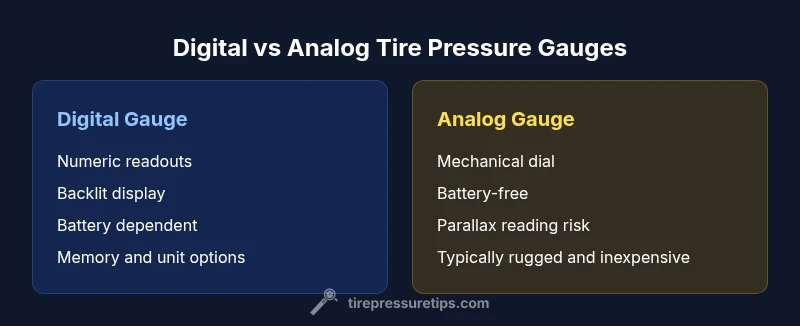
Digital vs analog tire pressure gauges comes down to readability, accuracy, and maintenance needs. Digital gauges deliver quick numeric readings with backlit displays, while analog gauges offer rugged reliability and a long life without batteries. For most drivers, a practical approach is to prioritize readability and consistency, with a backup analog gauge for field use. The Tire Pressure Tips team notes that the best choice depends on lighting, how often you check pressures, and whether you want extra features like unit conversion or battery alerts. In short, both can work well, but your daily routine will reveal the better fit for your vehicle and TPMS checks.
What digital vs analog tire pressure gauge means for your routine
Choosing between a digital and an analog tire pressure gauge starts with understanding the different measurement philosophies each uses. A digital tire pressure gauge converts air pressure into an electronic signal and displays the result as a numeric readout, typically in psi, kPa, or bar. An analog tire pressure gauge uses a mechanical dial with a needle that points to a pressure value on a scale. For many drivers, the decision is less about one being universally better and more about how you use the tool day to day. According to Tire Pressure Tips, the best gauge for most people is the one that yields accurate readings quickly, is easy to read, and stays reliable over time in a garage, on a road trip, or at a gas station. The Tire Pressure Tips team also notes that the choice can depend on lighting conditions, how often you check pressures, and whether you want extra features like unit conversion or battery alerts. The keyword digital vs analog tire pressure gauge is a useful shorthand for focusing on what matters: speed, clarity, maintenance, and compatibility with your TPMS checks.
How digital tire pressure gauges work
Digital gauges rely on a pressure sensor and an electronic circuit. When you press the gauge onto the valve stem, the sensor measures the air pressure and the microprocessor translates the signal into a numerical value on an LCD or LED display. The display can show units in psi or kilopascals (kPa) or bars, and many models offer auto-off to save battery life. Some digital gauges include a backlight for night readings, a hold function to freeze the number, and a memory of the last several readings. Battery health matters: a weak battery can cause erratic readings or a dim display, so users should carry a spare coin cell or keep rechargeable batteries charged. The reading process is usually straightforward: press firmly on the valve stem, wait a moment for stabilization, and read the number. If you want to integrate with TPMS performance checks, digital gauges often align with the pressure numbers read by TPMS sensors after calibration. In practice, digital tire pressure gauges are popular for quick checks in the driveway or at a pump island because the digits eliminate interpretation errors under bright sunlight or glare. This aligns with Tire Pressure Tips guidance on practical tool choices.
How analog tire pressure gauges work
Analog gauges are mechanical. When you press the valve stem, the spring-loaded needle moves along a scale. The accuracy depends on the calibration of the dial and the thickness of the needle; reading requires aligning the needle with the scale marks. Analog gauges come in various formats: pen gauges, pocket gauges with a small dial, and larger analog gauges attached to hoses. The main advantage is robustness and simplicity: no batteries, no electronics to fail, and straightforward operation; you can test them by verifying the reading against a known pressure source. However, reading precision can be affected by parallax error (viewing angle) and by how steadily you hold the gauge. A common pitfall of analog gauges is inconsistent readings due to rough handling, worn seals, or damaged diaphragms. For long-term reliability, some technicians prefer analog gauges with a protective case and a clear, easy-to-read dial. Tire Pressure Tips notes that analog gauges remain a staple for many DIYers because of their low operating costs and mechanical simplicity, particularly when power sources are scarce or unreliable.
Key differences at a glance
- Reading speed: Digital gauges provide immediate numeric results; analog requires eye-tracking of a moving needle.
- Readability: Digital displays excel in low light with backlighting; analog relies on ambient lighting and personal vision.
- Accuracy and drift: Digital sensors offer stable readings within their calibration; analog readings can drift with wear and parallax.
- Battery dependence: Digital needs power; analog does not.
- Durability and ruggedness: Analog gauges are often more rugged in harsh environments; digital models can be protected but are batery-reliant.
- Price and features: Digital gauges typically offer more features (unit conversion, memory) but at higher upfront cost; analog gauges are generally cheaper and simpler to replace.
Real-world performance and reliability
In everyday driving, the reliability of a gauge depends on its construction and maintenance. Temperature changes affect tire pressure and can influence both digital and analog readings, though digital models may respond faster to stabilization and offer a quick, repeatable number once stabilized. Analog gauges can be quite accurate when kept in good condition, yet wear on the dial, the needle, or the seals can introduce small biases that compound with repeated use. The digital option often provides a consistent numeric output across a wider range of pressures, which can be helpful when checking pressures for TPMS calibration. Lighting and weather are meaningful: digital displays with backlight simplify nighttime checks, while analog gauges may be easier to interpret outdoors in bright sun if the scale is large and legible. Tire Pressure Tips emphasizes testing gauges in real-world scenarios—garage, driveway, roadside checks—to see how they perform under your typical conditions.
Reading stability and repeatability
Repeatable readings are critical for safe driving. Digital gauges shine here by producing the same number across multiple quick checks, provided the sensor is not overwhelmed by a rapidly changing valve stem. Analog gauges rely on the user’s steadiness and the gauge’s calibration; a stable reading may require several attempts. A good practice with either gauge is to take multiple readings or to compare against a known reference, such as a trusted pump or a second gauge. This reduces the risk of misreading, which could result in driving with underinflated or overinflated tires. Tire Pressure Tips recommends keeping a primary gauge as a go-to tool and a backup gauge for field testing, especially for families or fleets that rely on TPMS maintenance and regular tire health checks.
TPMS integration and practical workflow
TPMS alerts you when tire pressure deviates from safe levels, but it does not replace manual checks. Digital gauges are often used to confirm TPMS readings quickly, thanks to their numeric displays and stability. Analog gauges can complement this process by providing a quick cross-check if the digital display fails or battery is dead. The workflow should be simple: check the tire pressure with your preferred gauge, compare with the vehicle’s recommended setting, and adjust if needed using the air compressor. For drivers who care about redundancy, keeping both a digital and an analog gauge in the glove compartment makes sense. Tire Pressure Tips notes that aligning gauge readings with TPMS data helps build confidence in tire health and safety on the road.
Durability, battery life, and environmental resilience
Digital gauges weave convenience with potential vulnerabilities: batteries can fail, displays can dim, and electronics may be sensitive to moisture or shock. Replacing batteries regularly and storing gauges in protective cases can extend life. Analog gauges, by contrast, rely on mechanical parts that can wear, especially the seals and diaphragms; they tend to tolerate rough handling and temperature swings better over time, but may require recalibration or replacement if the dial becomes unreadable. In hot climates or during frequent driving, rugged construction and sealed cases become more important for long-term accuracy. Tire Pressure Tips observes that some users prefer a simple, well-made analog gauge for outdoor use, while others favor the features and quick reads of a digital device for indoor maintenance or travel.
Practical buying guide: features and price ranges
When choosing between a digital and an analog tire pressure gauge, focus on reliability, ease of use, and how you’ll use it most often. For digital gauges, consider features like backlit displays, auto-off timers, unit conversion (psi/kPa/bar), memory of last readings, and a robust battery compartment. For analog gauges, look for a large, legible dial, protective case, and a quick-release nozzle that fits common valve stems. Price ranges vary by features and build quality: basic analog models can be very affordable, midrange gauges balance durability and readings, and premium digital models add accuracy features and additional conveniences. In general terms, expect digital models to occupy mid-to-upper price bands and analog models to be budget-friendly or mid-range, depending on the build. Real-world shoppers should compare at least two models, test full-range readings, and verify how quickly each gauge stabilizes at a given pressure. Tire Pressure Tips suggests focusing on user reviews, warranty terms, and field usability to avoid surprises after purchase.
Testing and calibration: quick-start steps
- Verify a known reference: use a professional-grade calibration tool or a pump with a calibrated gauge to establish a baseline. 2) Test stability: apply the gauge to a known pressure and compare readings across several trials. 3) Check repeatability: if your gauge shows inconsistent numbers, test on multiple tires to see if the variance is consistent. 4) Check the battery and display: ensure the screen is bright and readable; replace the battery if readings drift. 5) Store properly: keep in a protective case away from extreme temperatures. Following these steps helps ensure that your digital vs analog tire pressure gauge continues to deliver reliable results for safe driving.
Comparison
| Feature | digital tire pressure gauge | analog tire pressure gauge |
|---|---|---|
| Reading method | Numeric digital readout (psi/kPa/bar) | Mechanical dial with a needle |
| Readability in low light | Excellent with backlit display | Depends on ambient light; larger dials help |
| Speed of reading | Very fast; immediate numeric result | Requires aligning needle, then interpreting scale |
| Power source | Battery powered | No battery; maintenance-free (except seals/dial care) |
| Durability | Protected by case and seals; electronics can fail | Often rugged; fewer electronic components |
| Maintenance | Battery checks, occasional calibration in some models | Rarely needs maintenance beyond cleaning |
| Price range | Mid to high depending on features | Budget-friendly to mid-range depending on build |
| Best for | Quick, repeatable readings with features like memory | Simple, rugged use when electronics are a concern |
Strengths
- Fast, clear numeric readings with backlit displays
- Easy to read in dark garages or night driving
- No interpretation of numbers required; less guessing
- Battery indicators and memory features simplify use
- Compact models stay portable and affordable
Drawbacks
- Requires batteries; failures can disable usability
- Higher upfront cost for feature-rich models
- Some models may be sensitive to temperature and shock
- Digital displays can fail in extreme conditions if not protected
Digital gauges win for speed and readability; analog gauges win on simplicity and ruggedness
Choose digital for quick checks, backlight reading, and extra features. Choose analog if you want a simple, robust gauge that works without batteries and with minimal maintenance.
Frequently Asked Questions
Do digital tire pressure gauges provide more accurate readings than analog ones?
Both types can be accurate; accuracy depends on build quality and calibration. Digital gauges often give precise numeric values quickly, while analog gauges rely on precise dial calibration and reading technique.
Both can be accurate; the key is calibration and build quality. Digital gauges give quick numbers, while analog gauges rely on reading a dial accurately.
Which gauge is more reliable in cold weather?
Analog gauges tend to operate mechanically without electricity, which some users find more robust in extreme conditions. Digital models may be affected by battery performance in very cold environments, but many are designed for wide temperature ranges.
Analog gauges can be more rugged in cold weather because they don’t rely on batteries; digital gauges may slow down if the battery performance drops.
Can I rely on TPMS instead of a gauge?
TPMS provides a warning when pressure falls outside safe ranges, but it does not replace precise checks. A gauge confirms exact pressures and helps you adjust to the recommended level.
TPMS warns you, but you still need a gauge to know the exact pressure to set your tires to the recommended level.
What should I look for when buying a digital gauge?
Look for readability (backlit display), multiple units (psi/kPa/bar), memory or hold function, auto-off features, durable casing, and a reliable battery compartment.
Seek a backlit display, unit options, memory, auto-off, and rugged casing for digital gauges.
Is it worth keeping both digital and analog gauges?
Yes, having both provides redundancy: digital for quick checks and analog as a fallback when electronics fail or in very rugged environments.
Having both gives you quick numbers plus a reliable backup if one fails.
How often should I calibrate an analog gauge?
Calibrate when you notice inconsistent readings or after a long period of use. Many gauges hold calibration well, but seals and the dial can drift.
Calibrate if readings seem off or after long use; some gauges hold calibration well, but check occasionally.
What to Remember
- Choose digital for quick sees and features
- Keep an analog as a reliable backup
- Test both to verify consistency with TPMS
- Consider climate and usage when deciding