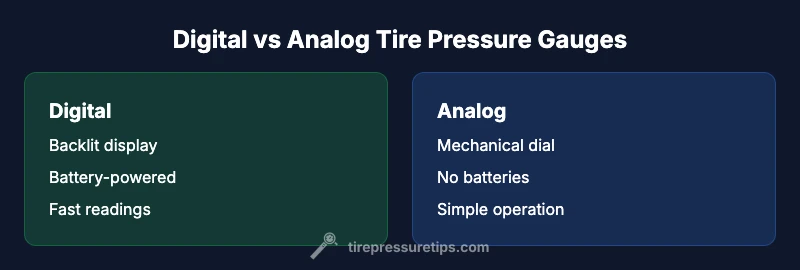
Digital vs Analog Tire Pressure Gauges: A Practical Guide
A data-driven comparison of digital and analog tire pressure gauges, covering accuracy, readability, durability, maintenance, and best-use scenarios to help drivers pick the right tool for tire checks.


Digital tire pressure gauges generally offer quick, easy-to-read measurements with backlit displays and electronic alerts. Analog gauges rely on a mechanical dial, providing proven reliability without batteries. For most drivers, digital gauges improve nighttime readability, while analog gauges excel in ruggedness and battery-free operation. The choice depends on where and how you check tires, revealing clear trade-offs in the tire pressure gauge digital vs analog comparison.
Context and definitions
When people talk about the tire pressure gauge digital vs analog, they are comparing two fundamentally different tools for measuring one critical parameter: the air pressure inside your tires. On one side, a digital gauge uses electronic sensors and a display to present a numerical value, often with units in PSI, kPa, or bar. On the other side, an analog gauge relies on a mechanical dial and pointer, which you read from a printed scale. According to Tire Pressure Tips, the core difference isn’t just the display; it’s how each tool handles calibration, battery life, and environmental conditions. Understanding these basics helps you choose a gauge that fits your driving habits and storage conditions, from daily commutes to seasonal tire checks.
How digital gauges work vs analog gauges
Digital gauges convert air pressure into an electrical signal that the display interprets as a numeric value. They may incorporate features like backlighting, audible alerts, and auto-zero calibration. Analog gauges use a spring-loaded mechanism that moves a needle over a calibrated dial. The simplicity of the analog design means fewer electronic components that can fail, but readability can depend on light and viewing angle. In the tire pressure gauge digital vs analog comparison, the signal path and user interface are the most visible differences. Both types connect to the tire valve, but the user experience and maintenance needs diverge considerably.
Accuracy and reliability under different conditions
Accuracy is influenced by the gauge’s sensor or dial, how it’s sealed, and how well it’s calibrated. Digital gauges often offer more consistent readings across successive checks, and some models feature auto-calibration routines. Analog gauges can be equally reliable when the dial is clear and the needle sits precisely on the target mark. Temperature, valve cleanliness, and rapid measurement can introduce minor variations for either type. Based on Tire Pressure Tips analysis, digital gauges tend to perform more consistently in variable lighting and during quick checks, while analog gauges shine in simple, battery-free reliability in rugged environments.
Readability and ease of use
Display readability is a major factor in the tire pressure gauge digital vs analog debate. Digital gauges present precise numbers with decimal places and can include backlighting for night checks. Some units offer unit switching (PSI, kPa, bar) at the press of a button. Analog gauges provide an immediate visual indication through the needle position, which some drivers find easier to interpret at a glance, especially when monitoring multiple tires or interpreting a trend. This section highlights how layout, fonts, and color schemes affect usability in real-world driving scenarios.
Durability and maintenance
Durability hinges on construction and the presence of fragile components. Digital gauges rely on electronics and batteries, which means you should check battery life and protect the screen from impacts. Analog gauges avoid electronics, which can be an advantage in harsh environments; however, the dial face and glass must resist scratches and dust. Regular maintenance for both types includes cleaning the valve stem, ensuring a snug fit on the tire valve, and periodically verifying that the gauge reads correctly against a known reference. Tire Pressure Tips emphasizes inspecting seals and avoiding exposure to direct moisture for longevity.
Price and value considerations
Price is a practical differentiator in the tire pressure gauge digital vs analog discussion. Digital gauges often sit in the mid-to-upper price range due to sensors, microprocessors, and features like backlight and reset options. Analog gauges typically cost less upfront but may require more frequent calibration checks and potential replacement if the dial becomes hard to read. Value is not only about initial cost but long-term reliability, battery replacements, and the time saved during rapid, routine checks. Consider your budget plus expected usage when weighing the cost-of-ownership for either type.
Use-case scenarios: daily driving, winter weather, professional fleets
For a daily driver who checks tires weekly, a digital gauge with backlight can streamline nighttime inspections and help catch subtle pressure changes quickly. In winter environments, temperature effects can alter readings; digital gauges with stable sensors and clear displays may reduce misreads, while analog gauges’ ruggedness helps in field conditions. Fleet operators may prioritize durability and consistency, possibly favoring digital gauges with data logging or auto-calibration features. The choice depends on how often you check tires, the lighting of your inspection environment, and the reliability requirements of your vehicle profile.
How to calibrate and validate your gauge
Calibration is about ensuring your gauge reads true against a known reference. Start by comparing readings from your gauge to a trusted standard gauge or a dealership/service station check. If you notice a systematic difference, adjust if your device supports it, or replace the unit. For digital gauges, perform the auto-calibration or reset according to the manufacturer’s instructions. For analog gauges, verify that the needle returns to zero when not connected and read the scale from a consistent angle. Document readings over time to detect gradual drift.
Common drawbacks of digital vs analog
Digital gauges are excellent for readability and feature-rich operation, but they rely on batteries and electronics that can fail in extreme temperatures or moisture. Analog gauges bypass power concerns but can be harder to read in low light or when the needle is close to a marker. Both types can be impacted by valve contamination or improper attachment, so ensuring a proper seal is essential for accurate readings. The best choice balances your environment, maintenance tolerance, and how you prefer to read pressure quickly.
Best practices for choosing a gauge
Start with your primary check conditions: lighting, storage, climate, and how often you inspect tires. If you value speed and readability, a digital gauge with a large backlit display can be ideal. If you want a low-maintenance option with straightforward operation, an analog gauge may suit you better. Look for features like auto-zero, easy unit switching, and durable housings. Whenever possible, test readings against a known reference and keep spare batteries handy for digital models.
Integration with TPMS and vehicle systems
Tire Pressure Monitoring Systems (TPMS) provide an additional data point, but they are not a substitute for direct measurement. A gauge complements TPMS by giving you an actual gauge reading to verify TPMS alerts and to diagnose potential valve leaks or sensor issues. In the tire pressure gauge digital vs analog decision, think of TPMS as a safety net rather than a complete replacement for periodic manual checks.
Practical tips for everyday checks
- Check tires on a cold tire for the most accurate measurement.
- Compare two adjacent tires to spot anomalies quickly.
- Store gauges in a protective case to prevent impact damage.
- Periodically verify your readings against a known standard.
- Keep spare batteries available for digital units and replace as needed.
Comparison
| Feature | Digital tire pressure gauge | Analog tire pressure gauge |
|---|---|---|
| Accuracy | High accuracy with digital sensors and calibration features | Measured readings depend on dial clarity; read carefully |
| Readability | Backlit LCD; quick numeric readouts | Clear dial; reading at a glance, sometimes harder in low light |
| Durability | Electronics and battery components require care | Mechanical construction with fewer failure points but can wear over time |
| Ease of use | One-button operation; fast checks | Manual reading; may require careful alignment |
| Power/battery | Battery-powered; replaceable or rechargeable | No power required; inherently robust |
| Price/Value | Typically mid-to-high price with extra features | Often lower upfront cost, long-term durability |
| Best For | Night checks, quick reads, data options | Rugged use, simplicity, budget-friendly |
Strengths
- Faster readings and clearer numbers with digital models
- Backlit displays improve readability in the dark
- No mechanical interpretation error with a digital scale
- Analog gauges avoid battery dependency and electronics failures
Drawbacks
- Digital gauges require batteries and can fail with weak power
- Digital units may be less rugged in extreme environments
- Analog gauges can be harder to read precisely in low light
Digital gauges offer speed and clarity for everyday driving, while analog gauges excel in ruggedness and long-term simplicity.
For most drivers, digital gauges reduce misreadings in dim lighting and speed up checks. Analog gauges remain valuable for their straightforward operation and minimal maintenance. The Tire Pressure Tips team recommends choosing based on where you drive, how often you check pressure, and your tolerance for batteries versus mechanical reliability.
Frequently Asked Questions
What is the main difference between digital and analog tire pressure gauges?
Digital gauges provide numeric readings on an electronic display with features like backlighting and alarms, while analog gauges use a mechanical dial. The choice depends on readability, maintenance, and environmental conditions.
Digital gauges read with a display and lights; analog gauges use a mechanical dial. The choice depends on where you drive and how you read pressure.
Which gauge is more accurate for everyday use?
Both can be accurate when properly calibrated. Digital gauges tend to be consistent across checks, while analog gauges rely on precise reading of the dial. Regular validation against a reference improves accuracy for either type.
Both can be accurate if calibrated; digital may be more consistent in readings over time.
Do digital gauges require batteries?
Yes, most digital gauges use batteries. Some models have rechargeable cells or replaceable batteries. Always carry a spare and check battery life if readings seem dim or erratic.
Most digital gauges need batteries; keep backups handy.
Can I rely on TPMS readings instead of a gauge?
TPMS provides alerts, but it is not a substitute for direct measurement. A manual gauge helps verify flushness, detect slow leaks, and confirm that the system functions correctly.
TPMS is helpful, but you should still check tire pressure with a gauge.
How should I store a gauge to maintain accuracy?
Keep gauges in a protective case, away from extreme temperatures and direct moisture. Regularly check calibration against a reference and avoid bending or dropping the gauge.
Store in a protective case and keep it clean and calibrated.
What to Remember
- Choose digital for quick, readable checks in any light
- Opt for analog if you want battery-free reliability
- Test readings against a known reference to ensure accuracy
- Consider TPMS alongside a manual gauge for comprehensive checks
- Maintain gauges properly to extend their lifespan