Tire Pressure Light Flashing Nissan: Troubleshooting Guide
Diagnose and fix a tire pressure light flashing Nissan with practical TPMS steps, cold-pressure checks, leak inspection, resets, and when to seek professional help.


According to Tire Pressure Tips, a flashing tire pressure light on a Nissan almost always signals a TPMS warning caused by underinflation or a faulty sensor. Start by checking all tires with a cold gauge, adjust to the vehicle’s recommended PSI, and scan for leaks. If the light keeps flashing after normal pressures, pursue professional diagnosis.
Why the tire pressure light flashes on Nissan
The tire pressure light flashing Nissan is a TPMS indicator that reacts to rapid changes in tire pressure or sensor health. In most cases, a flashing TPMS light means the system detected pressure that can't be safely managed—often caused by underinflation. The Tire Pressure Tips team emphasizes treating this as a safety signal. Start by confirming all tires, including the spare (if applicable), are inflated to the vehicle-recommended PSI when cold. Use a reliable gauge and compare reading to the door jamb sticker and owner's manual. If you find a tire significantly underinflated, inflate it and recheck. If the light continues to flash after inflating to the recommended level, the issue could be a leaky tire or a faulty TPMS sensor. If you notice tire pressure light flashing nissan, prioritize inspection for leaks and sensor health.
How to verify tire pressures quickly (cold start)
Always test tire pressures when tires are cold to avoid inflated readings from heat. Locate the recommended PSI on the door jamb label or owner's manual. Remove any valve stem caps and attach your gauge firmly to each tire, noting the reading. If a tire reads below the recommended PSI, inflate to the target level and re-check in a few minutes as the tire cools. For Nissan, some models require a brief drive to relearn TPMS after inflation; consult the manual for reset steps. The goal is to bring all tires within 1-2 PSI of the spec and ensure uniform wear.
Direct vs indirect TPMS explained (and why it matters)
There are two TPMS approaches used by vehicles like Nissan. Direct TPMS uses sensors in each tire to report pressure; indirect TPMS relies on wheel speed sensors and ABS data to infer low pressure. A flashing light can indicate real underinflation or a sensor fault, valve stem issue, or dead battery in a sensor. With direct systems, damaged batteries can fail to read accurately; indirect systems can misread after rapid temperature changes. Knowing which system your Nissan uses helps determine the right fix.
Step-by-step inflation, diagnosis, and reset checklist
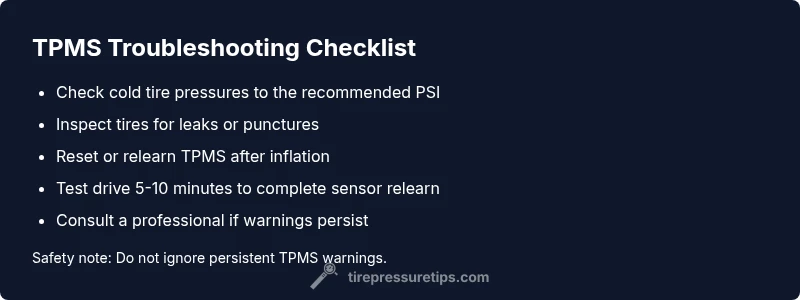
- Verify all tires are cold and inflated to the recommended PSI.
- Inspect tires for punctures, nails, or sidewall damage that could cause slow leaks.
- Check the spare (if your model uses one) and ensure it is properly inflated.
- After inflation, drive 5-10 minutes at moderate speed to allow TPMS to relearn (per manual).
- If your light remains flashing, use the vehicle’s TPMS reset procedure if applicable, or visit a dealer/as service shop for a sensor check.
- If a tire shows uneven wear or a nail hole, repair or replace before continuing.
- Keep a log of readings to monitor pressure changes over time. If the tire pressure light flashing nissan persists despite proper inflation, seek professional TPMS diagnostic.
Leaks, punctures, and sensor faults: common culprits beyond underinflation
A repeating tire pressure light can be caused by a leaking tire, a slow puncture, or a failed TPMS sensor/battery. Look for nails, screws, or stone embedment; check the valve stem for cracks. If a tire shows rapid pressure loss, it may require patching or replacement. Direct TPMS sensors have batteries that eventually fail; a sensor replacement might be needed every 5-10 years. In Nissan models, certain trims require dealer tooling to calibrate sensors after service. The Tire Pressure Tips perspective emphasizes checking for obvious signs first, then proceeding with a sensor health check if leaks are ruled out.
Safety reminders and driving with TPMS warnings
If the tire pressure light flashes while you're on the road, slow down and avoid hard cornering or high speeds. Driving on underinflated tires increases heat buildup and can lead to a blowout. In an emergency, pull over safely, inspect tires, and add air if feasible using a portable inflator. Always confirm that the tires are within 1-2 PSI of spec after any adjustment. When in doubt, stop and call for roadside assistance. A tire pressure light flashing Nissan is a clear cue to address tire health promptly.
Preventive maintenance to reduce future flashing lights
Create a simple proactive routine: check tire pressures monthly and before long trips, especially during temperature shifts. Keep your TPMS in good health by replacing sensor batteries as needed and having sensors calibrated after new tires or rotations. Use a quality digital tire gauge and record readings. The Tire Pressure Tips approach emphasizes prevention: stay within recommended PSI, check for leaks, and treat the TPMS as a critical safety feature. Regular maintenance reduces the odds of future tire pressure light flashing Nissan scenarios.
Steps
Estimated time: 60-90 minutes
- 1
Verify cold tire pressures
Use a trusted gauge to measure all tires when they are cool. Compare each reading to the door jamb label. Record any underinflation and adjust.
Tip: Keep a high-quality gauge in your glove box for quick checks. - 2
Inflate to recommended PSI
Inflate each tire to the recommended pressure. Do not exceed the max PSI printed on the tire's sidewall. After inflating, recheck the pressure across all tires once they have cooled.
Tip: If you can't reach the spec at the moment, add air gradually and recheck after driving a short distance. - 3
Check for leaks and damage
Inspect tires for slow leaks, punctures, and sidewall damage. Look for nails, screws, or cuts. If you spot damage, avoid driving long distances and arrange repair or replacement.
Tip: Use soapy water to detect slow leaks around valves and patches. - 4
Inspect spare tire and valves
Some Nissan models use a spare tire in the TPMS loop. Ensure the spare is properly inflated and the valve stem is intact.
Tip: Don’t assume the spare is okay—test it as part of your routine. - 5
Reset TPMS if applicable
Follow your owner's manual to reset or relearn the TPMS after inflation. Some models relearn automatically after a short drive.
Tip: Do not reset TPMS unless you have confirmed inflation and leaks are addressed. - 6
Test drive and re-check
Drive 5-10 minutes at a moderate speed to let the TPMS relearn. Recheck all tire pressures when cold to ensure stability.
Tip: Record your readings for future reference. - 7
Professional check if unresolved
If the light still flashes after following steps, have a professional diagnose TPMS sensors, batteries, and the wheel electronics.
Tip: Sensors can fail silently; a dealer can confirm sensor health. - 8
Post-service maintenance
After any tire service, recheck pressures and reset TPMS as needed. Maintain quarterly checks to prevent recurrence.
Tip: Use a dedicated TPMS checklist to stay consistent.
Diagnosis: Tire pressure light flashing on Nissan
Possible Causes
- highUnderinflation
- mediumSlow tire leak
- lowTPMS sensor fault or battery issue
- lowSpare tire or valve stem problems
Fixes
- easyInflate all tires to the recommended cold PSI and recheck within a few minutes
- easyInspect tires for punctures or leaks and repair/replace as needed
- mediumReset TPMS if your Nissan supports manual reset and sensor relearn
- hardIf light persists, perform professional TPMS diagnostics or sensor replacement
Frequently Asked Questions
What does a tire pressure light flashing mean on Nissan?
A flashing TPMS light usually signals underinflation or a sensor fault. It indicates the TPMS system detected a situation that requires inspection and correction.
A flashing TPMS light means your tires might be underinflated or a sensor has an issue. Check pressures and inspect sensors.
How do I check tire pressure when the light is flashing?
Use a cold tire gauge to measure all tires to the recommended PSI. Inflate any underinflated tires and recheck after they cool.
Use a cold gauge to measure each tire to the recommended PSI, then inflate as needed and recheck after cooling.
Should I reset the TPMS after inflating?
Many Nissan models relearn automatically after driving a few minutes. Some may require a manual reset via the menu or buttons in the dash; consult your manual.
After inflating, drive for a bit to let the system relearn. If it doesn’t reset, check the manual for a reset procedure.
Can weather cause a flashing TPMS light?
Yes. Temperature drops lower tire pressure and can trigger TPMS warnings even if tires read fine on a warm day.
Temperature changes can cause the TPMS warning to trigger, especially in cold mornings.
When should I replace a TPMS sensor?
TPMS sensors can fail after several years. If batteries die or readings are inconsistent, sensor replacement is often needed.
Sensors wear out; if readings are erratic, a replacement may be necessary.
Is it safe to drive with a flashing tire pressure light?
If a tire is clearly underinflated, reduce speed and limit driving distance until pressures are corrected to avoid blowouts.
Drive slowly and avoid long trips if the tire pressure warning persists after inflation.
Watch Video
What to Remember
- Check pressures when cold and align to the manufacturer spec.
- Inspect tires for leaks and damage before driving again.
- Reset or relearn TPMS after inflation or service.
- If the light persists, consult a professional TPMS technician.
- Prevent future issues with regular checks and sensor maintenance.