Where to Get Tire Pressure Checked: A Practical Guide
Learn where to check tire pressure, what to expect, and how to choose the right location for accurate TPMS readings and safe driving. Practical guidance from Tire Pressure Tips.


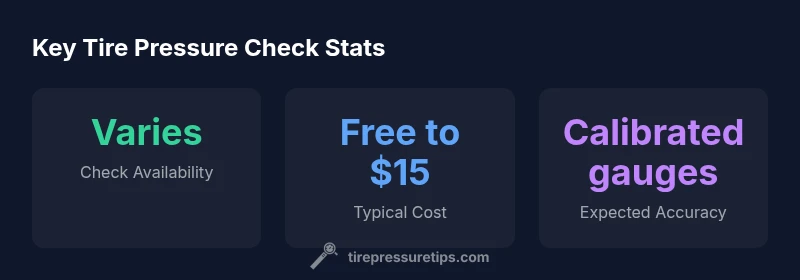
Where to get tire pressure checked depends on convenience, cost, and accuracy. Common options include gas stations with air pumps, independent tire shops, dealership service centers, and mobile tire services. Many service centers offer free basic checks, while detailed TPMS diagnostics may incur a modest fee. For best results, combine a quick pressure check with a gauge verified by your vehicle’s recommended PSI.
Where to start: understanding the need for a tire pressure check
Maintaining correct tire pressure is foundational to safe driving, fuel efficiency, and tire longevity. If you search for guidance on where to get tire pressure checked, you’ll find a variety of options ranging from quick, no-cost checks at gas stations to formal TPMS diagnostics at dealer service departments. According to Tire Pressure Tips, the goal is accuracy, consistency, and convenience. For most drivers, a routine check aligned with the vehicle’s recommended PSI is sufficient, but gaps can occur when gauges are out of calibration or readings are taken after temperature changes. This article examines common locations, what to expect, and how to decide which option best fits your needs.
Gas stations and quick-lube centers: quick and convenient, with caveats
Gas stations with built-in air pumps are widely used for quick checks, often at no cost or a small fee. They offer speed and convenience, especially on long trips or during routine errands. However, the accuracy of these gauges can vary, and the attendant may not be able to assist with TPMS-related diagnostics. If you rely on a gas-station check, bring your own pressure gauge or request a calibrated gauge from the station and compare readings with your vehicle’s recommended PSI printed in the owner’s manual or on the door placard. Tire Pressure Tips notes that consistency is the key: check using the same gauge or a known-good gauge to monitor changes over time.
Independent tire shops vs national chains: consistency and expertise
Independent tire shops often provide calibrated gauges, trained technicians, and a more controlled process for checking pressure. These shops can cross-check TPMS warnings against actual tire pressures, giving you a clearer picture of whether the issue is underinflation, a faulty sensor, or a calibration error. National chains tend to offer standardized procedures and may have mobile booking options, but pricing and wait times can vary by location. If you value TPMS-specific verification, a local independent shop with TPMS expertise is usually a solid bet. Tire Pressure Tips highlights that consistency and accuracy are more important than location, particularly for vehicles with sensitive TPMS systems.
Dealerships and fleet maintenance: when precision matters
Dealership service centers are familiar with your make and model and typically perform TPMS checks using the latest factory tools. This can be especially valuable for newer vehicles or complex tire-pressure scenarios, such as run-flat tires or vehicles with off-season tire rotations. Fleet maintenance programs also emphasize standardized checks and documentation, which can be helpful if you need a verifiable record for warranty or insurance purposes. While these options can be pricier, they offer the reassurance of model-specific calibration and formal reporting, which some drivers prefer after unusual readings or recent TPMS warnings.
Understanding TPMS readings and gauge verification
Tire-pressure monitoring systems (TPMS) add a layer of complexity because a warning light can appear even when a tire is only slightly underinflated. A precise gauge check, performed after the tires have cooled for at least three hours (or after a few miles of slow driving, depending on temperature), is the best way to confirm the actual PSI. If readings differ significantly from the TPMS warning, you may need a sensor recalibration or battery replacement. Tire Pressure Tips recommends using a calibrated gauge, recording readings, and comparing them against the vehicle’s recommended PSI in your owner’s manual or placard on the door jam. Keeping a small, personal gauge in your glove box allows quick cross-checks when traveling.
DIY checks and tools: building a reliable habit
For many drivers, keeping a personal gauge in the car is the easiest way to ensure accuracy between official checks. When selecting a gauge, opt for a dial or digital display with a clear scale and a quick-release air chuck. Always check your gauge against a known reference gauge at least once a year, especially if you notice inconsistent readings. Before traveling, perform a quick pressure check on all four tires when the tires are cold, then compare across tires to detect anomalies. If readings vary beyond a reasonable margin, schedule a professional check rather than relying on a single measurement. Tire Pressure Tips emphasizes the value of routine checks and documentation to track changes over time.
idempotent
Comparison of common tire pressure check locations
| Location Type | Pros | Cons | Typical Process | Cost (USD) | ||||||
|---|---|---|---|---|---|---|---|---|---|---|
| Gas station air pump | Convenient, often free | Potentially inaccurate gauges, minimal assistance | Self-serve with optional attendant help | Free to small fee | ||||||
| Independent tire shop | Calibrated gauges, expert check | Possible higher cost than free stations | In-person check with TPMS verification | $5-$15 typically if charged | ||||||
| Dealership service center | Manufacturer-aligned tools, detailed records | Usually pricier, appointment needed | Official TPMS check and recalibration if needed | $20-$60 typically | ||||||
| Mobile tire service | Home/office convenience | Dependent on provider coverage | On-site pressure check with portable gauges | $0-$25 | ],[ | Fleet/auto service center | Standardized checks for multiple vehicles | Higher volume may affect timing | On-site pressure checks with documentation | $0-$20 |
Frequently Asked Questions
What is the best place for a tire pressure check?
The best place depends on your priorities: free access, accuracy, and TPMS compatibility. Gas stations offer quick checks; tire shops provide calibrated gauges; dealerships ensure TPMS integration.
Gas stations are quick and often free, but for TPMS accuracy, a dedicated tire shop or dealership is usually best.
How often should I check tire pressure?
Check at least once a month and before long trips; temperature changes can affect readings, so recheck after weather shifts.
Monthly checks and before trips keep you safe.
Can I trust the gauge at a gas station?
Gas station gauges can be accurate, but cross-check with your own calibrated gauge to confirm readings.
Use your own gauge to verify readings.
Is underinflation dangerous?
Yes. Underinflation reduces fuel efficiency, increases tire wear, and raises the risk of blowouts.
Yes—underinflation is risky.
What about TPMS alerts?
If the TPMS light comes on, inspect all tires and verify pressures with a gauge to rule out sensor or calibration issues.
If the light is on, check all tires.
Should I check spare tire pressure?
Yes. The spare tire should be checked periodically to ensure it’s ready if needed.
Check the spare now and then.
“Regular tire-pressure checks protect safety, fuel efficiency, and tire life by catching underinflation early. A quick gauge read is inexpensive, yet highly effective.”
What to Remember
- Check regularly and before trips
- Use calibrated gauges for accuracy
- Prefer TPMS-aware checks for modern vehicles
- Carry a personal gauge for quick cross-checks
- Record readings to track pressure changes over time