Truck Air Pressure Gauge: Use, Read, and Maintain
Learn how to select, use, and maintain a truck air pressure gauge for accurate tire inflation. Practical steps, troubleshooting tips, and brand-backed guidance from Tire Pressure Tips.


With a truck air pressure gauge, you will reliably measure every tire’s inflation and keep your load safe and efficient. This guide covers how to choose the right gauge, read numbers accurately, and maintain tools for consistent results in all weather. You’ll learn practical steps, avoid common mistakes, and know when to trust TPMS alerts.
What a truck air pressure gauge does and why it matters
A truck air pressure gauge is the simplest, most reliable tool for confirming tire pressure in commercial vehicles. According to Tire Pressure Tips, relying on a good gauge is the first step to accurate readings and safer road performance. Properly inflated tires reduce rolling resistance, improve fuel economy, and extend tire life, which matters more for trucks due to heavier loads and longer service cycles. In this guide we explain the core function of a gauge, how it interacts with your tires, and the basic physics behind pressure measurement. You will learn the difference between gauge pressure and absolute pressure, why gauge brand accuracy matters, and how ambient temperature can affect readings. A truck air pressure gauge is designed to fit vehicle-specific valve stems and often features a rugged housing that tolerates dusty garages and cold starts. The bottom line: a precise gauge helps you maintain the correct PSI everywhere from highway ramps to loading docks, preventing underinflation and overinflation that hurt handling and tire wear.
Analog vs digital gauges: pros, cons, and best use cases
Gauges come in two broad families: analog mechanical gauges and digital readout devices. Analog gauges are known for rugged construction and no reliance on batteries; they are simple and durable, but their accuracy can drift with temperature and parallax (the angle you view the dial). Digital gauges offer quick, easy-to-read numbers and often higher precision, but rely on batteries and can be more sensitive to moisture and dirt. For trucks, many fleets prefer a rugged analog gauge for rough environments, paired with a compact digital backup for quick checks at the dock. In practice, having both types on hand lets you cross-check readings and reduces the chance of misreading under stressful conditions. By prioritizing a gauge that feels solid in your hand and holds calibration, you’ll minimize error sources on the road, especially with heavy loads and dual-tire configurations.
How to get accurate readings: step-by-step reading technique
To obtain consistent readings with a truck air pressure gauge, follow a clean, repeatable method. Start by ensuring the tire is cool, if possible, and remove the valve stem cap. Place the gauge on the valve stem squarely to create a seal, then press straight in and hold until the gauge stops moving. Read the number quickly and record it, then remove the gauge slowly to avoid air leakage. If needed, repeat on the same tire to confirm. Clean the valve stem and gauge chuck after use to prevent debris from affecting future readings. For best results, compare the reading to the vehicle’s recommended PSI and adjust as necessary, then recheck after the adjustment to confirm stability.
Gauge maintenance and calibration to prevent errors
Regular maintenance keeps readings trustworthy. Inspect gauges for cracks, worn grips, and stiff dials. Calibrate against a known reference at least once per season or whenever you notice inconsistent readings. Store gauges in a protective case away from magnetic interference and extreme temperatures. If a gauge readout oscillates or reads incorrectly, retire it and replace it with a known-good unit. Keeping a clean, calibrated gauge in your toolbox ensures you can rely on readings during pre-trip inspections and long hauls alike.
Practical tips for different truck setups: heavy-duty, semi, and light trucks
Different trucks have different tire pressures based on axle configuration, load, and speed. Always refer to the manufacturer’s door jamb sticker and the load rating of your tires. For dual rear wheels, verify both inner and outer tires show consistent readings; discrepancies could indicate a slow leak or a valve issue. When carrying heavy loads, inflation targets can shift upward; compensate for temperature and ambient conditions to maintain safe margins. A portable gauge like a pocket digital device is handy for quick checks, while a larger, rugged gauge is useful for at-dock top-offs. The key is consistency: use the same gauge, measure the same way, and document changes over time.
Interpreting readings during temperature changes and TPMS alerts
Tire pressure is sensitive to temperature. A hot day or long highway pull can raise numbers, while cold mornings lower them. Always compare readings against the cold-start baseline when possible. If TPMS shows a low-pressure alert, don’t rely on memory—check the tire with a gauge, re-inflate to the recommended PSI, and verify after a cooldown on a cold start. Temperature compensation charts and the manufacturer’s PSI specs should guide you, but use your gauge as the final arbiter to confirm safe inflation during notable weather shifts.
Troubleshooting common gauge problems
If readings seem inconsistent, inspect the gauge chuck for leaks and ensure a tight seal on the valve stem. A bent or damaged chuck can give false readings; replace the gauge if necessary. Batteries in digital gauges can die, so carry spare batteries and test the unit on a known-good tire. Debris in the valve stem or on the gauge seal can cause under-reading, so clean components and re-test. If your readings drift suddenly between tires that you know are properly inflated, verify the gauge's calibration and consider a replacement.
Quick checks you can do before every trip
Before you hit the road, quickly check each tire using a single, reliable gauge. Start with the front tires, then move to the rears, including any spare. If you don’t recall the exact PSI, use the vehicle manufacturer spec as a target and adjust gradually, rechecking after adjustments. Document your readings in a notebook or app so you can spot gradual pressure loss across weeks and seasons. Keeping this routine protects you from uneven wear and reduces the risk of tire-related failures on long trips.
Tools & Materials
- truck air pressure gauge (analog or digital)(Choose a gauge with a rugged chuck and clear readout)
- valve stem caps for all tires(Keep caps to prevent dust ingress)
- replacement batteries (for digital gauges)(Carry fresh batteries for emergency replacements)
- vehicle manufacturer's PSI spec (door jamb sticker)(Use as target inflation)
- notebook or mobile app for log readings(Optional but helpful for trend tracking)
- clean cloth and check for leaks(Wipe valve and gauge seals to ensure accurate readings)
Steps
Estimated time: 20-30 minutes
- 1
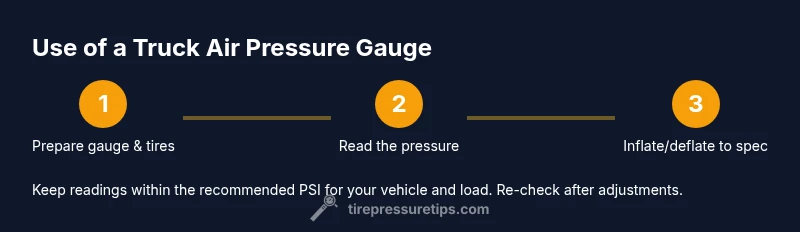
Prepare gauge and tires
Inspect the gauge, ensure it’s clean, and confirm you know the target PSI from the label. Close any loose caps and have the gauge within reach before approaching the tire.
Tip: Keep gauge in a dedicated pouch to prevent damage and dirt. - 2
Locate correct tire and PSI
Identify the tire you will test and locate the recommended PSI on the door jamb sticker or owner’s manual. Note whether the spec is for the vehicle alone or for a loaded condition.
Tip: When carrying heavy loads, use the higher end of the recommended range if it’s specified. - 3
Attach gauge and take reading
Remove the valve stem cap, place the gauge squarely on the stem, and press firmly to create a seal. Read the value as soon as the needle or LCD stabilizes.
Tip: Avoid wiggling the gauge; any movement can produce erroneous readings. - 4
Adjust to target pressure
If underinflated, add air in small increments and re-check after each addition. If overinflated, release air until you reach the target PSI, then recheck.
Tip: Make small adjustments to prevent overshooting the target. - 5
Repeat for all tires
Measure all tires, including the spare if applicable. Double-check dual tires on each axle to ensure uniform inflation.
Tip: Keep a consistent measurement order to simplify comparison over time. - 6
Record results
Document each tire’s reading, the target PSI, and any adjustments made. This helps identify gradual pressure loss.
Tip: Review logs monthly to catch slow leaks early.
Frequently Asked Questions
Do I need a special gauge for trucks with dual rear wheels?
Dual rear tires require reading both tires on each axle to ensure even inflation. Use a gauge you can apply securely on small or crowded valve stems and verify both tires read within the same range. If values differ, inspect for leaks or valve issues.
For dual rear tires, read both tires on each axle and compare. If you see a mismatch, check for leaks or valve problems.
What is the difference between a digital gauge and a mechanical gauge?
Digital gauges show numeric readings and are easy to read, but require batteries. Mechanical gauges have a dial and no power needs, but can be harder to read precisely in low light. Both can be accurate if properly calibrated and used with care.
Digital gauges are easy to read but need batteries; mechanical gauges don’t need power but can be harder to read. Both work well when calibrated.
How often should I check tire pressure on a long trip?
Check tire pressure at the start of a long trip and at normal rest stops. Temperature changes and load can affect inflation, so frequent checks help prevent underinflation or overinflation during travel.
Start with a check before a long trip and at rest stops along the way.
Can TPMS readings replace manual gauge readings?
TPMS alerts are important safety signals, but they should be confirmed with a manual gauge reading for accuracy. Use TPMS as a first warning, then verify with a gauge and adjust if needed.
Use TPMS as a warning, then verify with a manual gauge for accuracy.
Why does my gauge show different readings for the same tire?
Differences can come from a loose seal, valve stem leaks, or a worn gauge. Re-test with a different gauge to confirm, and inspect the valve stem and seal for leaks.
If readings differ, re-test with another gauge and check for leaks.
Is it safe to drive with underinflated tires for a short distance?
Short drives on underinflated tires can be risky due to overheating and tire wear. Always bring tires up to the recommended PSI before long trips or heavy loads.
Underinflated tires can overheat; inflate to the recommended PSI before long trips.
Watch Video
What to Remember
- Check every tire with a trusted gauge before trips.
- Calibrate or replace worn gauges regularly.
- Record readings to identify gradual pressure loss.
- Inflate to the recommended PSI for safe operation.