Big Tire Pressure Gauge: Use, Read, and Calibrate
Learn how to choose, use, and maintain a big tire pressure gauge for accurate readings, safe inflation, and TPMS integration. This guide covers selecting a gauge with a clear display, reading analog or digital formats, calibration, and common mistakes to avoid.


You will learn to select, use, and maintain a big tire pressure gauge for accurate readings, safe inflation, and TPMS integration. This guide covers choosing a gauge with a clear display, how to read both analog and digital formats, and when to calibrate or replace your tool. Gather a gauge, your vehicle’s door placard, and a quiet space to measure.
What a big tire pressure gauge is and why it matters
A big tire pressure gauge is a purpose-built tool designed to measure the air pressure in your tires with large, easy-to-read displays. For many drivers, especially those who service their own tires regularly, a high-visibility gauge reduces guesswork and increases accuracy. In 2026, the Tire Pressure Tips team notes that consistent use of a reliable gauge helps prevent under- or over-inflation, which can improve fuel efficiency, tire wear, and overall vehicle safety. When you rely on a gauge you can read from a distance, you reduce the likelihood of misreading under low light or awkward angles. Keep in mind that digital gauges provide quick numeric readouts, while analog gauges offer a visual dial that some users find easier to gauge at a glance. The bottom line: a big gauge is an investment in accuracy and peace of mind.
Choosing a big tire pressure gauge that fits your needs
When selecting a gauge, consider readability, compatibility, accuracy, and durability. Look for a large, high-contrast display and a clearly marked PSI scale (and possibly kPa as well). A big gauge should work with standard Schrader valves and seal well to avoid air leaks during measurement. Consider the gauge’s material quality, water resistance, and whether it includes a protective cap. For drivers who frequently check multiple vehicles, a gauge with a wider measurement range and a long hose can be very helpful. In practice, prioritize readability and reliability over extra features that don’t improve accuracy. Remember to verify that the gauge’s accuracy is within an acceptable tolerance, and that it can be calibrated if necessary.
Reading methods: analog vs digital on a big gauge
Big tire gauges come in two main formats: analog (dial) and digital (numeric display). Analog gauges provide a quick visual cue; a well-lit dial lets you compare the needle position against the scale in a single glance. Digital gauges provide precise numbers, which some users prefer for exact readings. Both types require the same technique—clean the valve stem, place the gauge squarely on the valve, and ensure a proper seal. When reading, avoid rushing; even a one-second hesitation can help you confirm stability if the needle or digits flicker slightly. If you find the gauge unreliable, test it against a known standard or try a different gauge to confirm accuracy.
Calibration and maintenance for long-term reliability
Calibration keeps readings trustworthy. If your gauge allows calibration, follow the manufacturer’s instructions to adjust the scale or mechanism. Regular maintenance includes cleaning the valve stem before use, keeping the gauge free from dust, and storing it in a protective case or pouch. For digital gauges, replace batteries as needed and check the display for dead segments. A big gauge should last many seasons with proper care; a small amount of effort now saves time and money later by preventing inaccurate inflations.
Common mistakes and safety warnings you should avoid
Common mistakes include reading a warm tire, which can yield higher pressures, and failing to reseal the valve cap after measurement. Over-tightening or under-tightening the gauge can also cause inaccurate readings or leaks. Always measure on cold tires and avoid venting air directly from the valve where possible; instead, adjust using a controlled air source. Safety-wise, disconnect the gauge gently and inspect the valve stem for damage after each use to prevent long-term valve issues.
Integrating gauge readings with TPMS and vehicle guidance
Gauge readings provide a manual check against the Tire Pressure Monitoring System (TPMS). If TPMS shows a warning, verify the pressure with your big gauge to confirm whether the tire is underinflated. Use the vehicle door placard as your reference for the correct PSI, and adjust as needed. Regular checks with a big gauge help you monitor fluctuations due to temperature changes and seasonal use, ensuring your tires stay within the recommended range for safety and efficiency.
Maintenance best practices and storage tips for longevity
Store the gauge in a dry, temperature-controlled place away from direct sunlight. Cap the gauge after use to protect the seals, and periodically test it against a known standard to catch drift over time. If the gauge has a hose or connector, inspect for cracks and replace components as needed. A well-maintained gauge becomes a reliable tool for you and your family’s safety on the road.
Tools & Materials
- Big tire pressure gauge (analog or digital)(Choose a gauge with a large, easy-to-read display and a reliable seal on Schrader valves.)
- Owner’s manual or door jamb PSI placard(Use as the reference for the correct tire pressures.)
- Air source (air compressor or pump)(Needed to adjust tire pressure after reading.)
- Cleaning cloth(Wipe valve stems and seals before attaching the gauge.)
- Gauge calibration tool or replacement parts(Optional, for precision gauges that support calibration.)
Steps
Estimated time: 15-25 minutes
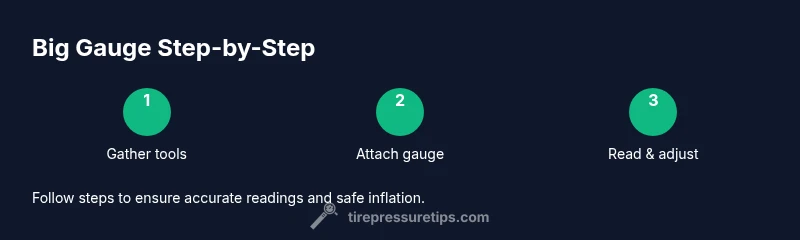
- 1
Gather tools and verify reference
Collect your big tire pressure gauge and the vehicle’s tire pressure placard. Confirm you have a cold-tire baseline reference since readings vary with temperature. This initial check ensures you are starting with the right frame of reference.
Tip: Keep the gauge in a protective case to avoid damage to the display or seals. - 2
Prepare the tire and valve
Inspect the valve stem for damage and wipe it clean. Remove the valve cap carefully to avoid dropping it or contaminating the stem. A clean, undamaged valve seal improves accuracy.
Tip: If the valve cap is damaged, replace it before proceeding to prevent dirt ingress. - 3
Attach the gauge securely
Place the gauge on the valve stem straight on and press firmly to create a seal. Avoid tilting the gauge, which can cause air leaks and incorrect readings. Hold steady to prevent movement during measurement.
Tip: If the gauge has a built-in locking mechanism, engage it to keep the connection stable. - 4
Read the pressure
Read the scale promptly after attaching the gauge. For analog gauges, look at the needle position; for digital gauges, read the numeric value. Confirm the reading is stable before recording.
Tip: If the digits or dial flicker, wait a few seconds and recheck to confirm stability. - 5
Compare with manufacturer recommendations
Compare your reading to the PSI listed on the door placard or manual. If the pressure is low or high, plan the necessary adjustment. Temperature and driving conditions can affect the ideal pressure, so consider retesting after a short drive if required.
Tip: Use the same gauge for all tires to maintain consistency. - 6
Adjust pressure if needed
If adjustment is necessary, use an air source to increase or release air gradually. Recheck after each adjustment to avoid overshooting the target pressure. Once you reach the target, depress the valve stem to release any residual air and reseat the cap.
Tip: Make small adjustments and recheck; large corrections are harder to dial in precisely. - 7
Final check and storage
Recheck the tires after driving a short distance if required and record the final readings. Replace the valve caps securely and store the gauge in its case. This ensures longevity and readiness for the next tire check.
Tip: Label readings in a notebook or app for trend tracking over time.
Frequently Asked Questions
Why is my gauge reading different from TPMS?
TPMS warnings can reflect temperature changes and tire wear; a manual gauge provides an independent check. If readings differ significantly, recheck the tire pressure with your gauge and inspect the valve stem for issues.
TPMS is a warning system that can drift with temperature and wear. Use your gauge to verify the pressure and inspect the stem if readings mismatch.
Can I use any gauge for all tires?
Most gauges work with standard Schrader valves, but fit and seal quality vary. Choose a big gauge with a reliable seal for consistency across tires.
Most gauges fit standard valves, but the seal quality matters for accuracy. Pick a big gauge with a good seal.
How often should I calibrate a tire gauge?
Calibration frequency depends on use, but test against a reference every few months or after a noticeable drift. Replace the gauge if accuracy cannot be achieved.
Test it against a known reference every few months, and replace if it drifts.
What is the best way to store a gauge?
Store in a protective case away from heat and sunlight. Keep it clean and dry to preserve seals and accuracy.
Use a protective case and keep it in a cool, dry place.
Why should I check tires when cold?
Cold tires reflect true pressure; driving heats tires and raises pressure, skewing readings. Check before you drive for accuracy.
Check when the tires are cold to get true readings.
What if I overinflate after checking?
If you overinflate, release air slowly and recheck until you reach the recommended PSI. Then monitor for gradual changes.
Let air out gradually and recheck to hit the target pressure.
Watch Video
What to Remember
- Choose a gauge with a clear, large display
- Measure when tires are cold for accuracy
- Always compare with the door placard PSI
- Calibrate or replace drifted gauges promptly