Tire Pressure Specs: A Practical Guide for Drivers
Explore tire pressure specs, how to read them, and practical steps to maintain optimal psi for safety, fuel efficiency, and tire longevity. Learn with data-driven guidance from Tire Pressure Tips.


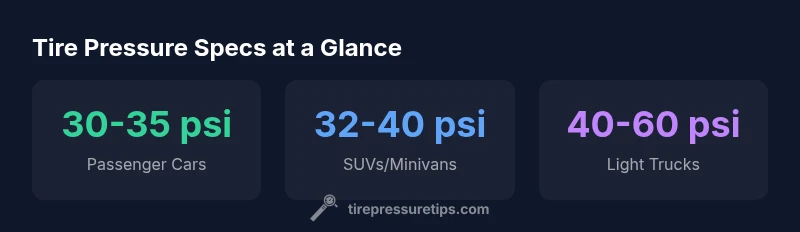
Most passenger cars use tire pressure specs in the 30–35 psi range when tires are cold. Always verify the exact figure on the door jamb placard or in the owner's manual, because your model, load, tire size, and climate can shift the target. This Tire Pressure Tips analysis provides practical guidance on applying these ranges for safety, fuel economy, and longer tire life.
What tire pressure specs are and why they matter
Tire pressure specs define the optimal pounds-per-square-inch (psi) for your tires, set by the vehicle manufacturer. These numbers account for performance, safety, load capacity, and fuel efficiency. Knowing and applying the correct tire pressure specs reduces uneven wear, improves handling, and preserves fuel economy. In practice, the most important value is the cold psi—the pressure when the tires are at ambient temperature, before driving. Small deviations from the spec, especially under load or at highway speeds, can compound into noticeable changes in grip and tire life. According to Tire Pressure Tips, always start with the manufacturer’s spec rather than chasing a generic target. The goal is consistent, cold-psi readings that match the vehicle’s design intent while accommodating your driving conditions.
- The door jamb placard and owner’s manual are the primary references for your exact tire pressure specs.
- Variations occur by tire size, weight distribution, driving style, and climate.
- Use a reliable gauge and check after the vehicle has been still for several hours (or after a car has cooled for at least 3 hours).
This section frames why “tire pressure specs” matter to everyday driving, safety, and efficiency. The Tire Pressure Tips team emphasizes that precision matters more than chasing a single universal value.
Reading the tire pressure spec on your vehicle
Reading the exact spec begins with locating the placard on the driver’s door jamb. This placard lists the recommended cold psi for the front and rear tires, and may include notes about vehicle load, tire size, and speed rating. In some cases, the manufacturer provides a separate specification for different tire sizes that you might have installed. If the placard is missing or unreadable, consult the owner’s manual or the manufacturer’s website, and consider contacting a dealer for confirmation. Always ensure you are reading the correct spec for the specific tire size installed on your vehicle. Some tires use lower psi values for certain performance modes; when in doubt, default to the manufacturer’s published spec and verify with a gauge.
- Compare front vs rear specs if your vehicle has asymmetric load distribution.
- Note any special instructions for winter tires or run-flat tires.
- Record your official spec in a maintenance log for quick reference.
How to check cold tires and why temperature matters
To get an accurate reading, check tire pressure when tires are cold—ideally after the car has been stationary for at least three hours or after driving less than a mile. Driving heats tires and raises the reading, which leads to an incorrect adjustment. Temperature fluctuations throughout the day can swing psi, especially in climates with dramatic seasonal changes. Inconsistent readings fuel incorrect adjustments that can undermine safety and wear patterns. When checking, use a good-quality gauge, and measure both front and rear tires. If you’re topping off after a ride, recheck once the tires have cooled to confirm accuracy. A routine (monthly) check helps catch slow leaks and slow down wear).
- Do not rely on “hot” readings from a recent drive.
- Consider a digital gauge for better precision and repeatability.
- Keep a small notebook or app record of the actual numbers you observe.
Vehicle categories and their typical ranges
While exact values come from the placard, general ranges help guide expectations. Sedans and compact cars typically aim for mid-30s psi when cold, SUVs and minivans often require slightly higher values to accommodate weight and tire choices, and light trucks may demand the highest numbers to support payloads. Always confirm the vehicle-specific spec and avoid guessing by model year alone. Temperature, tire age, and tread depth can influence recommended pressures, so treat the placard as the final authority. This practical overview helps you translate the general guidance into real-world choices for different vehicle types.
- Sedans: commonly in the low-to-mid 30s psi range
- SUVs/Minivans: commonly mid-30s to high-30s psi range
- Light Trucks/Heavy-Duty Vehicles: commonly high-30s to mid-40s psi range
How load, speed, and climate shift the target psi
The tire pressure you use is not a fixed number in every situation. When you carry heavier loads or drive at higher speeds, the tires compress more and may require higher psi to maintain shape and contact with the road. Temperature also shifts psi: cold air is denser, increasing base pressure; as tires heat up during driving, pressure rises further. Seasonal changes can be surprisingly influential: cold weather often lowers pressure, while summer heat can push it higher. The practical takeaway is to check and adjust within the manufacturer’s stated window, rather than chasing a single value across all conditions.
- Reset when carrying heavy cargo or towing.
- Re-check after changing tire sizes or upgrading tires.
- Use a tire gauge and TPMS readings as supplementary checks, not as a replacement for the placard value.
Practical steps to maintain correct tire pressure
Maintaining tire pressure is a straightforward habit with big returns in safety and efficiency. Start by confirming your spec from the placard and owner’s manual, then check monthly and before long trips. Use cold-tire measurements for accuracy, and adjust in small increments while the vehicle is stationary. After adding air, recheck the pressure on all tires, including the spare if applicable. Keep a reliable gauge and consider logging readings to track trends. If you notice persistent pressure loss, investigate possible leaks, valve stem issues, or damaged wheels. Running tires at the correct psi reduces irregular wear and improves handling in wet and dry conditions. Tire Pressure Tips recommends pairing PSI maintenance with routine TPMS checks for robust protection.
- Always calibrate after rotating tires.
- Never exceed the tire’s maximum pressure printed on the sidewall as your target.
- Replace compromised sensors or seals promptly to preserve TPMS accuracy.
Common mistakes and troubleshooting
Common mistakes include inflating to the max pressure printed on the tire sidewall, inflating without reference to the placard, or neglecting temperature effects when comparing readings. Another pitfall is using the wrong gauge or measuring after driving, which yields inflated psi values. If you observe frequent pressure loss, check for slow leaks around the valve stem, bead seat, or tire rim. Seasonal changes can mask leak signs; a simple soapy-water test around the bead area can reveal slow leaks. Finally, don’t rely on a single reading—consistent checks help you spot slow deterioration and prevent dangerous underinflation.
- Avoid max-pressure values as a target.
- Inspect for slow leaks regularly.
- Keep spare tire pressure in check as well, since it affects overall system behavior.
Typical tire pressure specs by vehicle type
| Vehicle Type | Target Cold PSI | Notes |
|---|---|---|
| Sedan | 32-34 | Common target for mid-size sedans; verify placard. |
| SUV/Crossover | 34-40 | Heavier loads or all-terrain tires may require higher pressure. |
| Truck/Van | 40-45 | Critical for payload and stability; consult manufacturer. |
Frequently Asked Questions
What are tire pressure specs?
Tire pressure specs are the manufacturer-recommended psi values for optimal performance, safety, and wear. They vary by vehicle model, tire size, load, and driving conditions. Always start with the placard and manual, not a generic target.
Tire pressure specs are the manufacturer-recommended psi values for your vehicle, varying by model and tire size.
Where can I find the exact tire pressure spec for my car?
The exact spec is listed on the driver’s door jamb placard and in the owner’s manual. If those aren’t accessible, check the manufacturer’s website or contact a dealer for confirmation.
Check the door placard or your owner’s manual for the exact spec.
Should I check tire pressure when tires are warm or cold?
Always check cold tires for accuracy. Warm tires show higher readings because heat increases pressure, which can lead to overinflation adjustments if not accounted for.
Check cold tires for the most accurate reading.
Do TPMS alerts mean I must adjust pressure immediately?
TPMS alerts indicate pressure is below the target; verify with a gauge and adjust to the specified cold psi. If the alert persists after inflation, inspect for leaks or sensor issues.
TPMS tells you pressure is low—check with a gauge and adjust to spec.
How often should I check tire pressure?
Check tire pressure at least monthly and before long trips. More frequent checks are wise in extreme temperatures or with frequent loads or towing.
Check monthly and before long trips, especially with temperature changes.
“Precise tire pressure specs are foundational for safe handling and optimal fuel efficiency; even small deviations can compound under load or temperature shifts.”
What to Remember
- Check your placard first; always verify.
- Measure cold tires; temperature matters.
- Use TPMS as a safeguard, calibrate after changes.
- Don’t rely on ‘max’ pressure as your target.
- Regular maintenance saves wear and improves safety.