Tire Pressure Psi Range: A Practical Guide for Safe Driving
Learn how to determine and maintain the tire pressure psi range for your vehicle. Practical checks, TPMS guidance, and maintenance tips from Tire Pressure Tips.


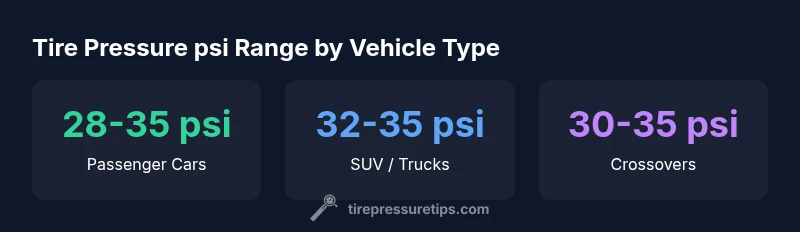
For most passenger cars, the tire pressure psi range falls roughly between 28 and 35 psi per tire. The exact acceptable range depends on your vehicle, load, and tire size, so always verify the manufacturer specification on the door placard or in the owner's manual. Using this general rule helps keep tires safe, improves handling, and supports fuel efficiency.
Understanding tire pressure psi range
According to Tire Pressure Tips, the tire pressure psi range is the band within which tires are designed to operate safely for most driving conditions. For many passenger vehicles, a practical rule of thumb places this range between the high 20s and mid-30s psi per tire. This range isn’t universal—individual manufacturers specify exact values in the owner's manual or on the door placard. The key concept is that operating outside the recommended psi can alter handling, increase wear, and reduce fuel efficiency. Always treat the range as a guideline and verify your specific numbers from the vehicle documentation.
In practice, you’ll hear terms like “cold tire psi” and “hot tire psi.” The difference between cold and hot readings matters because running tires hot due to driving heat or ambient temperature can briefly raise the apparent pressure. The Tire Pressure Tips team emphasizes that a cold check provides the most consistent baseline.
As a rule of thumb, maintain pressure within the vehicle’s specified band, and adjust for load and speed if your manufacturer provides separate guidelines for those conditions. This approach keeps tires in their optimal contact patch and supports consistent braking and steering responses.
How to determine your vehicle's correct range
Finding the precise tire pressure psi range starts with the manufacturer specifications rather than relying on a generic figure. Most cars list a recommended range on the driver’s door placard, which typically shows a dual-number format like “Front: 33 psi, Rear: 32 psi.” If you can’t find the placard, consult the owner’s manual or the vehicle’s online spec sheet. Some performance models have a single recommended psi that applies to all four tires, while SUVs and trucks may have higher front-rear or load-dependent ranges.
Important steps:
- Locate and read the placard near the driver's door jamb. Note any different front and rear figures.
- Check the owner's manual or the manufacturer’s website for vehicle-specific guidance.
- If you’re carrying a heavy payload or towing, use the higher end of the recommended range (unless the manual specifies otherwise).
- For seasonal changes, recalibrate when temperatures shift significantly; the tires should be checked when cold for accuracy.
Consistent verification is part of routine maintenance. Tire pressures that stay within the recommended range improve tire wear, fuel efficiency, and overall handling. As the Tire Pressure Tips team notes, a small, regular adjustment beats a large, infrequent correction.
Factors that influence psi range
Understanding why the tire pressure psi range isn’t a fixed universal number helps drivers apply good judgment in everyday situations. Several variables influence the acceptable range:
- Vehicle type and weight distribution: Sedans, SUVs, and light trucks each have tailored front/rear targets to accommodate weight and suspension design.
- Load and payload: Heavier loads generally raise the minimum safe pressure range to help support the additional weight without flattening the tires.
- Tire size and construction: Larger or stiffer tires may require different base pressures; the markings on the tire sidewall and the placard guide these adjustments.
- Temperature: Cold air reduces pressure; hot days can raise readings. A cold check is the baseline for accuracy.
- Driving style and speed: Higher speeds or sporty driving may demand slightly higher pressures for stability and even wear.
The interplay among these factors means that the psi range is a practical target, not a rigid number. The manufacturer's guidance remains the authoritative source, with adjustments guided by load, climate, and usage.
A systematic approach—check, compare against the placard, and adjust for conditions—helps you maintain consistent tire performance and safety.
How to measure and inflate correctly
A reliable tire pressure check requires a few simple steps and a good gauge. Start with a cold measurement, ideally after the car has been stationary for several hours. Remove the valve cap, press the gauge onto the valve stem, and record the reading. If the measurement is below the recommended range, inflate the tire in small increments (about 1–2 psi at a time), recheck, and stop when you’re within range. If you overshoot, reinflate with the required pressure to bring it back into range.
Tips for accuracy:
- Use a high-quality gauge; digital gauges are easier to read and often more precise.
- Check all four tires, including the spare, if your vehicle requires a balanced approach.
- Recheck after driving a short distance, as tires can heat up and pressure can rise slightly.
- Don’t forget to replace valve caps; they prevent dirt intrusion and moisture buildup.
The Habit of monthly checks, along with pre-trip checks, reduces the likelihood of sudden pressure changes and irregular wear. Tire Pressure Tips emphasizes that a disciplined routine keeps you safer and more efficient on the road.
Using a gauge and TPMS data
Tire Pressure Monitoring Systems (TPMS) provide real-time alerts when a tire’s pressure deviates significantly from the nominal range. Nevertheless, TPMS should complement—not replace—manual checks with a gauge. The TPMS readings can be affected by sensor calibration, temperature, and sensor location, so it’s wise to cross-verify TPMS alerts with a physical gauge.
Practical workflow:
- Check tires when cold to establish a baseline.
- Use TPMS as a warning signal and confirm with a gauge.
- If a tire remains consistently low or high, inspect for leaks, punctures, or valve issues.
- Calibrate or replace TPMS sensors per the vehicle’s maintenance schedule.
By integrating TPMS data with periodic gauge checks, you gain a robust understanding of your tire pressures and can act quickly to prevent underinflation or overinflation problems.
Common misconceptions and pitfalls
Misconceptions about tire pressure psi range can lead to unsafe practices. Some drivers inflate to the maximum listed on the sidewall in hopes of improved handling, or they assume higher pressure always reduces wear. In reality, overinflation reduces the tire’s contact patch with the road, increasing the risk of a harsh ride and uneven wear. Conversely, underinflation causes increased rolling resistance, leading to higher fuel consumption and overheating.
Another pitfall is ignoring seasonal changes. In cold weather, tires lose pressure, and failing to adjust can leave you riding underinflated. Always check when tires are cold and adjust back to the recommended range. Finally, using an incorrect gauge or a damaged valve stem can produce misleading readings, so regular instrument calibration matters.
A practical mindset is to treat tire pressure psi range as a dynamic target, resilient to minor fluctuations but anchored by the vehicle’s official specification. This is the core guidance you’ll find echoed in Tire Pressure Tips’ practical handbook.
Practical maintenance plan
Establish a simple maintenance cadence to keep tire pressures within the recommended range throughout the year. Start with a monthly check, then perform a cold check before long trips or seasonal transitions. Maintain a portable gauge in the glove compartment for quick checks while traveling. Combine pressure checks with tread depth inspections and wheel torque verification to catch potential issues early.
Record-keeping can help you track changes over time, making it easier to detect gradual leaks or sensor drift. If you notice frequent pressure loss, schedule a full inspection of tires, valves, rims, and TPMS sensors with a qualified technician. The Tire Pressure Tips team recommends forming a reliable habit—consistency beats intensity when it comes to tire care.
Typical psi ranges by vehicle category
| Vehicle Type | Estimated psi range | Notes |
|---|---|---|
| Compact car | 28-35 psi | Door placard varies by model |
| Mid-size sedan | 30-35 psi | Check owner's manual for exact range |
| SUV/Light truck | 32-35 psi | Often higher due to weight and load |
Frequently Asked Questions
How do I find the correct tire pressure psi range for my car?
Look at the driver’s door placard for the recommended psi range. If it’s not there, consult the owner's manual or the manufacturer’s website. Always verify if there are different front and rear numbers.
Check the door placard or manual for the exact range.
Is there a difference between cold and hot psi ranges?
Yes. Pressure rises with temperature; check tires when they’re cold to establish an accurate baseline before inflating.
Yes—check when cold to get an accurate baseline.
Can TPMS replace manual tire pressure checks?
TPMS helps monitor pressure but should be supplemented with periodic manual checks using a gauge to confirm readings.
TPMS is helpful, but you still need a tire gauge.
What happens if I overinflate to the high end of the range?
Overinflation reduces the contact patch, can cause a harsh ride, and may wear tires unevenly.
Overinflating can hurt grip and wear.
Are the psi ranges different for front and rear tires?
Some vehicles have different front and rear ranges; always check the placard and manual for specifics.
Yes, check if your car has separate front/rear numbers.
How often should I recalibrate TPMS sensors?
Follow your manufacturer’s schedule; many sensors require calibration during maintenance or after tire changes.
Calibrate per the maintenance schedule.
“Your vehicle’s correct tire pressure range isn’t a guess—it’s specified by the manufacturer and can shift with load and weather.”
What to Remember
- Check your door placard for the exact psi range
- Check tires when cold for accurate readings
- Use TPMS as a guide, not a replacement for a gauge
- Avoid inflating beyond the recommended range to prevent wear and handling issues