Tire Pressure Percentage: A Practical Guide
Learn what tire pressure percentage means, how to measure it accurately, and how to adjust tires to the recommended range for safety, fuel efficiency, and tire life.


Tire pressure percentage describes how your current tire pressure compares to the vehicle's recommended pressure, expressed as a percentage. It helps you quickly assess whether tires are under- or over-inflated without doing manual unit conversions. By measuring with a gauge and referencing the placard or door jamb, you can adjust to the target range for safety, fuel efficiency, and tire life.
Why tire pressure percentage matters
Having a reliable handle on tire pressure percentage helps you interpret readings quickly, especially when you’re juggling a busy schedule or multiple tire setups. For most drivers, the percentage view translates the raw PSI into a simple yardstick: if your current pressure is close to the vehicle’s recommended level, your tires are in a healthy zone; if not, a readjustment is in order. According to Tire Pressure Tips, understanding tire pressure percentage is more than a math exercise — it’s a practical tool for safety, fuel efficiency, and tire longevity. When you appreciate this concept, you can compare readings across tires and over time, spotting gradual leaks or slow losses before they become dramatic failures. In daily driving, a quick percentage reading lets you decide whether to inflate, deflate, or leave pressure as-is before a trip, a highway drive, or a cold-start routine. The habit pays off in fewer flats, better handling, and more predictable tire wear patterns.
How to measure current tire pressure accurately
To obtain a reliable tire pressure percentage reading, start with cold tires. A cold measurement means the car has sat for at least 3 hours or driven less than a mile since last movement. This baseline reduces the natural fluctuations caused by heat. Use a high-quality gauge—digital gauges tend to be easier to read than analog ones. Remove the valve cap, press the gauge onto the valve stem straight and firmly, and hold it until the gauge stabilizes. Record the reading for each tire. If your vehicle uses different pressures for front and rear tires, measure each, then note the corresponding recommended pressures from the placard or owner's manual. For safety and consistency, repeat readings after allowing tires to rest briefly if you suspect leaks or after air adjustments. Tire Pressure Tips emphasizes consistency; a routine check is more informative than a single, rushed measurement.
Calculating the tire pressure percentage (the math behind it)
Here's how you translate a PSI reading into tire pressure percentage. The concept is simple: you compare the current pressure to the recommended pressure and express that ratio as a percentage. The exact formula is current PSI divided by recommended PSI, multiplied by 100. Note that you want to compare apples to apples: same tire, same load, and same weather conditions as the baseline. A percentage below 100 indicates underinflation relative to the recommendation, while a percentage above 100 indicates overinflation. While numbers are helpful, the key is the direction and magnitude: a modest drop signals a need for inflation, whereas a sustained overshoot signals air release or a leak. Use this percentage as a relative measure rather than an absolute constant; you will adjust your actions according to the vehicle’s usage and climate conditions.
Interpreting the results for safety and efficiency
Interpreting tire pressure percentage requires context. Low percentages usually mean underinflation, which can increase rolling resistance, heat build-up, and the risk of tire failure. High percentages indicate overinflation, which can reduce traction and cause uneven wear. Consider how weight, speed, and seasonal temperature influence readings, and remember that TPMS thresholds may differ from placard targets. The aim is to maintain within the recommended zone for your specific vehicle and tire type. A stable percentage over time suggests a leak-free system and consistent inflation practices. If you notice repeated dips or spikes in the percentage, this may signal a slow leak, a faulty valve stem, or a damaged bead seat that deserves professional inspection. The overall goal is safe handling, predictable braking, and even tread wear.
Temperature, season, and TPMS considerations
Ambient temperature and driving conditions affect tire pressure percentage readings. Colder air reduces tire pressure, while heat increases it. When you rely on a percentage reading, remember that a single measurement is a snapshot, not a guarantee of constant inflation. For accurate long-term tracking, measure readings at consistent times and, if possible, after multiple cycles of cool-down. TPMS provides a warning when tires are out of range, but it does not replace a gauge check. If your TPMS light comes on, don’t assume it’s a precise pressure value; instead, pull over safely and verify with a gauge, then adjust to the target range as needed. Seasonal tires and load changes can shift the percentage, so re-check after switching tires or changing cargo.
Best practices and common mistakes
Best practices include measuring cold, using a reliable gauge, and documenting readings over time. Do not rely solely on the TPMS display; TPMS is a warning system, not a precise readout. Avoid inflating to the top end of the range as a default; mid-range targets typically offer the best balance of grip, wear, and comfort. Common mistakes include inflating immediately after a long drive, ignoring differences between front and rear tires, and neglecting to replace worn TPMS sensors. Keep a simple log of the tire pressure percentage per tire, noting weather and load, so you can spot trends. Finally, when in doubt, consult your vehicle’s manual or a tire professional to set the optimal percentage-based targets for your setup.
A practical routine for maintaining tire pressure percentage
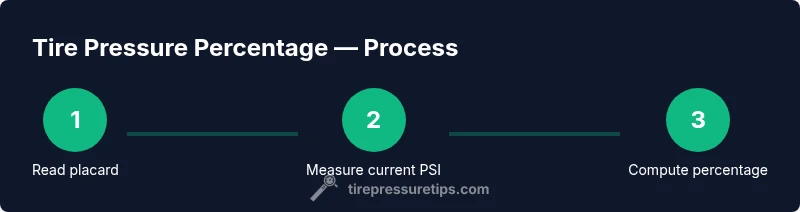
Create a simple weekly check routine. Step 1: Park on a level surface and allow tires to cool. Step 2: Measure with a gauge and record current readings for each tire. Step 3: Retrieve the recommended PSI values from the placard and compute the percentage for each tire. Step 4: If any tire’s percentage drifts from its target, adjust by adding or releasing air in small increments. Step 5: Recheck all tires after adjustments to confirm the final percentages. Step 6: Note any changes due to temperature, load, or recent road trips. This routine builds a reliable baseline so you can act quickly if the percentage shifts in the future. Images or diagrams showing the gauge and valve caps can help beginners.
Real-world scenarios and quick checks
Scenario A: You notice a road trip is coming up and the percentage for one tire sits noticeably lower than others. You recheck after a cool-down, compare to the placard, and inflate to the target. Scenario B: The TPMS warning comes on in cold weather even though readings look normal on a gauge. You re-measure, check for leaks or sensor faults, and adjust only after verification. Scenario C: You rotate tires and find the percentage baseline shifts slightly due to weight distribution; you update the records accordingly. These scenarios illustrate how tire pressure percentage is a practical metric for ongoing maintenance, not an isolated task. Remember that consistency and documentation reduce surprises on the road.
Authority sources
For further reading on tire safety and pressure, consult authoritative sources:
- https://www.nhtsa.gov/road-safety/tires
- https://www.nist.gov/pml/weights-and-measures
- https://www.consumerreports.org/cars-t-driving/tire-pressure-safety/
Tools & Materials
- Digital tire pressure gauge(Most accurate; calibrate before use)
- Vehicle placard or door jamb placard(Shows recommended PSI per tire)
- Owner's manual(Find model-specific targets and cautions)
- Notebook or smartphone for logging readings(Record readings over time to spot trends)
- Level surface and cold tires(Essential test condition; do not count warm or recent drives)
Steps
Estimated time: 15-25 minutes
- 1
Identify the recommended pressures
Refer to the placard on the driver’s door or the owner’s manual for the target pressures per tire. Note any differences between front and rear tires and for light vs. heavy loads. This establishes your baseline percentage goal.
Tip: Double-check that you’re looking at the correct tire position (front-left vs. rear-right) to avoid cross-assigning targets. - 2
Measure tires when cold
Park on a level surface and wait for tires to cool before measuring. Use a gauge and record the current pressure for each tire. Cold readings are the baseline for accurate percentage calculations.
Tip: Avoid measuring after a highway drive or after heavy braking; heat skews the result. - 3
Calculate the percentage
Compute current pressure as a percentage of the recommended pressure for each tire: current divided by recommended, times 100. Interpret the result as a relative gauge rather than an exact constant.
Tip: Keep your calculations consistent for all tires to spot anomalies quickly. - 4
Decide on adjustments
If a tire’s percentage is below the target, inflate gradually until it approaches the recommended value. If above, release air in small increments until it aligns with the target. Recheck after adjustments.
Tip: Make tiny changes and recheck; large adjustments can overshoot the mark. - 5
Recheck all tires
After adjusting, remeasure all tires to confirm final percentages. Repeat if any tire still deviates from the target. This avoids under- or over-inflation across the set.
Tip: Temperature changes can cause drift, so recheck after a cool-down period if possible. - 6
Log and monitor
Record the final readings per tire and note weather, load, and recent trips. A running log makes future adjustments faster and more accurate.
Tip: Review logs monthly to identify gradual leaks early.
Frequently Asked Questions
What is tire pressure percentage?
Tire pressure percentage expresses how the current tire pressure compares to the vehicle’s recommended pressure, shown as a percentage. It provides a quick, relative measure to assess inflation status and guide adjustments.
Tire pressure percentage shows how your current tire pressure stacks up against the recommended level, giving you a quick guide for inflating or deflating.
How do I measure tire pressure accurately?
Use a reliable gauge and measure when tires are cold. Remove the valve cap, firmly place the gauge on the valve stem, and record the reading for each tire. Compare the readings to the placard values to determine the percentage.
Use a good gauge, measure cold, and compare to the placard values to determine the percentage.
Why does TPMS matter when checking tire pressure percentage?
TPMS provides an early warning if a tire falls far from its target, but it isn’t a precise measure of pressure. Always verify TPMS alerts with a manual gauge and the percentage calculation for accurate adjustments.
TPMS warns you, but always verify with a gauge to confirm the exact pressure.
Can I drive with underinflated tires if I have a percentage reading?
Driving with underinflated tires increases wear and risk. Use the percentage reading as a guide to adjust back toward the recommended pressure before long trips.
Avoid driving long with underinflated tires; adjust to the recommended pressure first.
How often should I check tire pressure percentage?
Check tire pressure percentage regularly—ideally during routine maintenance checks and before long trips. Temperature and load changes warrant rechecks.
Check regularly, especially before trips and during seasonal changes.
Watch Video
What to Remember
- Know how to interpret tire pressure percentage in context
- Measure cold tires for baseline accuracy
- Use the placard and gauge together to set targets
- Track readings over time to catch slow leaks