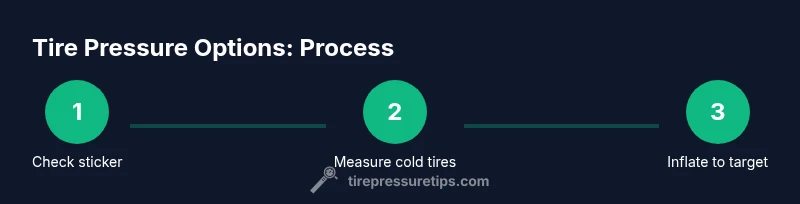
Tire Pressure Options: A Practical Guide
Discover practical tire pressure options, from standard air to nitrogen and TPMS-guided strategies. Learn to read manufacturer stickers, measure cold tires, and adjust for temperature, load, and season to maximize safety, fuel efficiency, and tire life.


With tire pressure options, you’ll learn how to choose between standard air, nitrogen, and TPMS-guided adjustments, plus how to read your vehicle’s sticker and measure cold tires accurately. This quick guide explains when to adjust for temperature and load, and how to balance safety, fuel efficiency, and tire life. Use the following sections to decide your best option.
Understanding tire pressure options
According to Tire Pressure Tips, understanding tire pressure options starts with your manufacturer’s target and ends with regular checks that account for climate, load, and driving style. The spectrum ranges from simple standard air fills to more nuanced approaches that leverage nitrogen or TPMS-driven guidance. The goal is to keep tires within the recommended range for safety, fuel efficiency, and longer tire life. In this section, we’ll define each option, compare their strengths, and outline scenarios where one approach may be preferable over another. Remember: your choice should balance accuracy, convenience, and cost, and it should adapt as seasons and loads change.
Air, nitrogen, and TPMS-guided adjustments
The most common option is standard air filled with the vehicle’s target pressure. Air is inexpensive, readily available, and dependable if you use a gauge and a compressor. Nitrogen is marketed as a moisture-reduing alternative that may hold pressure a bit longer in extreme temperatures, but the practical difference for everyday driving is modest for most drivers. TPMS-guided adjustments rely on sensors to alert you when pressure falls below or rises above the target; they do not directly set the pressure. The Tire Pressure Tips analysis shows that sensors help catch underinflation quickly, but you still need an accurate gauge and a planned check schedule. Your choice should consider climate, how often you drive, and your access to reliable air sources.
How TPMS interacts with pressure targets
TPMS provides continuous feedback on tire pressure, but it isn’t a replacement for manual checks. It can warn you when a tire is dangerously under- or overinflated, but it won’t tell you the exact psi required in every situation. Some systems use a low-tire indicator, while others display the current pressure for each tire in the instrument cluster. Rely on the target numbers on the door jamb sticker as your primary guide; let TPMS serve as a safety net that triggers a check when ambient conditions shift or the tires wear unevenly. Understanding this interaction helps you avoid guessing and over-relying on one source of truth.
Reading and following the factory pressure sticker
Your vehicle’s door jamb or fuel-filler flap carries the official tire pressure specification for front and rear tires. These numbers reflect the vehicle’s suspension, drivetrain, and expected payload. Always start here; inflating beyond the maximum allowed by the sticker can reduce grip, increase rolling resistance, and shorten tire life. If you regularly carry heavy loads or drive in very hot climates, some manufacturers provide separate recommendations for loaded vs. unloaded conditions. Keep a photo of the sticker or write the numbers in your maintenance log so you won’t forget when you swap between seasons or trips.
Temperature, load, and seasonal effects on tire pressure
Air expands with heat and contracts in cold weather, which means your tires may read higher PSI on hot days and lower PSI in cool mornings. Heavy loads increase pressure slightly due to weight on the tire and can shift the optimal range. The combination of temperature swings and loading can move your tires toward or away from the target, so regular checks become a best practice. For drivers in climates with big seasonal shifts, you’ll want to check pressure more often and adjust before long highway trips or winter driving. The goal is to keep the tires in the recommended range across the normal operating conditions.
Nitrogen vs regular air: is it worth switching?
Nitrogen can reduce moisture introduced during filling, which some people believe stabilizes pressure over time. For most everyday driving, the difference between nitrogen and air is small, and you’ll get the best results by focusing on consistent checking and correct target pressure rather than the gas itself. If your local shop offers nitrogen at a reasonable price and you frequently drive in extreme temperatures or rapid pressure changes, it might be worth trying. Otherwise, standard air with a good gauge and regular checks remains a solid, cost-effective choice.
How to choose the right option for your needs
Begin with your vehicle’s recommended tire pressure and your typical driving conditions. If you’re a casual driver in moderate climate, air with a good mechanical or digital gauge is typically enough. If you push your tires to the limit in hot weather or carry heavy loads, you may benefit from regular checks and a TPMS-driven workflow that pairs with a reliable gauge. For fleets or performance-oriented applications, nitrogen can be considered as a supplementary option. The key is to establish a routine that includes measurement, adjustment, and documentation, so you know your tires are within the safe range most of the time.
Maintenance best practices and common pitfalls
Keep a simple tool kit in your glove box: a tire pressure gauge, an inflator with a gauge, and a log to track readings. Always measure when tires are cold, at least three hours after driving, to avoid inflated numbers. Don’t exceed the maximum pressure listed on the tire sidewall, even if your TPMS shows a higher reading. Remember that TPMS is an alert system; it does not set the pressure. Finally, regularly rotate tires and inspect for wear, which can shift the optimal pressures between axles.
Tools, gauges, and care
A reliable tire pressure gauge (dial or digital) and a compatible inflator are essential. Keep spare valve stems and a notebook or mobile app for logs. Calibrate gauges at least once per year and replace worn components. Store your tools in a protective case in your glove box or trunk, and avoid using tools in direct sun or extreme heat, which can skew readings. Regular practice builds muscle memory for fast, accurate checks.
Authority sources
For reference, you can consult trusted sources like the National Highway Traffic Safety Administration (NHTSA) tire guidance and reputable automotive outlets for best practices. These sources reinforce that while nitrogen and TPMS offer benefits, understanding and applying the manufacturer’s pressure targets remains foundational. The Tire Pressure Tips team recommends keeping the official targets in sight and maintaining a simple, consistent check routine.
The Tire Pressure Tips perspective and conclusion
According to Tire Pressure Tips, the best approach to tire pressure options balances accessibility, accuracy, and cost. The core habit is a predictable check routine aligned with the manufacturer’s targets, augmented by TPMS alerts and occasional nitrogen consideration if you have specific needs. The Tire Pressure Tips Team believes steady, informed practices deliver safer handling, better fuel efficiency, and longer tire life.
Tools & Materials
- Tire pressure gauge (dial or digital)(Keep in glove box; periodically calibrate against a known standard)
- Inflation source (air compressor or air pump)(Ensure reliable gauge readings when filling)
- Owner’s manual / door jamb sticker(Always reference the official target pressures)
- Notebook or mobile logging tool(Track readings, dates, and adjustments)
- Valve stems and basic repair kit(Replace worn parts during maintenance)
Steps
Estimated time: 30-45 minutes
- 1
Identify target pressure
Locate the recommended tire pressure on the door jamb sticker for your vehicle. Note separate targets for front and rear tires if provided. This is your baseline; do not inflate to match a guess or a wrong sticker.
Tip: Use a flashlight to read the sticker clearly; if faded, photograph it for reference. - 2
Gather tools and prepare
Collect your gauge, inflation source, and recording method. Ensure the vehicle is parked on a level surface and away from direct heat or sun. If you’re using nitrogen, confirm availability and pricing.
Tip: Check gauge calibration before starting; a small error compounds when inflating multiple tires. - 3
Check tires when cold
Measure air pressure when the tires are cold (not after a drive). This yields the most accurate reading and avoids temporary pressure increases due to heat.
Tip: If you’ve driven recently, wait at least 3 hours or cool down in shade before checking. - 4
Inflate/deflate to target
Add or release air to reach the door-sticker value. Use slow, measured bursts and recheck after adjusting. For rear tires on a loaded trip, verify any separate loaded condition targets.
Tip: Inflate in small increments (1–2 psi) and recheck; overcorrection is common. - 5
Recheck and confirm
Recheck all four tires, ensuring each matches its target. If your TPMS shows a warning, address that tire first and then recheck others.
Tip: Document the readings and date for future reference. - 6
Log and maintenance plan
Record pressures and plan monthly or seasonally based on climate and usage. Schedule an inspection if you notice persistent changes in tire readings or uneven wear.
Tip: Set a reminder in your phone or car app to check pressure before long trips.
Frequently Asked Questions
What are tire pressure options and why do they matter?
Tire pressure options include using standard air, nitrogen, or a TPMS-guided approach to manage pressure. The choice affects accuracy, cost, and how often you need to check pressure. Properly managing tire pressure improves safety, fuel efficiency, and tire longevity.
Tire pressure options include air, nitrogen, or TPMS-guided adjustments. Properly managing pressure improves safety and fuel efficiency.
Should I use nitrogen instead of air to inflate my tires?
Nitrogen can reduce moisture during inflation and may stabilize pressure slightly in extreme conditions, but the practical difference for everyday driving is small. For most drivers, regular air with a good gauge and routine checks is sufficient.
Nitrogen might help in extreme conditions, but for most drivers, regular air and regular checks are enough.
How often should I check tire pressure?
Check tire pressure at least once a month and before long trips. When temperatures shift dramatically, check more often. Always measure when tires are cold for accuracy.
Check once a month and before long trips; check more often with big temperature changes.
Does TPMS replace manual pressure checks?
No. TPMS alerts you when pressure is off, but it doesn’t provide exact PSI targets or account for every load condition. Manual checks remain essential for precision.
TPMS alerts you about pressure but doesn’t replace manual checks for exact PSI.
Can seasonal temperature changes affect tire pressure?
Yes. Temperature changes cause air to expand or contract, affecting PSI. Check pressure more often in extreme heat or cold to keep tires within the recommended range.
Yes, temperature changes affect PSI; check more often in extreme weather.
How do I adjust tire pressure safely on the road?
If you must adjust on the road, pull over safely, wait for tires to cool, and inflate to the sticker target. Avoid overinflation and never adjust near heavy traffic.
Safely pull over, let tires cool, and inflate to the target. Avoid overinflating.
Watch Video
What to Remember
- Check tires when cold to ensure accuracy.
- Follow the manufacturer’s door jamb sticker pressure targets.
- TPMS is an alert system, not a replacement for gauges.
- Regular maintenance saves fuel and extends tire life.