Understanding the Tire Pressure Number: A Practical Guide
Learn how to locate, interpret, and apply the tire pressure number for safe, efficient driving. This guide covers cold readings, temperature effects, TPMS, and routine checks to keep tires in peak condition.


In this guide, you’ll learn how to locate and interpret the tire pressure number for your vehicle, how to check it with a gauge, and how to adjust to the manufacturer’s recommended range. We’ll cover TPMS signals, temperature effects, and practical steps to keep tires safe and efficient. This quick overview helps you act confidently during routine maintenance and unexpected pressure changes.
What is the tire pressure number?
The tire pressure number is the recommended inflation pressure for your tires, expressed in psi or kPa, and provided by the vehicle maker. It refers to the cold inflation reading and is not the maximum pressure printed on the sidewall. According to Tire Pressure Tips, understanding this number helps you balance fuel efficiency, tire wear, and handling. In practice, you’ll use this value as a target when tires are cold and before you begin driving a mile or more; readings warm up quickly as you drive, causing the pressure to rise.
Many drivers confuse the tire pressure number with the tire’s maximum load capacity or the sidewall maximum. The truth is that the manufacturer specifies a specific range for your vehicle model and load scenario. The number is chosen to optimize grip, steering response, and ride comfort while protecting the tire’s structural integrity. When you reference this number, you’re aligning your maintenance with the car’s designed performance envelope, not chasing a number pulled from a chart at random. The tire pressure number also interacts with temperature; heat expands air and cold contracts, so readings will differ between morning and late afternoon. The goal is to measure and adjust to the number consistently, then maintain it across seasons and driving conditions.
Locating the tire pressure number on your vehicle
The tire pressure number is not a secret code; it appears where the manufacturer says it should. For most cars, you’ll find it on the door jamb placard on the driver’s door frame, near the hinge. This placard shows two values: one for the front tires and one for the rear tires, and sometimes separate values for front/rear if your vehicle uses different sizes. If you can’t locate the placard, check your owner’s manual or the fuel-filler door for a sticker with the recommended cold inflation pressure. Some vehicles also list the number on the tire’s sidewall as a general reference, but it is not the target you should use for maintenance. Always confirm with the official sources for your exact model and trim level, because recommended pressures vary by load, axle, and driving conditions.
Why the tire pressure number matters for safety and efficiency
Maintaining the tire pressure number isn't just about avoiding a ding on the door placard. Proper inflation improves fuel economy, extends tire life, and enhances grip in wet or dry conditions. Underinflated tires generate more rolling resistance, leading to higher fuel consumption and increased heat buildup, while overinflated tires can reduce traction and wear unevenly along the tread center. The Tire Pressure Tips analysis shows that staying close to the manufacturer’s number consistently yields smoother handling and better mileage over time. When you keep tires near the recommended number, you also support even tread wear and more predictable braking performance, contributing to overall vehicle safety.
Temperature, vehicle load, and driving style all influence how close you stay to the tire pressure number. A hot day or a heavy cargo load can raise the air pressure inside the tire, while colder weather can lower it. The tire pressure number is a guideline that remains valid as a target; your readings should be cold readings taken after the vehicle has been parked for several hours or overnight for the most accurate baseline.
How to measure cold tire pressure accurately
Measuring cold tire pressure requires a few careful steps to avoid skewed results. Start by ensuring the tires are cold — ideally after the car has been parked for at least three hours or if the vehicle hasn’t been driven more than a mile. Use a reliable tire pressure gauge, whether dial, digital, or pencil-type. Remove the valve cap, press the gauge onto the valve stem firmly, and note the reading without wiggling. Compare the reading to the tire pressure number on the placard. If you’re above the target, release air slowly in short bursts until you reach the recommended pressure; if you’re below, add air with a compressor in small increments and recheck. Reinstall the valve cap when finished to protect against dust and moisture. Remember that tire pressure numbers are typically stated in psi in the United States, with kPa used in other regions; a quick conversion table in your manual can help if you encounter metric units.
Adjusting pressure for temperature, load, and speed
The tire pressure number is a baseline, but daily driving introduces variables that can move you away from it. Temperature changes have a direct effect on air density; a hot afternoon can raise the pressure slightly, while a cold morning can lower readings. If you frequently drive with a heavy load or at higher speeds, consult the vehicle manufacturer’s recommendations for those specific conditions, as some models require adjustments to the base tire pressure number. Instead of chasing a single fixed value, aim for consistency by checking the tires at the same ambient temperature and direction of travel. If you routinely carry passengers or heavy cargo, consider checking your tires more often, especially before long trips or highway driving.
Special cases: TPMS and spare tires
Tire Pressure Monitoring Systems (TPMS) provide a live alert when a tire falls below or rises above the recommended range. When an alert occurs, verify the pressure with a gauge and adjust to the tire pressure number on the placard. Some vehicles have different targets for cold inflation depending on the tire type or patch, so follow the exact guidance for your model. Spare tires often have their own pressure specification, and it can differ from the main set. Always check the spare’s label or manual before use to ensure you inflate to the correct number; using the wrong pressure in a spare can compromise handling and safety if you end up using it on the road.
Maintenance plan: monthly checks and seasonal adjustments
Develop a simple routine to stay on top of tire pressures. Check at least once a month, ideally when tires are cold, and before long trips. In extreme temperatures, recheck more frequently, as hot or cold conditions can move readings away from the tire pressure number. Keep a small gauge in your glove box for quick checks and document readings if you drive a lot or switch tires with different sizes. By building a habit around the tire pressure number, you’ll protect your tires, optimize fuel efficiency, and maintain confident handling in varied conditions.
Common mistakes to avoid
A few common errors undermine the effort to stay near the tire pressure number: inflating to the maximum pressure printed on the tire sidewall, ignoring TPMS warnings, neglecting to account for temperature and load changes, and using worn or inconsistent gauges. Failing to check all four tires can leave you with hidden weak points that compromise safety. Always ensure you are reading when tires are cold and use a gauge you trust. If in doubt, cross-check with a professional service center or refer to the manufacturer’s official guidance for your specific model.
Tools & Materials
- Tire pressure gauge (dial, digital, or pencil)(Use a gauge you trust; check calibration annually.)
- Air compressor or access to a service station(Needed to adjust pressure to the tire pressure number.)
- Owner’s manual or door placard(Contains the exact tire pressure number for your vehicle.)
- Valve caps(Keep on to protect valve stems when measuring.)
- Thermometer or ambient temperature reference(Helpful to understand temperature effects in extreme weather)
Steps
Estimated time: 20-35 minutes
- 1
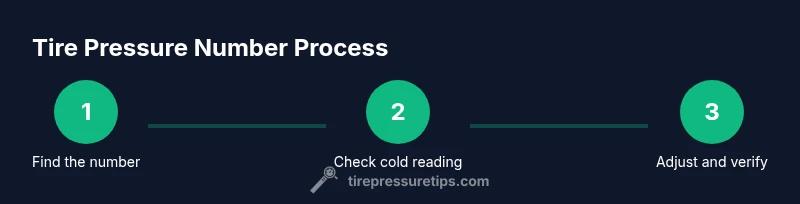
Find the tire pressure number
Locate the official tire pressure number on the door placard or in the owner's manual. Write down the value for cold tire readings and note whether it differs by axle or tire size. Have the vehicle parked away from direct sun and heat sources to avoid rapid pressure changes.
Tip: Keep a copy of the placard in your glove box for quick reference. - 2
Check that tires are cold
Ensure each tire has cooled for several hours before testing. If you’ve just driven, wait and recheck later. Hot tires read higher due to air expansion, giving a misleading result.
Tip: If you must check after a drive, wait at least 30 minutes for the tires to cool. - 3
Measure each tire
Remove each valve cap, press the gauge onto the valve stem firmly, and record the reading. Do this for all four tires (and the spare, if applicable). Replace caps after testing to keep out dirt.
Tip: Record the values in a notebook or app for ongoing tracking. - 4
Compare with the tire pressure number
If any tire reads below the target, add air in small increments and recheck. If above, release air gradually until you reach the target. Do not chase the maximum capacity printed on the tire sidewall.
Tip: Make small adjustments and recheck to avoid overshooting. - 5
Adjust if necessary for conditions
If you regularly drive with heavy loads or high speeds, refer to the manufacturer’s guidelines for those scenarios. Use the tire pressure number as your baseline, then apply recommended adjustments for load or speed.
Tip: Consult your vehicle manual for any special case guidance. - 6
Recheck after adjustments
After adding or releasing air, recheck all tires to confirm they are at the target number. Reinstall valve caps and clear any TPMS warnings if needed.
Tip: Always recheck to confirm no leaks or slow losses occurred. - 7
Create a maintenance cadence
Set a monthly reminder to inspect tire pressure and adjust as needed, especially during seasonal temperature shifts. Include warm-up and cooldown considerations in your routine.
Tip: Pair tire pressure checks with regular tire rotation or maintenance visits.
Frequently Asked Questions
What is the tire pressure number?
The tire pressure number is the manufacturer’s recommended cold inflation pressure for your tires. It isn’t the maximum sidewall pressure, but a target intended to balance safety, handling, and efficiency.
The tire pressure number is the car maker’s recommended cold inflation pressure for your tires.
How often should I check tire pressure?
Check at least once a month and before long trips. Check more often in extreme temperatures or when carrying heavy loads.
Check tire pressure at least monthly and before long trips.
Do TPMS alerts mean I should inflate to the tire pressure number?
TPMS alerts indicate abnormal pressure. Verify with a gauge and adjust toward the tire pressure number on the placard.
If TPMS warns, check pressure with a gauge and adjust to the recommended number.
Can I use the tire’s maximum sidewall pressure as the target?
No. The maximum printed on the sidewall is not the target for everyday use. Follow the vehicle’s tire pressure number.
Don’t inflate to the max; follow the vehicle’s recommended pressure.
Does load or speed change the tire pressure number?
Load and speed can influence optimal pressure. Use the manufacturer’s guidance for those conditions and revisit the base number when loading changes.
Loads and speeds can affect pressure; adjust per guidance.
Should I check tire pressure in hot vs cold conditions?
Check when tires are cold for the most accurate reading. Temperature changes will affect readings, so adjust readings accordingly.
Check cold for accuracy; temperature shifts readings.
Are spare tires included in the tire pressure number?
Spare tires often have their own recommended pressure. Check the spare’s label or manual to inflate correctly.
Spare tires can have a different number; verify.
Watch Video
What to Remember
- Know the tire pressure number and where to find it
- Check tires when cold for accurate readings
- Adjust to the manufacturer’s target and recheck
- Maintain a monthly pressure-check routine