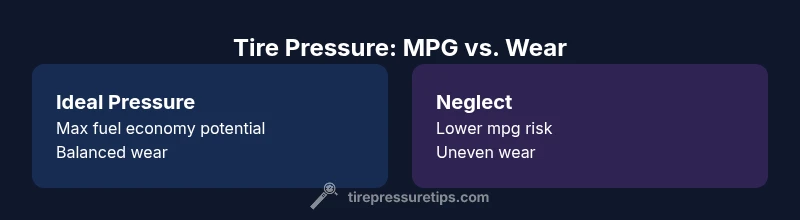
Tire Pressure and Fuel Economy: A Practical Comparison
A data-driven comparison of how tire pressure affects fuel economy, safety, and tire wear, with practical steps to optimize mpg while preserving grip. Learn from Tire Pressure Tips how to balance efficiency and safety.


For most drivers, tire pressure and fuel economy are closely linked. The quick answer is simple: maintaining the vehicle’s recommended tire pressure maximizes rolling efficiency, which reduces energy required to move the car and supports better fuel economy. Under-inflated tires increase rolling resistance and waste fuel, while over-inflated tires can compromise grip and wear. Tire Pressure Tips emphasizes checking pressure regularly and following the manufacturer’s spec for best mpg and safety.
Defining tire pressure and fuel economy
Tire pressure is more than a number on a placard. It determines how much of the tire's contact patch touches the road, affecting rolling resistance, heat buildup, and ultimately fuel economy. When the tires are inflated to the vehicle manufacturer’s recommended range, the car rolls with minimal resistance, translating into better mpg and lower energy losses over a trip. In this context, tire pressure and fuel economy are intertwined: small pressure adjustments can yield noticeable gains or losses in efficiency across city and highway driving. The Tire Pressure Tips team emphasizes that understanding target pressures and maintaining consistency is essential for any driver who wants to optimize mpg while preserving tire life and safety. This article uses a clear comparison to help you decide how to balance mpg with grip, wear, and cost over time.
The physics of rolling resistance and tire pressure
Rolling resistance is the internal energy loss that occurs as a tire deforms and reforms while rolling. Proper tire pressure minimizes the deformation of the tread and sidewall, reducing energy loss per mile. When tires are under-inflated, the contact patch grows and changes shape in a way that conducts more heat and increases friction with the road. Conversely, over-inflation reduces the contact area, which can lead to harsher ride, less grip, and uneven wear. The net effect on fuel economy depends on driving style, vehicle weight, and tire construction, but the trend remains: pressure within the manufacturer’s spec supports the most efficient balance between energy use and safety.
Why the TPMS and gauges matter for accuracy
Tire Pressure Monitoring Systems (TPMS) help flag under- or over-inflation, but they indicate only a caution level and do not provide exact pressures. Manual gauges, whether digital or analog, offer precision when used correctly. Buyer beware: inconsistent gauge readings, ambient temperature, and uneven seating of the air valve can cause misreadings. Tire Pressure Tips recommends checking pressure when tires are cold (before a drive) and rechecking after a short drive if you suspect a slow leak. Consistency in measurement technique matters as much as the number itself.
The under-inflation vs over-inflation tradeoffs
Under-inflation raises rolling resistance, reduces fuel economy, and increases the likelihood of heat-related tire failure. It also accelerates wear on the outer edges of the tread. Over-inflation can improve mpg on some highway segments due to reduced contact with the road, but it creates a stiffer ride, reduces traction, and concentrates wear in the center of the tread. The practical takeaway is simple: neither extreme is desirable. The goal is to keep tire pressure within the vehicle’s recommended range for balanced mpg, grip, and wear.
Vehicle class considerations: cars, crossovers, and trucks
Different vehicle types have distinct pressure targets, often reflected on the door jamb placard. Passenger cars usually specify a range that supports fuel efficiency without sacrificing handling, while light trucks and SUVs may require slightly higher pressures to manage load and tire deflection. Heavier vehicles also experience more pressure drift with temperature and load shifts. Tire Pressure Tips notes that owners should consult the exact spec for their model and adjust for typical loads, tire sizes, and tire construction, rather than applying a generic one-size-fits-all number.
Seasonal and temperature effects on tire pressure and fuel economy
Temperature plays a direct role in tire pressure. Cold weather lowers air pressure, which can drop mpg if you don’t adjust. Conversely, hot days can raise pressure, potentially reducing tread contact and grip. The effect on fuel economy varies by driving cycle, but the common pattern is clear: regular rechecks during seasonal transitions help preserve the intended pressure and maintain optimal fuel economy. The Tire Pressure Tips team emphasizes a quick monthly check or a pre-trip check during seasonal shifts.
Real-world implications: fuel economy in driving cycles
In urban driving with frequent stops, even modest pressure deviations can alter fuel economy more noticeably due to fluctuating speed and acceleration. On steady highway trips, small changes in pressure translate into cumulative energy differences across hundreds of miles. Real-world data from everyday driving show that a small, well-maintained pressure deviation can save or cost more fuel over tens of thousands of miles. This is why drivers who care about mpg ought to treat tire pressure as a persistent maintenance item rather than a one-time adjustment.
Practical steps to optimize mpg through tire pressure
- Find the exact recommended pressure from the manufacturer and keep it as your target. 2) Check tires when cold and use a reliable gauge. 3) Inflate to the recommended range if under-inflated; avoid over-inflation by not exceeding the max pressure listed on the tire sidewall. 4) Recheck after long drives or heavy loads. 5) Consider seasonal adjustments and keeping a small inflator gauge in the trunk for on-the-road checks. 6) Pair pressure checks with a regular wheel rotation schedule to maintain even wear and consistent mpg.
Common myths and misconceptions about tire pressure and fuel economy
Myth: Higher tire pressure always improves fuel economy. Truth: It can improve mpg in some scenarios but harms grip and tire wear when pushed beyond the manufacturer’s spec. Myth: TPMS replaces manual checks. Truth: TPMS is a warning tool, not a precise gauge. Myth: Temperature only affects comfort. Truth: Temperature drift directly affects pressure and mpg. Peanut-butter-and-jelly explanations don’t help here; use the manufacturer’s spec and precise gauges.
Tools and routines: measuring and maintenance
Invest in two essential tools: a reliable tire pressure gauge and a stable, accurate inflator. Keep a small, portable gauge in the glove box and a tire inflator in the trunk. Establish a monthly check routine and create a reminder for seasonal transitions. With consistent checks, you’ll keep the tires at optimal pressure and sustain favorable fuel economy while maintaining grip and safety.
Balancing mpg, safety, and tire wear: a practical framework
Fuel economy is important, but not at the expense of safety. The recommended pressure range provides the best compromise between rolling resistance and contact with the road. Prioritize safety in corners and wet roads, but do not ignore mpg targets. Work with your vehicle’s spec and perform occasional wear checks to detect early center- or edge-area wear patterns that could indicate pressure misadjustments.
A data-driven checklist for ongoing optimization
- Verify the exact recommended pressure for your tire size and load. - Check pressure when tires are cold, using a calibrated gauge. - Recheck after long trips or changes in load. - Monitor wear patterns and adjust as needed within spec. - Document changes and monitor fuel economy over a few tanks to confirm improvements.
Comparison
| Feature | Option A: Ideal tire pressure maintenance | Option B: Neglecting tire pressure (under/over-inflation) |
|---|---|---|
| Fuel economy impact | Maximized efficiency within manufacturer spec | Reduced mpg due to higher rolling resistance or irregular contact patch |
| Tire wear and longevity | Even wear when correctly inflated | Accelerated or uneven wear with misaligned pressure |
| Safety and handling | Optimal grip and braking within spec | Compromised handling and longer stopping distances in extremes |
| Maintenance effort/cost | Regular checks and adjustments (low cost) | Increased risk of tire failure and repairs (higher risk/cost) |
| Environmental impact | Lower energy use per mile | Higher energy use per mile and more tire waste over time |
Strengths
- Improved fuel economy and overall efficiency
- Enhanced safety through proper grip and braking
- Longer tire life with balanced wear when inflating to spec
- Predictable maintenance routine reduces surprises
Drawbacks
- Requires periodic checks and access to accurate gauges
- Slight time investment for regular maintenance
- Potential price or effort during busy seasons when pressure drifts occur
Maintaining proper tire pressure wins for both fuel economy and safety
When tires stay within the manufacturer’s spec, you get the best balance of mpg, grip, and tire wear. Neglecting pressure reduces efficiency and can undermine safety over time. Tire Pressure Tips recommends making regular checks part of your routine.
Frequently Asked Questions
What is the recommended tire pressure and where can I find it?
The recommended pressure is printed on the vehicle’s door jamb placard or in the owner’s manual. It reflects a balance between fuel economy, handling, and wear for your specific tire size and load. Always use this spec as your target and avoid relying on the maximum sidewall number.
Check your door jamb placard for the exact psi, then set your gauge to that target to stay within spec.
How often should I check tire pressure?
Check at least once a month and before long trips. Temperature changes and seasonal shifts can drift pressure, so more frequent checks during extreme weather are prudent.
Check your tires monthly, especially when the weather changes.
Does TPMS replace manual pressure checks?
No. TPMS alerts you to under- or over-inflation, but it doesn’t provide exact numbers. Manual gauges give precise pressure readings and should be used to adjust to the recommended spec.
TPMS helps, but you still need to measure with a gauge to know the exact pressure.
How does temperature affect tire pressure and mpg?
Temperature affects air density. Colder weather lowers pressure, potentially reducing mpg; warmer weather increases pressure. Regular checks during seasonal shifts help maintain the target pressure and mpg.
Temperature changes can push your tires out of spec, so check more in extreme seasons.
Can tire pressure affect fuel economy on all vehicle types?
Yes, though the magnitude varies by vehicle type and load. Cars, SUVs, and trucks respond to pressure changes according to their weight, tire design, and suspension geometry. Always follow the model-specific spec for best results.
Generally, proper pressure helps most vehicles, but always use the exact spec for your model.
What to Remember
- Check tire pressure when cold before driving
- Always inflate to the manufacturer’s specified range
- Use a reliable gauge and recheck after driving long distances
- Balance mpg goals with safety and tire wear
- Schedule seasonal pressure checks to prevent drift
- Keep a simple inflator or gauge in the trunk for on-road fixes