How Tire Pressure Affects MPG: An Analytical Guide
Explore how tire pressure influences fuel economy, the science behind rolling resistance, and practical steps to optimize inflation for better mpg and safety. Learn from Tire Pressure Tips with data-backed guidance for real-world driving.


How much does tire pressure affect mpg? In general, tire pressure has a measurable effect on fuel economy, primarily through rolling resistance. Under-inflated tires raise rolling resistance and can lower mpg by a few percent, while over-inflated tires can reduce efficiency due to changes in contact patch and handling. The exact impact varies by vehicle, load, driving style, and temperature, but keeping to the recommended psi minimizes unnecessary losses.
How much does tire pressure affect mpg?
Tire pressure has a measurable influence on fuel economy, primarily through rolling resistance and the size of the contact patch. According to Tire Pressure Tips, maintaining the manufacturer’s recommended psi is the simplest, most reliable way to avoid unnecessary losses in mpg. The relationship is real but modest for most everyday driving; expect the effect to be in the single-digit percentage range for typical pressure deviations, with larger impacts under extreme under- or over-inflation. The exact change depends on the vehicle, its load, your driving style, and the environment (temperature, road conditions, and tire type). For most drivers, the goal is simple: keep tires at or near the recommended pressure to maximize mpg while preserving safety and tire life.
The physics behind rolling resistance and mpg
Rolling resistance is the force resisting the motion of a rolling tire. It increases when a tire is under-inflated because the tread wears unevenly and the contact patch grows, causing more deformation as the tire rolls. Conversely, over-inflation reduces the contact patch, which can lower rolling resistance but also harms grip, ride comfort, and tread wear. The net effect on mpg is a balancing act between friction, energy lost in flexing the tire, and how the vehicle distributes weight across the road. Different tire constructions (tread pattern, width, and sidewall stiffness) respond differently to pressure changes, so the mpg impact is not identical across all vehicles.
Under-inflation: what happens to fuel economy
When tires are under-inflated, rolling resistance rises. This not only lowers mpg but can also lead to uneven wear, heat buildup, and reduced handling. The impact tends to grow with longer trips and heavier loads, where the tire carries more permanent deformation over time. In practical terms, a modest under-inflation can cost a few percent of mpg, and more extreme cases can compound fuel use. Beyond mpg, under-inflation poses safety risks, including reduced braking efficiency and poorer cornering.
Over-inflation: trade-offs between mpg and safety
Over-inflated tires spread less contact with the road, which can lower rolling resistance slightly but at the expense of traction, braking performance, and ride comfort. The mpg benefit is usually small and often outweighed by safety and wear concerns. In cold weather, over-inflation can be particularly problematic as pressures rise with temperature changes, making it even easier to exceed the recommended range. The key takeaway is that the ideal pressure is the vehicle manufacturer’s specification, not an arbitrary higher target.
Real-world factors that influence the effect
The mpg impact of tire pressure does not occur in a vacuum. Vehicle weight, aerodynamics, tire size and type (summer, all-season, or winter), inflation maintenance habits, and driving patterns (city vs. highway) all modulate the effect. Heavier loads increase rolling resistance, making accurate inflation more critical. Low rolling resistance tires may respond differently to pressure changes than conventional tires. Seasonal temperature shifts can also alter the air inside tires, changing psi and thereby mpg.
How to measure and maintain optimal pressure for mpg
Begin with the vehicle’s door jamb sticker or the owner’s manual to identify the recommended psi for front and rear tires. Use a reliable gauge—digital or analog—and check when tires are cold, ideally before a drive. Check pressure monthly and before long trips. If you notice a discrepancy between TPMS readings and your gauge, investigate for slow leaks or a faulty sensor. Keep tires inflated to the specified range and adjust for load and temperature as needed. Regular checks are a small, high-value habit for mpg and safety.
Seasonal and temperature considerations and how to adapt
Temperature affects tire pressure: cold air reduces psi, while hot conditions can raise it. A drop of a few psi due to cold weather can meaningfully impact mpg, especially for sensitive vehicles or high-performance tires. In winter, check tire pressure more often and adjust to the cold-weather pressure targets from the manufacturer. In very hot climates or after long highway runs, recheck to ensure pressure remains within the recommended range.
Practical tips to maximize mpg through tire pressure
- Check pressure monthly and before trips, using the recommended psi as the target.
- Use TPMS readings as a guide, but verify with a quality pressure gauge.
- Adjust pressure for load if you frequently carry heavy cargo or passengers.
- Consider seasonal changes and temperature when planning long drives.
- Pair proper inflation with regular tire rotation and alignment for overall efficiency.
MPG impact by tire pressure scenarios
| Scenario | Estimated mpg impact | Notes |
|---|---|---|
| At/near recommended pressure | Baseline (0% change) | Best overall efficiency and safety |
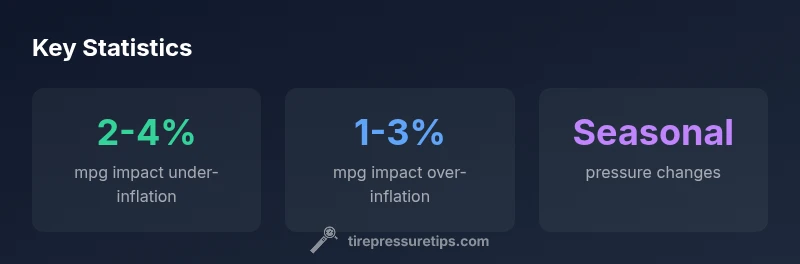
| Under-inflated by 15% | 2-5% decrease | Higher rolling resistance, more heat |
| Over-inflated by 10% | 1-3% decrease | Reduced grip and uneven wear |
| Cold weather drop in pressure | Additional small changes | Check pressure when temperatures fall |
| Loaded vehicle with heavy cargo | Impact varies | Increased load amplifies pressure sensitivity |
Frequently Asked Questions
Does low tire pressure affect mpg?
Yes. Low tire pressure increases rolling resistance, which can reduce mpg. The effect depends on how far the pressure deviates from the recommended level and on driving conditions. Regular checks help minimize this loss.
Yes. Low tire pressure can lower mpg due to higher rolling resistance. Check your tires regularly to keep mpg steady and safety high.
How often should I check tire pressure?
Check tire pressure at least once a month and before long trips. Temperature changes and load can shift pressure, so periodic checks help maintain mpg and safety.
Check your tire pressure monthly and before long trips to keep mpg and safety optimal.
Can TPMS replace manual checks?
TPMS is a helpful alert system but is not a perfect substitute for manual checks. Sensors may lag or be slow to respond to rapid changes in temperature or load. Always verify with a gauge when in doubt.
TPMS helps, but you should still manually check pressure with a gauge when you suspect a change.
Does cold weather affect tire pressure and mpg?
Yes. Colder temperatures lower tire pressure, which can reduce mpg. Recheck pressures when temperatures drop, and return to the recommended range once tires warm up.
Cold weather can lower tire pressure and mpg, so recheck pressure when it gets colder.
Will inflating beyond recommended pressure improve mpg?
Inflating beyond the recommended pressure can slightly reduce rolling resistance but often harms grip, tire wear, and safety. Stick to the manufacturer’s specification for optimal mpg and safety.
No. Over-inflating not only risks safety but can negate any tiny mpg gains.
“Maintaining the vehicle’s recommended tire pressure is a simple, impactful way to improve mpg and safety. The Tire Pressure Tips Team recommends checking tire pressure monthly and before long trips.”
What to Remember
- Maintain tires at the vehicle’s recommended psi.
- Under-inflation harms mpg more than mild over-inflation.
- TPMS helps, but manual checks are essential.
- Temperature and load amplify pressure effects on mpg.
- Check pressure monthly and before long trips.