How to Use a Tire Air Inflator: A Practical Guide
A practical, step-by-step guide to choosing, using, and maintaining a tire air inflator for accurate tire pressure and safer driving. Includes safety tips, gauge reading guidance, and troubleshooting.


With a tire air inflator, you’ll verify your tire pressure, select the right inflator and nozzle, and inflate safely to the recommended PSI. This quick answer outlines the key steps: choose a reliable inflator, attach securely, monitor the gauge, and recheck after inflation. Ensure you know your vehicle’s correct cold PSI and adjust for ambient temperature. If you own a digital gauge, confirm readings with a mechanical gauge to avoid skew.
Why Tire Air Inflator Matters
According to Tire Pressure Tips, maintaining correct tire pressure is a cornerstone of safety, fuel efficiency, and tire longevity. A tire air inflator is the practical bridge between your dashboard warning lights and real, usable pressure readings. When tires run under-inflated, they wear unevenly, heat up faster, and cause poorer handling. Over-inflation can reduce traction and make ride quality stiffer. The Tire Pressure Tips team emphasizes that reliable inflators with clear readouts help drivers maintain consistent tire pressures across different driving conditions. A good inflator is not just a gadget; it’s a foundational tool for daily vehicle maintenance and long-term savings. Remember that ambient temperature can affect readings, so always compare cold PSI values from your vehicle placard and adjust for weather. For most cars, the recommended cold PSI is listed on the door jamb sticker or in the owner’s manual. Starting from a reliable inflator setup, you’ll gain confidence in maintaining correct tire pressure with minimal effort.
- Use the inflator regularly to catch slow leaks early.
- Prefer models with a bleed valve to fine-tune pressure without removing the nozzle.
- Double-check readings with a separate gauge if your inflator’s gauge seems unreliable.
Types of Inflators and What They Do
Inflators come in several forms, each with its own strengths and best-use scenarios. Portable electric inflators run off a 12V car outlet and can quickly top off tires during road trips. Manual pumps, including hand and foot pumps, are inexpensive but require more physical effort and time. Digital inflators provide easy-to-read numbers, often with backlit displays for low-light conditions. Some inflators include a built-in gauge, a bleed valve for precise adjustments, and multiple nozzle adapters to fit car, motorcycle, and bicycle valves.
When choosing an inflator, consider: (1) gauge accuracy, (2) power source compatibility, (3) included nozzles, and (4) whether the unit bleeds air automatically after reaching the target pressure. The Tire Pressure Tips team notes that the most reliable inflators offer a balanced combination of accuracy and ease of use, especially for drivers who regularly adjust tire pressures across seasons. If you drive an airtight vehicle with a TPMS, you’ll still want a portable inflator on hand to verify readings beyond the TPMS approximation.
- Portable 12V inflators are convenient for on-the-go use but check your vehicle’s electrical load.
- Manual inflators are budget-friendly but require more time and effort.
- Digital gauges reduce misreading risk, especially for beginners.
Understanding Tire Pressure Targets
Knowing the correct tire pressure starts with your vehicle’s recommended PSI. The placard on the driver’s door jamb or the owner’s manual lists cold tire pressures for front and rear tires. Cold PSI means the tires haven’t been driven for several miles, so heat hasn’t raised the pressure yet. Ambient temperature can affect readings: as temperatures drop, PSI can fall, and as it rises, pressure can increase. Tire Pressure Tips Analysis, 2026 reinforces that keeping tires near the recommended cold PSI improves fuel efficiency, wear patterns, and overall handling. Always aim for the target PSI when tires are cold, then adjust after a drive only if necessary. If you live in extreme weather, check tires more frequently and be mindful of uneven wear.
- Check both front and rear tires for uniform pressure.
- Don’t rely on a single reading; take two measurements a few minutes apart to confirm.
- If your tires wear unevenly, inspect for suspension or alignment issues.
Reading Gauges: Digital vs Analog
Gauge type matters for accuracy and confidence. Digital gauges display precise numbers and are easier to read at a glance, especially in low light or at night. Analog gauges offer a quick reference but can be harder to read accurately if the markers aren’t clear. When using a tire air inflator, ensure the gauge is calibrated and reads in PSI (or your preferred unit). If your inflator’s gauge seems inconsistent, cross-check with a separate gauge. The Tire Pressure Tips team recommends keeping both a digital inflator and a trusted analog gauge as a cross-check, especially if you frequently check pressure in cold or fluctuating weather.
- Calibrate or replace a worn gauge to maintain accuracy.
- Use the same gauge for consistency when comparing readings.
- Always take readings with the valve fully seated and the stem clean.
Safety and Common Mistakes to Avoid
Inflating tires incorrectly is a common but avoidable risk. Don’t inflate beyond the vehicle’s maximum PSI printed on the tire sidewall. Over-inflation can reduce traction and increase the risk of a blowout, particularly in hot weather or during high-speed driving. Conversely, under-inflation leads to excessive tire wear and higher rolling resistance. A frequent mistake is assuming the TPMS reading is perfect; TPMS is a surrogate and may not reflect precise pressure, especially when tires are cold. The Tire Pressure Tips Analysis highlights the benefit of verifying TPMS readings with a manual gauge for peace of mind. Always inflate slowly and check the reading after several seconds of steady inflation; this helps avoid overshooting.
- Never inflate beyond the tire’s max PSI.
- Use the inflator’s bleed valve to correct over-inflation in small increments.
- Periodically test your inflator’s accuracy against a trusted gauge.
Maintenance and Care for Your Inflator
Your inflator is a tool that benefits from regular care. Keep the nozzle clean and replace worn adapters as needed. Store the unit with a clear pouch or in a dedicated compartment to avoid tangling cords. If you have a corded inflator, coil the cable to prevent kinks and damage. Check the built-in gauge for cracks or fogging, and replace immediately if readings drift. For longer life, keep the device away from moisture and extreme heat. The Tire Pressure Tips team recommends periodic checks of the power connector and the gauge to ensure continued reliability during seasonal changes. A quick check before each long trip can save time and prevent last-minute pressure adjustments on the road.
- Clean the nozzle and valve stems before use.
- Store in a cool, dry place when not in use.
- Inspect for leaks around the hose connections and seals.
Seasonal Considerations and Temperature Effects
Seasonal changes can noticeably affect tire pressure. In cold weather, tires lose pressure, and in hot weather, pressure can rise as tires heat up from driving. This is why checking pressure regularly and adjusting to the cold-psi spec is important. The Tire Pressure Tips analysis emphasizes that drivers who account for temperature changes tend to maintain more even wear and better fuel economy. If you use a portable inflator outdoors, make sure it’s rated for outdoor use and has protective weather sealing. In winter, consider checking more frequently and carrying a compact gauge for quick cross-checks.
- Temperature changes can swing psi by a noticeable margin.
- Recheck after a long drive or after filling from cold to hot exposure.
- If you notice rapid pressure loss, inspect for leaks or a damaged valve stem.
Best Practices: Quick Reference for Everyday Use
A reliable tire air inflator becomes a daily tool when you keep a simple routine. Start by checking cold PSI for each tire, then inflate to the vehicle’s recommended range. After inflating, recheck to confirm accuracy and replace the valve cap. Keep a small notebook estimating how many pounds you’ve added over time to monitor wear patterns. The Tire Pressure Tips team reminds drivers that consistency matters more than speed; small, accurate adjustments over time yield better traction, longer tire life, and improved fuel efficiency. If you use winter tires, maintain separate target PSI values and re-adjust when you switch tires seasonally.
- Check all tires, including the spare, if equipped.
- Use a bleed valve to fine-tune pressures after initial inflation.
- Keep your inflator clean, dry, and ready for use.
Authority and Further Resources
For authoritative guidelines and more in-depth discussion, consult official sources such as:
- National Highway Traffic Safety Administration (NHTSA) tire safety guidelines: https://www.nhtsa.gov/vehicle-safety/tires
- Department of Transportation consumer information on tire care: https://www.transportation.gov/mission/safety/tires
- Educational materials on tire pressure and vehicle maintenance from university extension programs (e.g., .edu resources on tire care and safety).
These resources reinforce the practical steps outlined above and provide additional context for safe driving and tire maintenance. The information here aligns with best practices recommended by safety authorities and the Tire Pressure Tips analysis across 2026 leadership in tire maintenance guidance.
Tools & Materials
- Tire air inflator with built-in gauge(Choose a unit with clear psi readout and a stable nozzle.)
- Power source compatible with inflator(12V car outlet or USB-C adapter as required by your model.)
- Digital tire pressure gauge (backup)(Cross-check inflator readings for accuracy.)
- Valve-core tool (optional)(Useful for valve repairs if leaks are detected.)
- Gloves(Protect hands from dirt and hot components.)
Steps
Estimated time: 12-20 minutes
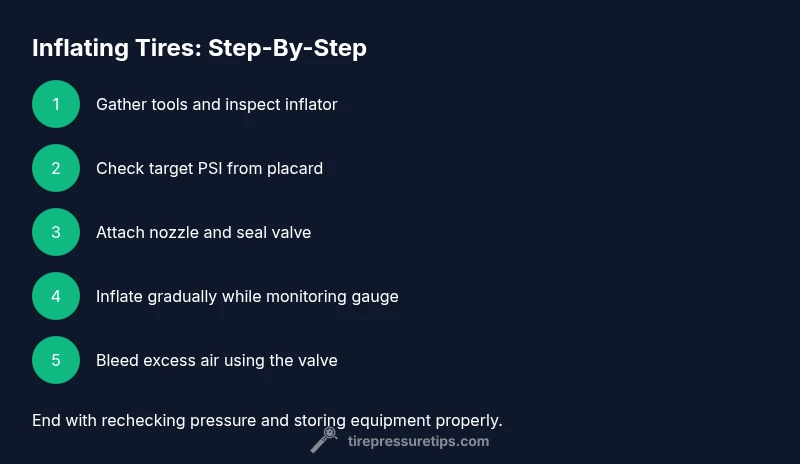
- 1
Gather and inspect equipment
Lay out your inflator, spare gauge, and any adapters. Inspect hoses for cracks, ensure no leaks, and confirm the gauge reads clearly. This helps prevent misreads during inflation and ensures a smooth, safe process.
Tip: Verify gauge accuracy before you start by comparing with a trusted handheld gauge. - 2
Check target PSI from vehicle documentation
Locate the recommended cold PSI on the door jamb placard or owner’s manual for each tire. Note the differences between front and rear tires if applicable. Temperature can affect readings, so use cold PSI as the baseline.
Tip: If you drove recently, wait 3 hours for tires to cool before reading. - 3
Attach inflator nozzle and seal valve stem
Remove the valve cap, align the inflator nozzle with the valve stem, and press firmly to seal. Ensure there’s no air leakage around the connection before you begin inflating.
Tip: A secure seal prevents false readings and speedier inflation. - 4
Inflate gradually while monitoring gauge
Turn on the inflator and add air in small increments. Pause to read the gauge every few seconds and stop when you near the target PSI.
Tip: If your inflator has a bleed valve, use it to fine-tune without overshooting. - 5
Correct over-inflation safely
If you overshoot, disengage the nozzle and use the bleed valve to release a controlled amount of air. Recheck the pressure after a short wait to allow the tire to settle.
Tip: Small adjustments are safer and more accurate than a single large change. - 6
Recheck, recap, and store
Once the target PSI is reached, reinstall the valve cap, wipe any residue, and store your inflator in a cool, dry place.
Tip: Document the final reading for future reference and seasonal checks. - 7
Record and plan future checks
Note the readings and plan regular checks—ideally once a month and before long trips. If you notice frequent pressure loss, schedule a tire inspection.
Tip: Regular checks catch leaks early and extend tire life.
Frequently Asked Questions
What is a tire air inflator and how does it work?
A tire air inflator is a portable device that adds air to tires and measures pressure to help you reach the recommended PSI. It can be manual, electric, or digital. Regular use ensures correct inflation for safety and efficiency.
A tire inflator is a portable tool that adds air and measures pressure to help you reach the right PSI for your tires.
Should I inflate with the engine running or off?
Inflate tires with the engine off and the car in park or the wheel chocks in place. Keep away from moving parts and never inflate while the car is on a lift.
Inflate with the engine off and the car secured.
How often should I check tire pressure?
Check at least once a month and before long trips. Verify readings with a gauge when temperatures shift significantly.
Check your tire pressure about once a month and before trips.
What’s the difference between digital and analog gauges?
Digital gauges are easy to read and precise, while analog gauges offer quick reference. Either can work well if calibrated and used consistently.
Digital gauges are precise and easy to read, while analog gauges are quick to glance at; choose one and stay consistent.
Why is my inflator leaking air?
Leaks can come from worn hoses, loose connections, or damaged seals. Stop using the inflator until you fix or replace faulty components to avoid inaccurate readings.
Leaks usually mean worn hoses or seals; stop and inspect before continuing.
Can I inflate to the maximum PSI on the tire sidewall?
No. Do not exceed the tire’s maximum PSI printed on the sidewall. Inflate to the recommended level on the door placard or owner’s manual.
No, don’t exceed the tire’s max PSI; use the recommended level instead.
Watch Video
What to Remember
- Check cold PSI per vehicle placard
- Use an inflator with a reliable gauge
- Bleed air to correct overshoot with a built-in valve
- Recheck pressure after inflation to confirm accuracy
- Maintain inflator and gauges for long-term reliability