Sienna Tire Pressure Guide: TPMS, Checks & Maintenance
Sienna tire pressure guide: Learn to check, adjust, and maintain TPMS, with seasonal tips and a clear step-by-step routine to boost safety and fuel efficiency.


Master the sienna tire pressure checklist to keep your minivan safe and efficient. Start with the vehicle's recommended PSI from the owner’s door placard or manual, then check cold tires using a reliable gauge, adjust each tire to spec, and monitor TPMS alerts. Regular rotation and consistent pressures reduce wear, improve fuel economy, and boost handling.
Why sienna tire pressure matters
Maintaining the correct sienna tire pressure is essential for safety, handling, and longevity. When pressures are off, you risk unpredictable steering, longer stopping distances, and uneven wear. The Tire Pressure Tips team emphasizes that staying aligned with the vehicle’s recommended PSI protects passengers and can improve fuel efficiency, especially in a family minivan used for daily driving and road trips. Remember: tire pressures respond to temperature and load, so regular checks prevent surprises on the highway and ensure consistent performance. According to Tire Pressure Tips, driving with underinflated or overinflated tires changes contact patch and heat buildup, which increases risk of blowouts.
How to find the correct psi for a Toyota Sienna
The best source of the exact psi for your Sienna is the door jamb placard and the owner's manual. These values can vary by trim, wheel size, and whether the vehicle is carrying a heavy load or traveling in extreme temperatures. Start with the placard when tires are cold, and refer to the manual for advisory differences between front and rear tires. If your tires are older or you’ve replaced them, confirm that the replacement tires have compatible load and speed ratings, otherwise adjust only under professional guidance. Using a pressure gauge, compare readings to the placard, and remember that seasonal temperature changes can temporarily shift psi.
Tools and gauges you need
For accurate sienna tire pressure checks, assemble a simple kit: a reliable tire pressure gauge (digital preferred for readability), an air compressor or access to a gas station pump, and access to the owner’s manual or placard. Optional but useful: a cloth to wipe stems and a small flashlight for low-light checks. Keep the gauge in your glove compartment and replace batteries as needed. Having these tools on hand makes it easy to perform quick checks during road trips or monthly maintenance windows.
Interpreting TPMS and sensor basics
Tire Pressure Monitoring Systems (TPMS) help by alerting when a tire drops below the recommended pressure, but the warnings are not a substitute for manual checks. Direct TPMS uses sensors inside each tire to report actual pressure, while indirect TPMS estimates pressure based on wheel speed and ABS data. Either way, treat a TPMS alert as a reminder to inspect all tires, not a license to drive with uncertainty. If you notice a persistent TPMS fault, consult a professional as soon as possible. Regular manual checks complement TPMS by confirming the actual psi in each tire.
Seasonal and load-related adjustments without guessing
Seasonal temperature swings can cause tires to gain or lose pressure. Heavy loads, towing, or long highway trips can also change the required psi. The core idea is to start from the placard values when tires are cold and re-check after a drive only if you suspect a significant change due to weather or load. Adjustments should be small and incremental, ensuring you stay within the vehicle's recommended range. Keep a note of any frequent changes and inspect tires for wear as part of your routine.
Common mistakes and how to avoid them
Common errors include checking hot tires, using an inaccurate gauge, inflating to feel rather than to spec, and ignoring uneven wear patterns. Another pitfall is inflating one tire to match the others when load distribution requires different pressures. Also, never rely on visual cues alone—tire sidewalls can look fine but still be underinflated. Stick to the placard values and verify with a gauge before and after inflation.
Maintenance routine you can actually stick to
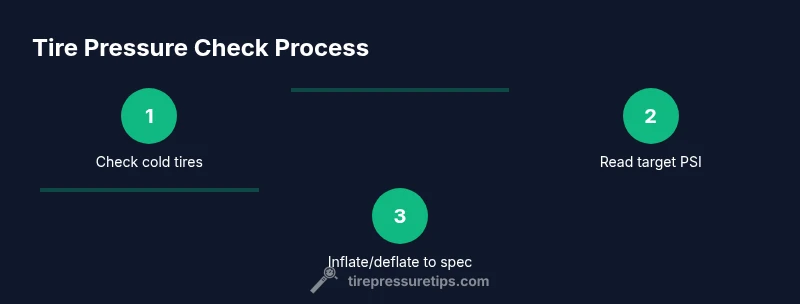
Create a simple monthly routine: 1) check all tires when cold, 2) compare readings to placard values, 3) inflate or deflate as needed in small increments, 4) re-check after the vehicle has cooled for a few minutes, and 5) inspect tires for wear and tread depth. Keep a small notebook in the glovebox or a mobile note reminding you to verify TPMS status. This habit improves safety, fuel economy, and tire life over the long term.
Spare tire pressure and why it matters
The spare tire is part of the overall system, and its pressure can differ from the road tires. If your spare is a full-size tire, check it using the same method you use for road tires; if it’s a compact temporary spare, ensure it is inflated according to the vehicle’s instructions. Regularly inspect the spare for cracks or weather-related damage, especially if the vehicle is stored for extended periods. Having the spare in proper condition can save you time and stress in an emergency.
Quick inflation tips and safety reminders
When inflating, do so in short bursts and re-check the pressure to avoid overinflation. If you notice a sudden drop in pressure, check for punctures and seek service. Always replace valve caps after checking and use gloves or a cloth to avoid contamination. Finally, remember that TPMS assists, but it does not replace the need for manual checks at regular intervals, especially during seasonal changes.
Tools & Materials
- tire pressure gauge(digital preferred for readability; ensure accuracy within ±1 psi)
- air compressor or access to gas station air pump(use when tires are cold; avoid inflating hot tires)
- owner's manual or placard(contains exact psi values by tire and load)
- rag or cloth(wipe valve stems for clean readings)
Steps
Estimated time: 15-25 minutes
- 1
Park and verify tires are cold
Park on a level surface and wait at least 3 hours after driving before checking pressure. Cold tires give the most accurate readings and prevent inflating beyond spec due to heat.
Tip: If you must check before a trip, avoid driving for several hours prior to check or plan to verify again after cooling. - 2
Locate the target PSI on placard/manual
Find the recommended PSI for each tire from the door placard or owner’s manual. Note any differences between front, rear, and spare tires depending on load or trim.
Tip: Write the values down or take a photo for quick reference during inflation. - 3
Remove valve cap and prepare gauge
Take off the valve cap from the tire you’ll check. Keep the cap somewhere handy so it doesn’t get lost and ensure the gauge is ready to read.
Tip: Inspect the valve stem for damage or leaks while the cap is off. - 4
Read current PSI with gauge
Firmly place the gauge on the valve stem and read the displayed pressure. Compare to the target value from placard/manual for that tire.
Tip: If readings vary markedly between tires, consider recalibrating your gauge or replacing it. - 5
Inflate or deflate to target
Add air in small increments or release air as needed until the reading matches the target. Recheck after a short wait to ensure it stabilizes.
Tip: Inflate in 1-2 psi increments and recheck; avoid overshooting the target in one step. - 6
Check all tires (including spare if feasible)
Repeat steps 3–5 for every tire. If your spare is a full-size tire, check it as well; for a temporary spare, follow the vehicle’s instructions.
Tip: Inspect tread and sidewalls for damage while you’re at each tire. - 7
Reinstall valve caps and recheck
Replace all valve caps securely and perform a final quick scan of all tires to confirm consistency across the set.
Tip: A final 1–2 minute check right after finishing helps catch any slow leaks.
Frequently Asked Questions
What is the best way to determine the correct sienna tire pressure?
Refer to the door placard or owner's manual for exact PSI values, which vary by tire size, trim, and load. Use a reliable gauge and check when tires are cold.
Check the door placard for the exact PSI and use a gauge when the tires are cold.
How often should I check sienna tire pressure?
Check monthly and before long trips. Temperature changes and heavy loading can necessitate more frequent checks.
Check monthly and before trips; seasonal changes may require more frequent checks.
Does TPMS replace manual tire pressure checks?
No. TPMS alerts you to low pressure, but you should still measure with a gauge to confirm the actual PSI in each tire.
TPMS helps, but you should still check with a gauge.
What should I do if the TPMS warning stays on after inflation?
Recheck all tires and ensure they are at the placard values. If the light remains on or readings seem off, have the system inspected by a professional to check sensors or wheel alignment issues.
If the light stays on, inspect all tires again and consult a professional if readings remain inconsistent.
Can I inflate tires beyond the placard for winter changes?
Always stay within the placard values. Seasonal temperature changes do not justify exceeding the recommended range.
Never exceed the placard; follow seasonal guidance within those limits.
Is it safe to drive with a tire that's slightly underinflated?
Short-term driving with slight underinflation is possible but risks heat buildup, uneven wear, and reduced fuel efficiency. Inflate to spec as soon as safe.
It’s not ideal; inflate to the recommended PSI as soon as you can.
Watch Video
What to Remember
- Check cold tires against placard values
- Use a reliable gauge for accuracy
- Regularly monitor TPMS and confirm manually
- Rotate tires and maintain even pressures