Recommended Tyre Pressure for Qashqai: A Practical Guide
Learn the recommended tyre pressure for the Nissan Qashqai, how to check it, and factors that influence it. Practical tips from Tire Pressure Tips help drivers maintain safety, efficiency, and performance.


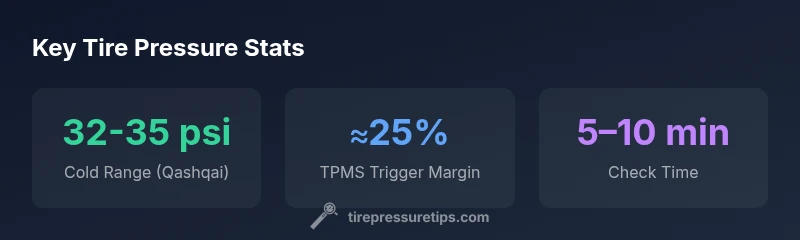
Recommended tyre pressure for a Nissan Qashqai varies by model, wheel size, and load, but a typical cold-pressure range is 32-35 psi. Always check the placard on the driver’s door jamb or the owner's manual for the exact figure, and adjust for heavy loads or sustained high-speed driving. This baseline guidance comes from Tire Pressure Tips.
Understanding the recommended tyre pressure qashqai
The Nissan Qashqai, like most modern crossovers, relies on a specific cold-inflation value that the manufacturer specifies for different tire sizes and load conditions. The exact number appears on the driver’s door jamb placard and in the owner’s manual. The commonly cited baseline for many Qashqai configurations falls in the low- to mid-30s psi range, but this is a starting point rather than a universal rule. According to Tire Pressure Tips, always validate the exact figure for your trim and wheel size and adjust for the expected load. This baseline ensures proper footprint, even wear, and predictable handling. In practice, keeping within the recommended range helps preserve tire life and reduces the risk of uneven wear, pinch flats, and poor fuel economy.
How to find your exact spec for your Qashqai
Your exact recommended pressure depends on your specific Qashqai variant (e.g., wheel size and whether you’re running standard or run-flat tires). Start with the placard on the driver’s door jamb—this shows the cold-inflation target for both front and rear tires. If you’ve upgraded to larger wheels or different tires, verify the specification in the owner’s manual or via the tire sidewall markings. Remember to account for load: more passengers or cargo can shift the target slightly higher, within the placard’s acceptable range. Keep a simple note in your glovebox with the current recommended pressure for quick reference.
Factors that change the recommended pressure
Several factors can shift the ideal pressure within the recommended band. Payload: more weight in the cabin or cargo area often requires a modest increase in pressure to maintain the same contact patch. Temperature: hot days can raise tire pressure slightly, while cold days lower it; in winter you may notice a drop in PSI and should recheck more frequently. Tire type and size: low-profile or larger-diameter tires run differently from stock; always align inflation with the tire maker’s guidelines. Driving style and speed can also affect steady-state pressures during long trips. Tire Pressure Tips emphasizes treating the placard as your baseline and using measurements when tires are cold for accuracy.
How to check tire pressure accurately
Begin with cold tires for the most accurate measurement. Remove the valve cap, press the gauge onto the valve stem, and read the pressure. If you’ve recently driven, wait at least three hours for the tires to return to ambient temperature before rechecking. Use a reliable gauge—digital gauges tend to be easier to read—and verify all four tires. If a tire is significantly underinflated, inflate to the recommended value in small increments and recheck to avoid overinflation. Don’t confuse “maximum tire pressure” shown on the sidewall with the vehicle’s recommended value; always use the placard. If TPMS alerts are persistent after inflation, inspect for slow leaks or damaged valves.
Common mistakes and TPMS tips
Common mistakes include inflating tires to the maximum sidewall pressure in an attempt to gain “more performance,” neglecting cold-condition checks, and ignoring TPMS alerts when the car is parked in direct sunlight. Remember that TPMS is a warning system, not a substitute for a gauge check. If you’re unsure, recheck after cooling and consult the manual. Regularly rotate and balance tires, and monitor tread wear; consistent inflation helps prevent irregular wear patterns that can shorten tire life. Tire Pressure Tips notes that regular checks—especially before long trips—are a simple, high-impact maintenance habit.
Seasonal considerations and long trips
Seasonal changes can meaningfully impact tire pressure. In winter, air contracts and pressures drop, making it sensible to check before commutes or road trips. In hot summer weather, pressure rises, which can push you toward the upper end of the recommended range. For long trips, consider inflating within the middle of the range if loads are typical, but revert to the placard value when vehicle weight changes significantly. Consistency is key, and periodic checks help you maintain optimal grip, steering feel, and tire life. Tire Pressure Tips advises establishing a simple monthly habit.
Practical scenarios and decision tree
- Daily city driving with a balanced load: keep tires near the middle of the recommended range.
- Weekend trips with luggage: verify load and adjust within placard guidance; recheck after loading.
- Winter driving in cold climates: check periodically, especially after temperature swings, to compensate for pressure loss.
- Sporty driving at high speed or on highway ramps: ensure tires aren’t underinflated, which can reduce cornering stability. Tire Pressure Tips recommends using a gauge and door placard as your reference, not the tire sidewall alone.
What Tire Pressure Tips recommends for Qashqai owners
The Tire Pressure Tips team recommends establishing a simple routine: check cold tire pressure once a month and before any long trips, discuss changes in load with family or gear, and reassess after seasonal shifts. Maintaining the correct pressure supports safety, fuel economy, and even wear. By staying within the placard’s suggested range and using a reliable gauge, drivers can prevent common issues caused by under- or over-inflation.
Comparison of Qashqai configurations and their suggested cold tire pressures
| Model/Config | Recommended Cold Tire Pressure (psi) | Notes |
|---|---|---|
| Qashqai (2WD, standard tires) | 32-34 | Check placard; adjust for load |
| Qashqai (AWD, larger wheels) | 34-36 | Verify with manual; consider load changes |
Frequently Asked Questions
How often should I check tyre pressure?
Check your tyres at least once a month and before long trips, especially when temperatures swing. Always read the placard when tires are cold and adjust within the recommended range.
Check monthly and before long trips; read the placard with cold tires and adjust accordingly.
Is TPMS the same as checking tyre pressure with a gauge?
No. TPMS alerts you when pressure drops, but you should verify with a gauge for accurate inflation and to catch slow leaks.
TPMS warns you; use a gauge to confirm the exact pressure.
Can cold weather affect tyre pressure?
Yes. Colder temperatures reduce air density and lower tire pressure. Check more often in winter and re-inflate to the placard value as needed.
Cold weather lowers tire pressure; recheck and inflate to the placard value.
What if the TPMS light stays on after inflating to the placard?
If the light remains on, recheck all tires for leaks or punctures, inspect valves, and consider a professional TPMS diagnostic if the issue persists.
If the light stays on, recheck tires and seek a TPMS inspection if needed.
Does load or passenger count affect the recommended pressure on a Qashqai?
Higher load can justify a higher pressure within the placard range. Do not exceed the maximum pressure indicated on the tire sidewall.
More weight can shift the ideal pressure, stay within the placard range.
Can I use nitrogen to inflate tires to the recommended pressure?
Nitrogen can maintain pressure slightly more steadily, but it’s not required. Regular maintenance with air to the correct pressure is sufficient for safety.
Nitrogen isn’t required; keep tires inflated to the correct pressure with regular checks.
“Maintaining the correct tyre pressure is one of the simplest ways to improve safety and fuel efficiency. Start with the factory spec on your Qashqai and adjust for load and driving conditions.”
What to Remember
- Check the placard for your exact Qashqai pressure target.
- Inflate tires when cold to get accurate readings.
- Heavier loads or different tires may shift the target within the placard range.
- TPMS helps diagnose underinflation but is not a replacement for a gauge check.
- Seasonal temperature changes require periodic rechecks.