Nissan Micra Tire Pressure Guide: Check, Adjust, and Maintain
Learn how to check, adjust, and maintain tire pressure on the Nissan Micra. Find the correct cold-pressure specs, understand TPMS readings, and follow step-by-step guidance for safer driving and better fuel efficiency.


Learn how to check and adjust tire pressure on a Nissan Micra to ensure safety, handling, and fuel efficiency. This guide covers where to find the exact cold-pressure spec, how to use TPMS readings, and step‑by‑step actions to adjust each tire, plus tips for load, weather, and maintenance.
Why proper tire pressure matters for the Nissan Micra
For the Nissan Micra, correct tire pressure is not just a number on a sticker; it affects handling, braking distance, tire wear, fuel economy, and ride comfort. When pressure is too low, the tire deforms at the contact patch, increasing rolling resistance and heat; when it's too high, the contact patch shrinks, reducing grip and comfort. The Tire Pressure Tips team notes that maintaining the recommended cold PSI helps preserve tire geometry, improves fuel efficiency, and reduces the risk of blowouts on highways. The Micra's compact design relies on precise tire behavior for predictable steering and safe cornering. Monthly checks, especially during temperature swings, are a small investment with big safety rewards. In this guide we translate the official numbers into practical, everyday steps you can perform in minutes. If you want to maximize safety and minimize wear, start here.
Find the exact Micra tire pressure specification
The official tire pressure specification for your Nissan Micra is not generic; it can differ by trim, wheel size, and load. The primary source is the door jamb placard, usually located on the driver's side pillar, but you may also find the same information in the owner's manual. In many Micra models, there are separate targets for front and rear tires and for different load conditions. If you can't access the placard, consult the service manual or contact a dealer. Regardless of where you read it, always use the cold-pressure value and adjust for seasonal temperature changes. For accuracy, record both the front and rear targets and keep them handy for quick checks before long trips or when you’re carrying extra cargo. According to Tire Pressure Tips, this careful approach underpins safe braking, good handling, and even tire wear.
Tools and prep: what you need before you start
Having the right tools saves time and reduces errors. A reliable tire pressure gauge is essential; digital gauges are easy to read and often include a memory function, but an analog stick gauge can be quicker. An air compressor or portable pump helps you reach the target quickly, especially if many tires are low after a long trip or cold snaps. Keep valve caps, a flashlight for low-light areas, and a simple logbook or app to track readings. Before you begin, locate the Micra's spec as described above and make sure your wheels are cold. If your car uses a run-flat tire or a space saver, note that some spares have different pressures. This preparation prevents multiple trips back to the air pump and helps you act confidently.
How to check tire pressure accurately on a Micra
Use a good gauge and read the pressure when the tires are cold. Remove the valve cap, press the gauge onto the valve stem firmly, and read the psi. If you notice a fluctuation, recheck with a second gauge to confirm accuracy. Record the reading and compare it to the official Micra spec. If the value is off, either add air (in small increments) or release air until you reach the target. Temperature affects readings, so treat readings on cool mornings as your baseline. After you reach the target, replace the valve caps and wipe away any spilled air from the rim.
How to inflate or release air to reach the target pressure
If the measured psi is below target, add air in small increments (2–3 psi at a time) until you reach the spec. If above, release air in small amounts and recheck each time. Avoid overinflating; over 3 psi beyond target can reduce grip and cause uneven wear. Recheck all tires after adjustments, since inflating one tire can alter the car's weight distribution slightly. If you’re using a portable pump, use the built-in gauge to minimize errors. It’s normal for pressures to drift slightly with driving, so plan a recheck after a short drive of 5–10 miles (8–16 km) to confirm stability.
Seasonal and load considerations for the Micra
Seasonal temperature changes have a noticeable effect on tire pressure. For every 10°C drop, tire pressure can fall by about 1–2 psi. Heavier loads, frequent highway driving, or winter conditions may require adjustments beyond the standard front/rear split. If you regularly carry passengers or cargo, you may need to adjust to the higher end of the recommended range to maintain optimal handling. The goal is to maintain consistent performance and even wear across tires, not to chase a single fixed number in every condition.
TPMS: understanding the tire pressure monitoring system
TPMS provides a valuable warning if a tire’s pressure deviates from the target. It’s not a replacement for checking with a gauge. If TPMS shows a warning but your gauges read within the recommended range, the sensor or its calibration may be faulty and require service. Conversely, if the gauge reads correctly but the TPMS shows a warning, inspect the sensor valve stem, battery, or wiring for faults. Regular cross-checks with a manual gauge help you interpret TPMS alerts accurately and avoid unnecessary tire servicing.
Long-term maintenance and quick daily checks
Make tire pressure a monthly habit, and check before long trips or seasonal transitions. Pair your checks with a quick visual inspection of each tire for cuts, bulges, or uneven wear. Keep the valve caps clean and tighten them finger-tight after readings. Maintain a small log of readings and the date to track trends and catch slow leaks early. If you notice persistent loss of air, seek professional inspection, as small leaks can indicate punctures or damaged valves. Keeping to a routine ensures you stay safe and maximize tire life.
Quick recap: why it matters and how to do it
Proper tire pressure on the Nissan Micra supports safe handling, efficient fuel use, and longer tire life. Always start with the official cold-psi specification, use a reliable gauge, and adjust in small steps. Don’t overlook seasonal changes or the TPMS; combine all sources for the most reliable result. With a simple monthly routine, you’ll enjoy better performance and fewer tire problems.
The Tire Pressure Tips perspective and practice
According to Tire Pressure Tips, a disciplined approach to tire pressure—grounded in the vehicle’s official spec and reinforced by TPMS readings—delivers tangible benefits in everyday driving. This aligns with practical maintenance habits that keep the Micra responsive and economical, especially in city traffic and variable weather.
Tools & Materials
- tire pressure gauge(prefer digital or stick gauge; ensure accuracy by calibration; use when tires are cold)
- air compressor or portable pump(for inflating tires; ideally with a built-in gauge)
- owner's manual / door jamb placard(contains the exact Micra tire pressure spec; front/rear may differ)
- flashlight(helps reading gauge in dim areas)
- notebook or app log(record readings and dates for maintenance history)
Steps
Estimated time: 60-90 minutes
- 1
Find the official Micra tire pressure spec
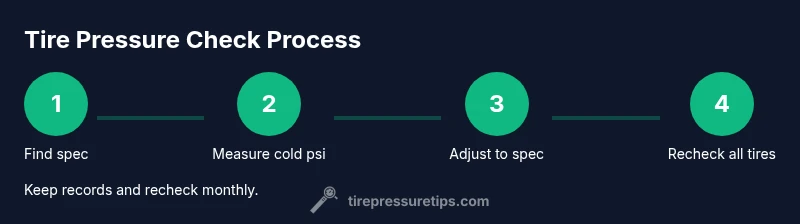
Start by locating the cold-pressure values on the door jamb placard or in the owner's manual. Note separate numbers for front and rear tires, and for different load conditions. These numbers are the target you’ll aim for when tires are cold and stationary.
Tip: Take a quick photo of the placard for easy reference. - 2
Park on a level surface and prepare
Park away from traffic on a level surface. Let the car sit for at least 3 hours after driving to ensure readings are cold. If you’ve just parked after a drive, wait until the tires cool before measuring.
Tip: If you can’t wait, measure after a longer cool-down period once you reach a safe location. - 3
Remove valve caps and inspect stems
Gently remove the valve caps and inspect the stems for damage or leakage before attaching the gauge. Keep caps in your pocket so you don’t lose them during the test.
Tip: Don’t over-tighten the valve cap during replacement. - 4
Attach gauge and read cold pressure
Press the gauge onto the valve stem firmly and read the pressure. Ensure the reading stabilizes and corresponds to the 'cold' spec on the placard. If you see a fluctuating reading, test again or use a second gauge to confirm.
Tip: If you’ve driven recently, wait until the tires cool or test after a longer drive when they cool. - 5
Inflate or release air to target
If the measured psi is below target, add air in small increments (2–3 psi at a time) until you reach the spec. If above, release air in small amounts and recheck each time.
Tip: Avoid overinflating; over 3 psi beyond target can reduce grip and cause uneven wear. - 6
Recheck all tires and the spare
Re-test all tires including the spare if your Micra has a run-flat or small space-saver. Air pressure in the spare can differ from the regular tires and needs verification.
Tip: Make sure all caps are properly tightened after rereading. - 7
Calibrate TPMS awareness and record
If your car has TPMS, verify that the system shows a normal reading after adjustment. If TPMS remains active with correct psi readings, there may be a sensor fault; consult a professional.
Tip: Note the date and psi readings to track TPMS stability. - 8
Document and plan the next check
Log the date and pressures in your notebook or app and set a reminder to recheck monthly or before long trips. Seasonal changes may require adjustments.
Tip: Keep a simple cheat sheet in the glove box for quick checks.
Frequently Asked Questions
What is the recommended tire pressure for Nissan Micra?
Check the door jamb placard for the exact cold-psi values. Front and rear may differ, and load changes can adjust the target. Use the owner's manual if the placard is unreadable.
Check the door jamb placard for the exact cold tire pressures; values can vary by trim and load.
How do I interpret TPMS warnings?
TPMS alerts you when a tire is under- or over-inflated. Verify with a gauge, adjust to the spec, and if the warning persists with correct pressure, have the sensor inspected.
TPMS warns you of pressure deviations; confirm with a gauge and adjust to spec, then check sensors if needed.
Can I drive with low tire pressure?
Short trips with slightly low pressure aren’t catastrophic but can cause heat buildup and uneven wear. Refill to spec as soon as possible and monitor for additional loss.
It's unsafe to drive far on underinflated tires; refill to spec and monitor closely.
When should I check tire pressure, hot or cold?
Always check when the tires are cold for an accurate measurement. Hot tires show higher readings due to recent driving.
Check when cold to get the true psi; hot tires read higher.
How often should I check tire pressure?
Aim to check monthly and before long trips. Adjust more often in extreme weather or after abrupt load changes.
Check monthly and before trips; adjust for weather and load as needed.
Is TPMS always perfectly accurate?
TPMS provides warnings, not an exact psi reading. Use a gauge for precise pressures and service TPMS if readings are inconsistent.
TPMS gives warnings, not exact pressure; rely on a gauge for accuracy.
Watch Video
What to Remember
- Check cold pressure monthly for accuracy.
- Always follow the Micra placard spec.
- Use TPMS as a guide, not a sole source.
- Inflate/reduce pressure in small increments.
- Document readings to track changes over time.