Mini Tire Pressure Guide: Check, Adjust & Maintain
Learn how to use a mini tire pressure gauge and portable inflator to accurately check and adjust tire pressure, protect tires, and improve fuel efficiency.


With this guide, you will learn how to use a mini tire pressure gauge and a portable inflator to accurately check, adjust, and maintain your vehicle’s tire pressure. You’ll understand how to read PSI, account for temperature, and keep tires at the recommended level for safety and efficiency in all conditions.
What is mini tire pressure and why it matters
Mini tire pressure refers to using compact, portable tools to measure and adjust your vehicle’s tire air pressure. The goal is to make accurate readings accessible without a full service bay. For most drivers, keeping tires within the recommended range improves safety, handling, tread life, and fuel economy. According to Tire Pressure Tips, pairing a reliable mini gauge with a portable inflator delivers on-the-go accuracy and convenience. The practice is not about replacing your mechanic; it’s about empowering you to spot underinflation early and avoid costly issues. A small drop in PSI can affect traction and braking, especially in wet or snowy conditions. This guide focuses on practical steps with everyday tools, not specialized equipment. By learning to read PSI correctly and adjust in small increments, you can extend tire life, reduce rolling resistance, and minimize the risk of underinflation in daily driving.
Essential tools for managing mini tire pressure
To manage mini tire pressure effectively, assemble a compact kit: a digital or analog mini tire pressure gauge, a portable air inflator or compressor, a tire pressure chart for your vehicle, a spare valve core tool, and a clean cloth for wiping stems. Choose a gauge that reads in PSI and kPa; verify accuracy by checking against a known-good gauge. Keep the kit in your trunk or glove compartment. A small flashlight can help in dim parking lots, and a tire pressure log can help you track readings over time. Storing these tools in a dedicated pouch keeps them ready for quick checks before road trips or on daily commutes. For accuracy, rotate the gauge you use with a trusted backup periodically and calibrate if the manufacturer recommends it.
Reading PSI accurately with your mini gauge
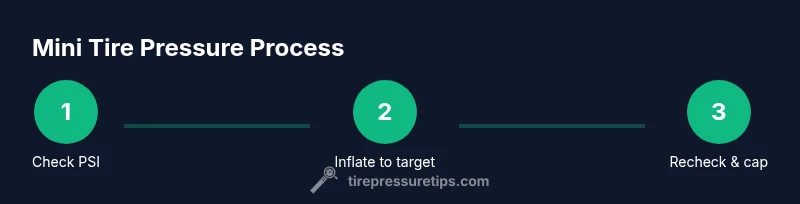
Start with cold tires to avoid readings biased by recent road heat. Remove the valve cap, place the gauge squarely on the valve stem, and press straight down until you hear a brief hiss stop. Read the value quickly and compare to the vehicle’s recommended PSI on the door placard or owner’s manual. If you use an analog gauge, read the pointer at eye level to reduce parallax error. For digital gauges, press the hold button if available to lock the number while you verify it against the target. If readings differ significantly from the target, recheck with a second gauge to confirm accuracy. Record any unusual readings and consider checking for leaks if a tire consistently sits low.
Inflating with a compact inflator: best practices
Attach the inflator securely to the valve stem and turn it on. If your inflator has a built-in gauge and target PSI, set it to the vehicle’s recommended number and let it auto-stop when the target is reached. If not, inflate in small increments of 2–3 PSI and pause to recheck with your gauge. Avoid inflating to the maximum PSI printed on the tire sidewall; always shoot for the vehicle’s recommended level. After inflating, detach carefully to prevent air from escaping, then recheck the pressure. If the gauge reads higher than desired, release air slowly through the valve core and recheck. Always follow the inflator’s safety guidelines to prevent overheating in confined spaces or during long uses.
Temperature effects on tire pressure and why mini tools help
Ambient temperature directly affects tire air pressure: as it cools, PSI tends to drop; as it heats, PSI rises, especially after driving. This makes a portable tool invaluable for quick cold checks and adjustments. The Tire Pressure Tips Analysis, 2026 notes that regular readings help maintain stable handling and tire wear across seasons. In winter, check more frequently because cold weather lowers pressure, while in summer, verify after long drives to account for heating. If you notice sudden pressure changes without obvious leaks, inspect tires and valves for damage or consider TPMS alerts as a sign to inspect further.
Common mistakes and how to avoid them
Common errors include checking pressure after driving, using an inaccurate gauge, ignoring the door placard, and inflating to match a stubborn reading rather than the recommended level. Don’t forget to replace valve caps after each check, and never assume one gauge is perfectly accurate: cross-check with a second gauge occasionally. Overinflation can reduce grip and increase wear in the center of the tread, while underinflation leads to excessive rolling resistance and heat buildup. Calibrate your gauge regularly and keep your inflator in good condition. When in doubt, refer to Tire Pressure Tips guidance for best practices.
Maintenance routine for consistent tire pressure
Create a simple monthly routine that starts with a cold tire check, updates your pressure log, and calibrates your gauges as needed. Before long trips, verify all four tires, including the spare if applicable. Replace worn valve stems or caps if you notice cracking or leaks, and inspect the valve cores for signs of wear. A consistent habit reduces the chances of emergencies and improves fuel efficiency and tire longevity. Keep your tool kit dry, and consider a small notebook or digital log to track pressure trends over time. The goal is steady, repeatable checks that fit into your regular driving schedule.
Real-world scenarios and quick checks
Scenario A: Morning commute in cool weather. Check each tire before leaving; add air if PSI is below the door placard value. Scenario B: After a long highway trip in hot weather. Recheck PSI when tires have cooled, as heat can temporarily raise readings. Scenario C: Before a cross-country trip. Verify your spare tire’s pressure too. Quick checks for city drivers can be done at gas stations or at home with a portable inflator. Practicing these quick checks ensures you stay within the recommended range on the road.
How to choose the right mini tools and where to start
Choose a compact gauge with clear readability, reliability, and a range that fits your needs. For inflators, look for auto shut-off at your target PSI and a compact design that fits in your glove box or trunk. Prioritize tools that are easy to clean, durable, and compatible with both PSI and kPa scales. Start with a basic kit and expand as you gain confidence. Keep your vehicle’s PSI chart handy, and consider a digital backup gauge for speed. Over time, your routine becomes second nature, and you’ll notice improvements in handling, tire wear, and fuel efficiency.
Tools & Materials
- Mini tire pressure gauge(Choose a gauge that reads in psi; calibrate if possible)
- Portable tire inflator/air compressor(Look for auto shut-off and a built-in gauge when possible)
- Vehicle-specific PSI chart(From owner's manual or door jamb placard; keep handy)
- Valve caps and valve core tool(Extra caps help prevent leaks; tool aids valve core work if needed)
- Tire pressure log(Record readings to track changes over time)
- Flashlight and clean cloth(For dim spaces and cleaning stems before measurement)
- Leak detection supplies (soap/water)(Soapy water helps reveal slow leaks around stems)
Steps
Estimated time: 15-25 minutes
- 1
Gather your mini tire pressure toolkit
Lay out all tools in a clean, dry space. Check calibration on the gauge against a known reference if available. This ensures accuracy before you start the checks.
Tip: Keep tools in a dedicated pouch in the trunk for quick access. - 2
Find the correct PSI for your vehicle
Locate the recommended cold PSI on the door placard or in the owner's manual. Do not rely on readings from recently driven tires, as heat skews the numbers.
Tip: Use the cold tire scenario for your target pressure. - 3
Remove valve caps and inspect stems
Take off the valve caps and inspect the stems for damage or leaks. Replace caps if damaged and keep them nearby for reattachment.
Tip: Wipe stems clean so the gauge sits properly. - 4
Attach mini gauge and read pressure
Place the gauge squarely on the valve stem and read quickly. If you have a digital gauge, hold it steady to lock the reading; with an analog gauge, read at eye level for accuracy.
Tip: Watch for parallax error with analog gauges. - 5
Set target pressure on inflator
If your inflator has a set target, configure it to the vehicle’s recommended PSI. If not, plan to add air in small increments and verify with your gauge.
Tip: Start slightly under target if unsure. - 6
Inflate in small increments
Add air in 2–3 PSI steps, pausing to recheck with the gauge after each increment. This minimizes overshoot and keeps you close to the target.
Tip: Avoid rapid bursts of air that overshoot the mark. - 7
Re-check and fine-tune
Re-check all tires after inflation. If readings differ from target, adjust again in small steps until within tolerance.
Tip: Double-check after a short drive to account for settling. - 8
Re-seat the valve caps and inspect for leaks
Replace valve caps securely. If you notice persistent leaks, inspect the valve core or seek professional help.
Tip: Leaks may indicate a damaged valve stem or core. - 9
Store tools and plan routine checks
Return tools to their pouch, and log your readings. Schedule monthly checks or checks before long trips.
Tip: Calibrate gauges monthly for ongoing accuracy. - 10
Document and review
Keep a small notebook or digital log of PSI readings and adjustments to track trends over time.
Tip: Trend data helps identify gradual leaks or valve issues.
Frequently Asked Questions
What is a mini tire pressure gauge and how does it differ from a standard gauge?
A mini tire pressure gauge is a compact tool for measuring PSI on the go. It’s portable and designed for quick readings, unlike bulk shop gauges. Regular use helps you keep tires within the recommended range.
A mini gauge is a small, portable tool for checking tire pressure quickly, perfect for on-the-go use. Regular checks help you stay safe on the road.
How often should you check tire pressure using a mini tool?
Check at least once a month and before long trips. If you drive in extreme temperatures or frequently haul loads, more frequent checks are wise.
Check at least monthly and before long trips to stay safe.
Can temperature affect tire pressure readings with a mini gauge?
Yes. Temperature changes can raise or lower PSI; read cold tires for accurate comparison to the recommended PSI.
Temperature affects readings; always check when tires are cold for accuracy.
Is it safe to inflate tires with a mini inflator?
Yes, as long as you follow the target PSI and monitor for overheating. Use the inflator’s auto shut-off if available.
Yes, just follow the target PSI and watch for overheating.
What should you do if your tire won't reach the recommended PSI?
Check for slow leaks around the valve stem, a damaged valve core, or a puncture. If the tire doesn’t hold air after repair, consult a professional.
If it won’t reach the right PSI, inspect for leaks or valve issues and seek professional help if needed.
Watch Video
What to Remember
- Measure with a reliable mini gauge before inflating
- Inflate in small increments and recheck PSI
- Account for temperature when reading PSI
- Maintain a routine to prevent under/over-inflation