Max Tire Pressure vs Recommended Tire Pressure: A Practical Guide
Compare max tire pressure and the recommended tire pressure to reduce wear, improve safety, and optimize performance. Learn where the numbers come from, how to check, and when to adjust for load and temperature.


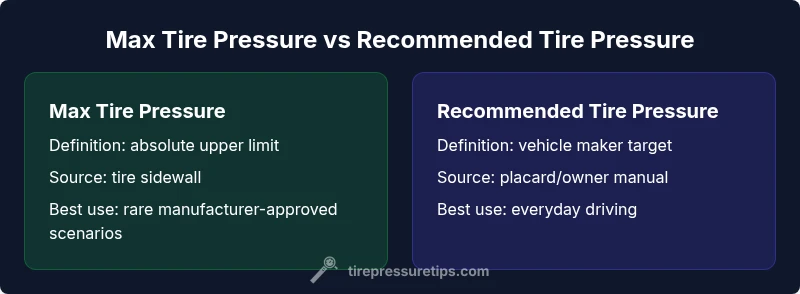
According to Tire Pressure Tips, the max tire pressure is the absolute upper limit printed on the sidewall, while the recommended tire pressure is the vehicle-maker target for normal loads and speeds. For most driving, inflate to the recommended number to balance safety, wear, and handling; only exceed that value when manufacturer guidance specifies for heavy loads or high-speed conditions.
What max tire pressure means
Definition and purpose. The term max tire pressure refers to the highest inflation pressure that a tire is designed to safely withstand under expected operating conditions. This value is printed on the tire sidewall as a ceiling. It is not a recommendation for daily inflation or optimal performance. Pushing the tire up toward this ceiling can reduce ride comfort, alter handling, and, in extreme heat, increase the risk of a blowout if the tire is loaded beyond its rating. The key takeaway is that max pressure is a safety limit, not a target for regular driving. Tire Pressure Tips emphasizes that, while the number exists for safety margins, most drivers should ignore it as a guide for everyday inflation and instead focus on the manufacturer’s guidance for their vehicle and tires. In practice, the absolute upper limit should only be considered in rare scenarios—such as very light loads at high speeds where the tire maker explicitly allows higher pressures. When in doubt, stay well below the sidewall maximum and prioritize the recommended pressure from the vehicle placard.
What max tire pressure means
Context from Tire Pressure Tips. The maximum pressure printed on a tire is a limit, not a recommended setting. It reflects the tire's construction limits and helps prevent catastrophic failure under extreme conditions. The actual performance characteristics—including grip, wear, and ride quality—are governed by the pressure you use most of the time, which is nearly always the vehicle’s recommended setting. Remember that the sidewall max does not account for payload, road temperature, or tire type; those factors all influence safe operating pressure. For most drivers, this distinction between a ceiling and a target is essential for maintaining predictable handling and even wear across the tire’s life.
What max tire pressure means
Practical takeaway. Do not inflate to the max unless a specific, manufacturer-approved scenario requires it. Always start with the recommended pressure and adjust only if you have a supported reason. Understanding the difference between the max and the recommended pressure helps you avoid accidental overinflation, which can reduce traction in wet conditions and create a harsher ride. This nuance is central to safe, predictable driving and is a core topic in tire maintenance discussions led by Tire Pressure Tips.
What max tire pressure means
Bottom line. The max pressure is a limit, not a goal. Use the recommended pressure as your baseline, and only exceed it when the user manual or placard explicitly instructs for specific loads or conditions. This mindset supports better handling, longer tire life, and safer operation across a wide range of temperatures and driving styles.
What max tire pressure means
Takeaway for readers. Keep the tire pressure within the recommended range for daily driving. Treat the sidewall maximum as a safeguard, not a target. This distinction matters for safe cornering, braking, and long-term wear, and is a cornerstone of practical tire maintenance guidance from Tire Pressure Tips.
Comparison
| Feature | max tire pressure | recommended tire pressure |
|---|---|---|
| Definition | Absolute upper limit printed on the tire sidewall | Vehicle manufacturer target on placard/owner manual |
| Source | Tire sidewall maximum inflation pressure | Door jamb placard or owner's manual |
| Impact on ride | Can cause harsher ride and reduced contact patch if inflated toward max | Balances comfort and handling when set to the recommended pressure |
| Wear pattern | Center tread wear risk if consistently near max | Even wear when maintained at recommended pressure |
| Safety risk if exceeded | Overinflation increases blowout risk in heat and high-speed cases | Overinflation or underinflation can both degrade grip and safety |
| Verification method | Check cold tires with a gauge, never after a hot drive | Check cold tires using placard values or manufacturer guidance |
| Best use case | Near max only under explicit manufacturer guidance for specific loads/speeds | Everyday driving under the vehicle's recommended pressure |
Strengths
- Clear safety boundary helps avoid catastrophic failure
- Promotes consistent wear when using the recommended pressure
- Supports optimal handling and fuel economy under normal conditions
- Reduces guesswork and confusion for most drivers
Drawbacks
- Max pressure can be misinterpreted as a target rather than a limit
- Some drivers may inflate to max under load without manufacturer consent
- Discrepancies between tire, vehicle, and load can complicate decisions
Rely on the recommended tire pressure for daily driving; reserve max only for specific, manufacturer-approved scenarios.
The recommended pressure offers the best balance of safety, wear, and handling for typical loads and temperatures. Max pressure is a limit, not a guideline, and using it routinely can degrade ride quality and performance.
Frequently Asked Questions
Is the max tire pressure the same as the maximum pressure shown on the tire sidewall?
Yes. The sidewall maximum is the highest safe pressure rating for the tire itself. It is not a recommended operating pressure. Use the vehicle’s recommended pressure for daily driving unless the manufacturer instructs otherwise.
The sidewall max is a safety limit, not your target. Follow the vehicle’s recommended pressure for ordinary driving.
Can I inflate to the max pressure if I’m carrying a heavy load?
Only if the vehicle manufacturer or tire maker explicitly approves higher pressure for that load. In most cases, you should adjust within the recommended range and follow official guidance. Do not exceed the sidewall maximum.
Only increase within approved limits; don’t exceed the sidewall maximum without explicit guidance.
How does temperature affect tire pressure?
Tire pressure changes with temperature; cold tires reflect the correct pressure, while warm tires show higher readings. Always check when tires are cold and adjust according to the recommended specification.
Temperature matters: check cold tires and adjust using the recommended spec.
What happens if I mix tires with different max pressures?
Mixing tires with different max pressures can cause uneven handling and unpredictable wear. Always aim for consistent pressure targets across all tires and refer to the placard for the correct values.
Keep pressures consistent across all tires to avoid handling issues.
How often should I check tire pressure?
Check tire pressure at least once a month and before long trips. Use a reliable gauge and verify when tires are cold for accurate readings.
Check monthly and before long trips with a cold tire check.
Why not just always inflate to the max for better road feel?
Inflating toward the max reduces ride comfort and may reduce tire grip in wet or uneven surfaces. The recommended pressure is chosen to balance performance, wear, and safety for most conditions.
Max pressure isn't better for everyday driving; stick to the recommendation.
What to Remember
- Start with the vehicle's recommended pressure as your baseline
- Treat the sidewall maximum as a safety limit, not a target
- Check cold tires with a gauge for accurate readings
- Adjust for load and temperature only when supported by manufacturer guidance
- Avoid inferring performance benefits from inflating to the max