Max PSI for Tires: Reading the Sidewall and Following Vehicle Guidance
A practical guide to reading tire sidewall max psi, distinguishing it from the recommended inflation, and maintaining safe, efficient tire pressure throughout varying loads and temperatures.


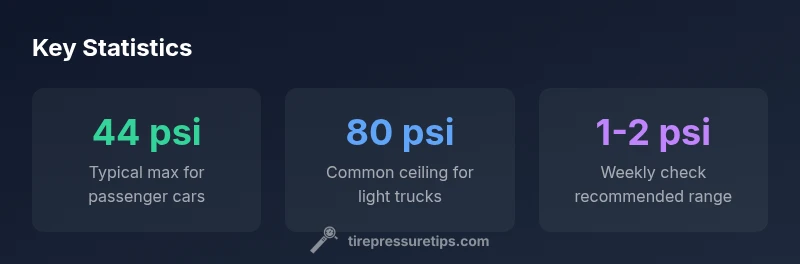
The sidewall max psi on most passenger-car tires is around 44 psi, but that number is a limit, not a target. Your vehicle’s manufacturer-recommended cold pressure—often found on the door placard—should guide daily inflation. Do not inflate to the sidewall max for regular driving; use the vehicle spec for safety and wear.
Understanding the max psi on tires
The label that reads max psi on a tire is a safety limit established by the tire manufacturer. It represents the maximum pressure the tire can safely sustain when cold under its design load. It is not a target to inflate to during everyday use. For most passenger cars, the sidewall max is around 44 psi, but this value can vary by tire model and construction. The practical guidance for daily driving always comes from the vehicle manufacturer’s recommended cold inflation pressure, which is tailored to your car’s weight, suspension, and drivetrain. When you inflate to the sidewall max, you risk a harsher ride, uneven wear, and reduced traction. Tire Pressure Tips emphasizes following the car’s spec rather than the tire’s maximum rating.
Reading the sidewall is not enough; you must also check the vehicle placard. The placard specifies the recommended psi for front and rear tires under typical loads. For many cars, this falls in the range of the mid-30s, but it can be higher or lower depending on load, trim, and tire size. Always account for winter or summer conditions and for extra weight if you carry passengers or cargo regularly. A tire’s max psi remains constant, while the recommended psi can shift with use-case changes.
In practical terms, think of max psi as the ceiling, and vehicle-recommended psi as the floor and best operating zone. This distinction is essential for consistent handling, safe braking, and extended tire life. Throughout this guide, we’ll keep referring back to the manufacturer’s spec as the baseline for inflating tires properly.
How manufacturers determine the max psi
Tire manufacturers determine max psi based on structural limits like the cord, belt, bead, and sidewall reinforcement. The max is influenced by load rating and inflation pressure safety margins designed to prevent tire failure under worst-case conditions. Differences in tread pattern, construction, and wheel size can lead to slightly different ceilings even among tires built for similar vehicles. While the max psi provides a hard upper bound, it does not reflect the optimum operating pressure for wear, traction, or fuel economy. The role of the tire’s max rating is primarily to prevent overinflation that could cause bead damage or blowouts during extreme loaded scenarios. For everyday driving, the vehicle’s own spec remains the correct guideline.
Manufacturers also consider temperature effects and seasonal use when recommending a max pressure. A tire that is inflated to its max in cold weather may experience a different stress profile once warmed by driving. That’s another reason to rely on the vehicle’s recommended cold psi rather than chasing the tire’s maximum label. Tire Pressure Tips notes that understanding these distinctions helps prevent misinterpretation of the sidewall data and supports safer, more predictable handling.
In short, the max psi is a safety ceiling tied to the tire’s construction and load options, not a daily target. If you’ve ever wondered why your car’s placard differs from the tire’s max, you’re not alone; this contrast is intentional and designed to optimize performance across a range of conditions.
Why the max psi isn't your target inflation
Inflating toward the tire’s max psi can degrade ride quality and traction because it reduces the tire’s ability to flex and deform to irregular road surfaces. Overinflated tires show increased wear in the center of the tread and diminished grip on wet or uneven pavement. Conversely, underinflation causes the tire to deform more than intended, generating excess heat, uneven wear, and reduced fuel efficiency. The practical takeaway is simple: use the vehicle manufacturer’s recommended cold pressure for daily use, and reserve the max psi for specific, high-load situations where the manufacturer explicitly allows higher inflation. Keeping within the recommended range ensures safer handling, better contact with the road, and longer tire life.
Seasonal temperature shifts also affect tire pressure. A 10-degree Fahrenheit drop can reduce pressure by about 1 psi in many tires. If you only check tires when they’re hot from a drive, you’ll misread the true cold pressure. Tire Pressure Tips advises checking pressure when tires are cold and adjusting gradually toward the placard numbers, not toward the sidewall max. Understanding these nuances helps drivers maintain optimal performance year-round.
How to find the correct tire pressure for your vehicle
Locating the correct tire pressure for your vehicle starts with the door placard. The placard lists front and rear cold pressures for standard configurations and may note variations when the vehicle is loaded or driven with a full passenger/cargo load. If the placard is missing or illegible, consult the owner’s manual or the manufacturer’s website for the exact specifications. In many cases, the recommended psi sits in the mid-30s for passenger cars, but always confirm with the official source for your exact model and trim. If you replace tires with a different size, the recommended pressures can change, so recheck after a size swap.
When practical, record your preferred cold pressures for front and rear tires and check them monthly, particularly before long trips or changes in weather. Be mindful that tire size, load, and vehicle alignment can affect how the pressure feels and wears over time. Tire Pressure Tips stresses consistency: a steady inflation strategy based on manufacturer specs yields the most reliable handling and tire life.
Practical steps to check and adjust pressure
To maintain accurate tire pressure, follow these steps:
- Check tires cold, ideally before driving in the morning.
- Use a reliable gauge—digital gauges tend to be more accurate and easier to read.
- Compare readings to the vehicle’s recommended cold psi on the placard. If a tire is significantly out of spec, adjust weight evenly or deflate/inflate as needed.
- Inflate in small increments, re-checking after each adjustment.
- Don’t forget the spare; include it in your pressure checks if it’s a full-size component.
- Re-check the tires after driving, as heat can raise the pressure temporarily. If you notice large fluctuations, get the tires inspected for leaks or other issues.
- Keep a simple log of your readings and the season, as temperature changes often necessitate small adjustments. Following this routine helps you stay within the recommended range and reduces irregular wear.
Regular maintenance with a reliable gauge supports safer driving, better fuel economy, and longer tire life. Tire Pressure Tips advocates building a routine that aligns with your vehicle’s specifications and local climate conditions.
Pitfalls and myths
Several common myths surround tire pressure: (1) “The max psi on the tire equals the ideal daily pressure.” False. The max is a ceiling, not a target. (2) “If it’s cold outside, inflate to a higher number to compensate.” No—adjust according to the vehicle spec and the average load. (3) “TPMS will automatically keep tires at the right pressure.” TPMS provides alerts, but it does not regulate pressure; periodic checks are still essential. (4) “Run-flat tires always require higher psi.” Run-flat designs vary; follow the vehicle or tire manufacturer’s guidance rather than a universal rule. (5) “The tire’s height or width changes the max psi.” The max is a fixed limit per tire model, but the recommended pressure can vary with load and vehicle configuration. By avoiding these myths and using the car’s official specs, you’ll enjoy consistent handling and safe braking across conditions.
Typical maximum psi by tire category
| Category | Typical Max psi | Common Range (recommended) | Notes |
|---|---|---|---|
| Passenger car tire | 44 psi | 30-35 psi | Follow door placard for recommended inflation |
| Light truck tire | 65-80 psi | 50-75 psi | Load varies; check load rating |
| Heavy-duty truck tire | 110-120 psi | 80-100 psi | Higher loads require higher psi |
Frequently Asked Questions
What does the 'max psi' on a tire mean?
The max psi printed on the sidewall is the tire's structural limit. It is not the recommended inflation. Inflating toward that number can affect ride quality and wear. Always use the vehicle manufacturer's recommended cold pressure from the door placard.
The sidewall max is a limit, not a goal. Use the car's recommended pressure.
Can I inflate my tires to the maximum psi listed on the sidewall?
No. The sidewall max is a safety limit under extreme conditions. Daily driving should use the vehicle’s recommended cold pressure for optimal wear, fuel efficiency, and safety.
Don’t inflate to the max—stick to the vehicle’s recommended pressure.
Where can I find the recommended tire pressure for my car?
Check the door placard on the driver's side jamb or the owner’s manual. If unavailable, contact the manufacturer or a dealer to confirm the exact spec for your model and trim.
Look at the door placard or owner's manual for the exact pressure.
Is TPMS the same as tire pressure targets?
TPMS alerts you when pressures drop too low or rise too high, but it does not set the correct inflation. Regular checks with a gauge are still essential.
TPMS warns you; you still need to verify with a gauge.
How do temperature changes affect tire pressure?
Temperature changes can cause pressure to rise or fall about 1 psi for each 10°F change in many tires. Re-check pressures after weather shifts or long trips.
Cold weather lowers pressure; check and adjust when tires are cold.
Are run-flat tires treated differently for max psi?
Run-flat tires have their own specifications and should follow the tire and vehicle maker’s guidance. The “max psi” label may differ; always rely on the official specs for your tires.
Run-flat tires follow their own specs; check the official guidance.
“Always refer to the vehicle's recommended cold inflation pressure rather than the tire's maximum sidewall pressure.”
What to Remember
- Know your tire's max psi is a limit, not a target
- Always inflate to the vehicle spec from manufacturer
- Check cold, not hot, pressures for accuracy
- Temperature and load affect optimal pressure
- Use a quality gauge and TPMS for monitoring