Jiffy Lube Tire Pressure Guide: Check, Inflate, Maintain
Learn how to check tire pressure, interpret TPMS readings, and safely inflate to the manufacturer’s spec. This educational guide covers steps you can take at home or at a shop to improve safety, fuel efficiency, and tire life.


In this how-to, you will learn how to check tire pressure accurately, interpret TPMS and gauge readings, find your vehicle’s recommended cold PSI, and adjust inflation safely. According to Tire Pressure Tips, keeping tires within the manufacturer’s spec improves fuel economy, handling, and tire life. This guide shows you exactly how to do it at home or at a shop.
Why jiffy lube tire pressure matters
Correct tire pressure is essential for safety, efficiency, and tire longevity. In everyday driving, most people check their tires only when something seems off, but the optimum pressure is not a fixed number; it depends on vehicle weight, load, speed, and temperature. According to Tire Pressure Tips, maintaining proper tire pressure improves fuel efficiency, reduces uneven wear, and helps in safer handling. In the context of a service environment like Jiffy Lube, proper tire pressure checks are a practical step toward overall tire maintenance and customer safety. The tire pressure you learn today applies to passenger cars, crossovers, and light trucks. By understanding the basics of air pressure and how TPMS works, you gain confidence to verify that your tires are within spec before a road trip or a daily commute. The goal is simple: keep each tire within the manufacturer's recommended range, read readings accurately, and adjust when necessary. This approach minimizes heat buildup, improves traction in wet conditions, and helps your tires wear evenly over their life. Tire pressure also influences ride quality; underinflated tires feel mushy and respond slowly to steering input, while overinflated tires ride stiffly, reducing grip on rough roads. In short, proper tire pressure is a cornerstone of vehicle safety and efficiency, something every driver should know by heart.
How to check tire pressure accurately
A reliable gauge is the tool you will rely on most days. Start by ensuring the tires are cold—ideally after the car has been parked for three hours or more. A hot tire can show inflated readings that mislead you. For the best results, use a gauge with clear measurement and a good seal on the valve stem. Insert the gauge and note the reading; wait a moment if the needle is bouncing. The goal is a steady number per tire, not a momentary fluctuation. When you take a reading, check both front and rear tires if your vehicle has different specs, or if you carry a heavy load; some cars have slightly different recommended pressures for each axle. The easiest way to check is to use a dedicated tire pressure gauge rather than relying on a memory or an inaccurate gauge. If you’re at a service center, they may use professional equipment to quickly verify readings and confirm whether adjustments are needed. Finally, compare your readings to the manufacturer’s recommended pressure printed on the door placard or inside the owner’s manual. This process should become part of your overall vehicle maintenance routine.
Reading TPMS alerts and gauge readings
Tire Pressure Monitoring System (TPMS) provides real-time feedback; however, a TPMS warning is not a precise pressure reading. If TPMS triggers, you should measure with a gauge to confirm. In some cases, the TPMS may be more sensitive on one tire than another; a detected 2-3 psi variance can be meaningful. Use a gauge to verify all tires, including the spare, if your car uses a full-size spare with a TPMS sensor. If readings are consistently inconsistent between the gauge and the TPMS, consider a TPMS recalibration or sensor inspection at a reputable shop. It's worth noting that temperature changes, weather, and driving conditions can alter readings. The rule is to rely on a standard gauge reading when determining whether to inflate or deflate, while using TPMS as a practical alert rather than a replacement for gauge checks. By understanding how gauge readings align with TPMS signals, you can prevent underinflation and the overheating risk that comes with it.
Vehicle-specific pressures: finding the right number
Most modern vehicles provide a recommended tire pressure for front and rear tires on the door placard or in the owner’s manual. Those numbers are determined by the manufacturer to balance handling, fuel economy, and ride comfort. There can be different pressures for front and rear axles, or a range for different load conditions. Always use the cold- tire pressure reading as the reference; inflating a warm tire yields a higher reading. If you take a heavy load on a road trip or carry a roof rack, you may need to adjust pressure within the recommended range to preserve safety and tire life. The car’s tire size can influence the ideal pressure, but do not exceed the tire's maximum sidewall rating. In a service environment, technicians will confirm the correct spec for your specific vehicle by checking the placard and comparing it to the vehicle’s load. The take-away is that "recommended pressure" is not a universal constant; it's model and scenario dependent.
How to inflate safely and correct under/over inflation
Inflating or releasing air should be done gradually while monitoring the gauge. Start from the current reading and add air in small increments, checking after each increment. For most passenger cars, a small adjustment of 1-2 psi can make a meaningful difference, but avoid overshooting. If you are at a gas station or service center, use the built-in gauge or your own to verify the final target. After reaching the target, re-check all tires again after a few minutes, as the pressure can slightly change while you move away from the pump. Never inflate beyond the tire's maximum pressure printed on the sidewall. Hard stops, aggressive cornering, and high-speed driving with underinflated or overinflated tires can cause uneven wear, heat buildup, and reduced grip. The goal is not to chase a number; it’s to maintain a safe, consistent, and manufacturer-specified range across all tires.
Seasonal effects and maintenance schedule
Temperature is a major driver of tire pressure; cold air reduces pressure and warm weather increases it, which is why many drivers notice changes as the seasons shift. Plan to check tire pressure at least monthly, and before long trips, especially after a temperature drop. If you live in a climate with wide seasonal swings, proactive checks can prevent unsafe conditions. Keep a log of readings, noting the date, tire, and observed psi. An easy habit is to check your tires every time you fill up with fuel, or set a calendar reminder for the first of every month. Maintenance isn't just about one measurement; it's a repeatable practice that ensures optimal tire contact with the road across conditions. This consistency improves handling, mileage, and safety year-round.
Common mistakes and how to avoid them
One common mistake is inflating tires to what you think is a 'normal' value rather than what the manufacturer prescribes. Another error is checking pressure after driving; heat can inflate readings. Always check cold tires for accuracy. Never ignore differential pressures between tires wearing differently or rounding to the nearest whole number; precision matters. Use a good gauge, keep it clean, and store it away from heat and sunlight. Finally, don't overlook the spare; if your car uses a spare TPMS sensor, it should be checked periodically as well. By avoiding these mistakes, you can extend tire life, avoid premature wear, and maintain safer handling.
AUTHORITY SOURCES
To help you verify the information in this guide, consult official sources such as the National Highway Traffic Safety Administration (NHTSA) tire maintenance page and the Environmental Protection Agency (EPA) fuel economy guidance on tire maintenance. These sources provide general principles for tire pressure and its impact on safety and efficiency. See: NHTSA: Tire Maintenance (https://www.nhtsa.gov/equipment/tire-maintenance); EPA: Maintain proper tire pressure for fuel economy (https://www.fueleconomy.gov/feg/maintain.jsp).
Quick maintenance checklist
- Check cold tire pressure monthly and before trips
- Use a reliable gauge and verify all tires, including the spare
- Adjust to the door placard values and recheck after inflation
- Log readings and create reminders to maintain consistency
- Inspect valve stems for leaks and ensure TPMS sensors are functioning properly
Tools & Materials
- digital tire pressure gauge(Prefer a gauge with 0.5 psi resolution and a stable seal on the valve stem)
- owner's manual or door placard(Use the official cold psi values for front and rear tires)
- air compressor or service station air pump(Must be able to add or release air; monitor with your gauge)
- notebook or tire pressure app(Record readings and track trends over time)
- rag or cloth(Wipe the valve stem to ensure an accurate reading)
Steps
Estimated time: 15-20 minutes
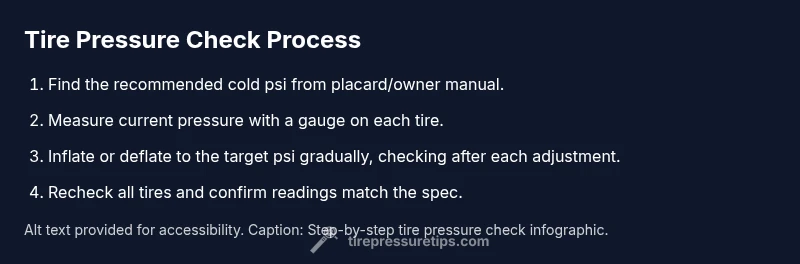
- 1
Find the correct pressure
Identify the recommended cold psi from the door placard or owner's manual. This number may differ between front and rear tires and with load conditions.
Tip: Always start with cold tires to avoid inflated readings. - 2
Measure current pressure
Use a reliable gauge and firmly place it on the valve stem to get a stable reading. Record each tire separately.
Tip: Wipe the valve stem first to prevent debris from skewing results. - 3
Inflate or deflate to spec
Add or release air gradually until the gauge shows the target pressure for each tire. Do not exceed the tire's maximum rating.
Tip: Inflate in small increments and recheck after each change. - 4
Recheck all tires
Re-measure each tire after adjustments and before driving, ensuring all pressures match the spec.
Tip: Check front and rear if the spec differs. - 5
Record and schedule checks
Log the readings and set a monthly reminder to maintain consistent tire pressure.
Tip: Keep a simple notebook or digital log for trends. - 6
Inspect for leaks and TPMS
Look for slow leaks at valve stems and confirm TPMS sensors are working.
Tip: If TPMS warns repeatedly, have the system inspected.
Frequently Asked Questions
What is the correct tire pressure for my car?
Check the door placard or owner’s manual for the exact cold psi. Pressures can differ by axle and load.
Check the door placard on your car for the exact cold tire pressure.
How often should I check tire pressure?
Check at least monthly and before long trips, especially in extreme weather. Tires should be cold when you read the pressure.
Check at least once a month and before long trips when tires are cold.
What happens if tires are underinflated?
Underinflated tires wear the edges faster, reduce fuel economy, and can overheat. Proper inflation helps safety and handling.
Underinflated tires wear faster and can overheat, affecting safety.
Can I inflate tires at home?
Yes, with a reliable gauge and access to an air compressor. Follow the vehicle’s spec and never exceed the max sidewall pressure.
Yes, use a good gauge and an air source to reach the spec.
What is TPMS and how does it work?
TPMS alerts when tires are underinflated; it’s a reminder to check with a gauge. It does not provide precise psi.
TPMS warns when pressure is low; it's not a precise gauge.
Is it safe to drive with low pressure?
Driving on underinflated tires risks overheating and blowouts. Find a safe place to inflate as soon as possible.
Driving on low pressure is risky; inflate as soon as possible.
Watch Video
What to Remember
- Check tires when cold before driving
- Use a precise gauge and verify per tire
- Follow vehicle-specific cold PSI from placard
- Recheck after inflation and log readings