Does Low Tire Pressure Cause Car Shake? A Troubleshooting Guide
Urgent guide: learn whether does low tire pressure make car shake, diagnose causes, and fix it fast with actionable steps and safety tips from Tire Pressure Tips.


Yes. The most common cause of a car shake is underinflation or inconsistent tire pressure. Start by checking all tires with a gauge, inflate to the vehicle’s recommended PSI, and inspect for punctures or sidewall damage. If the shake persists, check wheel balance, TPMS readings, and look for worn suspension components. If you’re unsure, consult a professional for a precise diagnosis.
Does low tire pressure trigger vehicle shake?
Yes, does low tire pressure make car shake? In many cases, the answer is yes. When a tire is underinflated, its contact patch with the road becomes uneven. That irregular deformation increases heat, causes flexing, and sends vibrations through the steering wheel and chassis. At highway speeds, these vibrations can feel like a constant rumble or wobble. The Tire Pressure Tips team emphasizes that maintaining proper tire pressure helps stabilize the ride, improve steering response, and reduce tire wear. Regular checks are essential, especially when seasons change or after long trips, because small pressure changes can magnify into noticeable shakiness over time.
Other culprits that mimic shaking
Shaking isn’t always about the tires alone. Other dynamics can contribute to a similar sensation:
- Wheel balance issues: A bent wheel or missing weights can create rhythmic vibrations at certain speeds.
- Alignment problems: Misalignment can make the car pull and vibrate, especially on straight roads or during acceleration.
- Worn suspension or steering components: Bushings, ball joints, or worn struts can translate road irregularities into vibration.
- Damaged tires: Sidewall bulges, puncture-related damage, or uneven wear can cause wobble even if pressures seem fine.
- TPMS misreads: A faulty sensor or incorrect reset can display false PSI values, leading you to inflate the wrong amount.
To distinguish among these, start with tire pressure and visually inspect tires, then proceed to balance and alignment checks if the shake continues. Tire Pressure Tips stresses that a systematic approach reduces guesswork and keeps you safer on the road.
How to verify tire pressure accurately
Accurate pressure measurement is critical. Use a good digital or dial gauge and follow these steps:
- Check when tires are cold (before driving or after at least three hours of no driving) to avoid heat-induced pressure changes.
- Read all four corners. Don’t assume a single buggy tire is the cause.
- Compare readings to your vehicle’s door jamb sticker or owner’s manual for the recommended PSI per tire.
- If a tire is low, inspect for visible punctures, nails, or leaks around the valve stem and bead.
- Reinflate to the recommended PSI and recheck within a few minutes to ensure even seating.
A persistent discrepancy between tires can indicate a bigger problem. The Tire Pressure Tips team notes that consistent PSI across tires is a strong predictor of a smooth ride and better fuel efficiency.
Diagnosing more than just pressure
If inflating tires to spec doesn’t eliminate shake, broaden your diagnostic net. Vibrations can stem from wheel assembly, drivetrain, or aerodynamic issues:
- Wheel balance: If vibration is pulsating, especially at highway speeds, you’ll want a professional balance job and inspection for bent rims.
- Tire condition: Check for flat spots, unusual wear patterns, or cords showing through the tread. If you find damage, replace the tire.
- Alignment and suspension: If you notice pulling to one side or uneven tire wear, a wheel alignment and suspension inspection may be needed.
- Drivetrain and engine mounts: In rare cases, shakes can originate from engine or transmission mounts transferring engine vibration to the cabin.
Document your findings and discuss them with a tire service tech. Tire Pressure Tips recommends a methodical approach to identify the root cause rather than treating symptoms alone.
Practical fixes you can attempt today
Getting rid of the shake involves a combination of quick checks and longer-term maintenance:
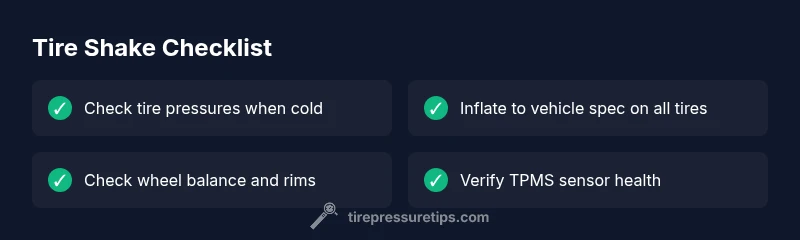
- Inflate to spec: Ensure all tires meet the vehicle manufacturer’s recommended PSI.
- Check for leaks and seal or replace tires as needed.
- Balance wheels and inspect rims for bends or cracks.
- Inspect TPMS: Reset or replace faulty sensors; recalibrate if the system has been recently serviced.
- Alignment and suspension: If you suspect misalignment or worn components, schedule a professional check.
- Spares and rotations: Rotate tires according to the service manual to even out wear.
If you’ve completed these steps and the vehicle still shakes, you should stop driving at high speeds and seek a professional diagnosis promptly to avoid tire failure. The Tire Pressure Tips team emphasizes that early intervention protects both your safety and your wallet.
Safety considerations and when to seek help
Shaking can indicate a tire failure risk. Stop driving if you notice:
- Rapid changes in vibration or a tire losing air rapidly
- A visible bubble, bulge, or tread separation on a tire
- Severe steering wheel vibration accompanied by pulling or loss of control
For these emergencies, contact roadside assistance. Do not attempt to drive long distances on a damaged tire. If you’re unsure about what you feel, a trained technician can assess tire condition, wheel balance, TPMS health, and suspension components safely. Tire Pressure Tips reminds readers that professional diagnostics are part of responsible maintenance, especially after a collision or curb impact that could bend a wheel.
Prevention: maintenance tips to avoid future shakes
Preventing shake starts with proactive care:
- Check tire pressure monthly and before long trips, adjusting for load and temperature.
- Inspect tires for wear and damage every 5,000–6,000 miles or with every oil change.
- Balance wheels and rotate tires as recommended by the vehicle manufacturer.
- Keep TPMS sensors in good health and replace batteries when needed.
- Align wheels after hitting potholes or curbs to prevent accelerated tire wear and vibration transmission.
- Use good-quality tires and avoid mixing brands or tread patterns on the same axle.
By integrating these habits, you’ll minimize shaking and extend tire life while maintaining safety on the road.
Steps
Estimated time: 60-90 minutes
- 1
Check tire pressures when cold
Park on a level surface and measure all four tires after they’ve cooled for several hours. Use a reliable gauge and compare readings to the vehicle’s recommended PSI.
Tip: Always measure when tires are cold to avoid heat-inflated readings. - 2
Inflate to manufacturer PSI
If any tire is below spec, fill it to the exact PSI listed on the door jamb sticker or owner’s manual. Recheck after a few minutes for accuracy.
Tip: Don’t guess; use the correct gauge and confirm each tire reads within 1–2 psi of spec. - 3
Inspect tires for damage
Look for cuts, bulges, cracks, or nails. If you find damage or uneven wear, replace the tire rather than inflating it.
Tip: A damaged tire can fail suddenly; replacing is safer than patching. - 4
Check wheel balance
If vibration persists after inflation, request a wheel balance and inspect rims for bends or cracks. Uneven weight can cause hop at speed.
Tip: Ask for a complete balance with weights and a rim inspection. - 5
Verify TPMS health
Test or recalibrate TPMS sensors. Replace any faulty sensors or batteries to ensure accurate readings.
Tip: A weak battery can cause the sensor to report wrong pressures. - 6
Consider alignment and suspension
If vibration continues, a professional should evaluate alignment and suspension components for wear or damage.
Tip: Poor alignment can accelerate tire wear and cause persistent shaking.
Diagnosis: Vehicle shakes or vibrates while driving, especially at highway speeds
Possible Causes
- highLow tire pressure
- highWheel imbalance or bent/misaligned wheel
- mediumDamaged or worn tread or sidewall
- lowTPMS misread or faulty sensor
- mediumSuspension or alignment issues
Fixes
- easyCheck tire pressures with a gauge and inflate to the manufacturer spec for all tires
- mediumBalance wheels and inspect for bent rims; rotate if needed
- easyInspect tires for damage and replace if necessary
- mediumCheck TPMS sensors and reset/recalibrate; replace faulty sensor
- hardAlign suspension components if misalignment is found
Frequently Asked Questions
Can low tire pressure really cause a car to shake?
Yes. Low tire pressure can deform the tire’s contact patch, causing vibrations that feel like shaking, especially at speed. It’s a common and fixable cause.
Yes. Low tire pressure often causes vibrations at speed, but it’s usually fixable by inflating to the right PSI and inspecting the tire.
What should my tire pressure be for my car?
Use the vehicle manufacturer’s recommended PSI from the door jamb sticker or owner’s manual. Do not rely on feel or assumptions. Check all four tires for consistent readings.
Check the manufacturer’s recommended PSI on the door jamb sticker and set all tires to that value.
How often should I check tire pressure?
Check at least once a month and before long trips. Temperature changes can alter pressure, so recheck when the seasons shift.
Every month and before long trips; temperature changes can affect PSI, so recheck when seasons change.
Why might TPMS show the wrong pressure?
TPMS can be slow to update after pressure changes or malfunction if a sensor battery is weak. Always cross-check with a gauge.
TPMS can be slow or faulty; always verify with a manual gauge if numbers seem off.
Will wheel balancing fix vibration after inflating tires?
If vibrations persist after correct inflation, wheel balancing or checking for bent rims is often the fix.
Balancing the wheels is commonly needed if the vibration continues after tires are properly inflated.
When should I replace tires due to shake?
If tread wear is uneven, sidewalls are damaged, or the tire shows bulges, replacement is safer than repair. Shake alone isn’t a guarantee you must replace, but tires are critical for safety.
Replace tires when there’s visible damage or wear; shaking isn’t a sole reason but it can indicate tire compromise.
Watch Video
What to Remember
- Check tire pressures first to rule out underinflation.
- Balance wheels and inspect for damage if shaking persists.
- Validate TPMS readings and consider vehicle alignment.
- Seek professional help if symptoms continue after basic checks.