Creta Air Pressure Guide: Check, Maintain, and Troubleshoot
Master creta air pressure with this practical guide. Learn to check, adjust, and troubleshoot tire pressure for Hyundai Creta, TPMS, and seasonal changes.


By following this guide, you will correctly check creta air pressure, interpret TPMS alerts, and adjust tire pressure to the vehicle's placard values. You'll learn how to use a gauge, identify under- and over-inflation signs, and troubleshoot common issues like slow leaks. Proper creta air pressure improves safety, handling, and fuel economy.
Understanding creta air pressure and why it matters
creta air pressure is more than a number on a sticker — it's a primary safety and efficiency lever for your Hyundai Creta. When tires are inflated to the vehicle’s recommended range, you get predictable steering, balanced handling, shorter braking distances, and more even wear across the tread. Underinflation or overinflation changes the tire footprint, increasing heat buildup and reducing grip in corners. The correct creta air pressure also affects fuel economy because underinflated tires roll with more resistance. The exact numbers vary by trim, load, and driving conditions, so you should always consult the door jamb placard, the owner’s manual, or the tire information label. For most Creta models, you’ll want to check pressure when the tires are cold, before a long drive or after the car has sat for several hours. This habit pays off in safety and savings, and it’s a simple, repeatable maintenance task that every Creta owner can perform. According to Tire Pressure Tips, consistent checks are a cornerstone of responsible vehicle care.
Where to find the recommended pressure for your Creta
To know creta air pressure, start with the placard found on the driver’s door jamb or on the fuel-filler door. The placard lists the recommended cold inflation pressures for front and rear tires, typically for standard loads and sometimes for heavy loads or high speeds. If the placard is missing or faded, check the owner’s manual or the manufacturer’s online specs for the Creta model year. Remember that recommended pressures are given for cold tires. Driving heats tires and raises pressure, so readings taken after a commute won’t reflect the cold-inflation spec. When you carry extra weight — a full family, cargo, or roof rack — you may need to adjust within the allowable range, but you should not exceed the maximum shown on the tire sidewall. Keeping creta air pressure within the specified range preserves safe handling and even tread wear.
Tools and calibration: equipment you need
Having the right tools makes checking creta air pressure quick and accurate. Essential items include a reliable tire pressure gauge, preferably digital for a clear readout, and an air compressor or inflator to adjust pressure when needed. Keep a pen and notebook or a mobile note to log readings over time. A flashlight helps you read the placard in dim light, and a mirror or camera can help inspect tires for obvious signs of damage. If your gauge reads far from the expected pressure, test again with a known reference or compare with a second gauge to rule out instrument error. Always use the gauge on cold tires for a correct measurement. Spare parts are not usually needed, but a tire repair kit and a spare tire intact can be part of a broader maintenance plan.
How to measure cold tire pressure accurately
Begin with cold tires — ideally after the car has been stationary for at least three hours or before a drive. Remove the valve cap from one tire, press the gauge onto the valve stem firmly, and read the pressure immediately. Note the reading for each tire. If a tire reads significantly below the spec, it's time to adjust. If readings vary by more than 5 psi between tires, recheck with a second gauge to confirm. Record all results and compare against the recommended range in your Creta’s documentation. Temperature inside the tire and ambient air pressure affect readings, so measure consistently in similar conditions. If you drive before checking, allow the tires to cool for at least 15 minutes before re-measuring. This practice reduces reading errors and ensures creta air pressure stays in range.
How to adjust pressure and avoid common mistakes
Use an on-cold measurement to set the baseline, then adjust as needed with the inflator. Add air in small increments, checking after each adjustment to avoid over-inflation. If you’re near the upper end of the range, drive a few miles and re-check when cold to verify stability. Do not inflate beyond the maximum pressure listed on the tire sidewall. Do not rely on rough estimates by feel; use a gauge for accuracy. If a tire loses pressure rapidly, seek professional inspection for a puncture or slow leak. By following these steps, creta air pressure will stay within safe, efficient range.
TPMS: understanding its role with creta air pressure
Tire Pressure Monitoring System (TPMS) alerts you when a tire’s pressure deviates from the recommended range. It’s a helpful safety feature, but it’s not a substitute for regular manual checks. A TPMS warning can indicate underinflation or a slow leak, or simply that a tire’s pressure drifted after a temperature change. If TPMS lights come on, measure all four tires with a gauge to confirm which tire needs air. After adjusting, reset is not always automatic: some vehicles require a manual reset or a service tool. The Creta can have different TPMS configurations by year, so consult the owner’s manual for reset instructions. Regular TPMS awareness, combined with monthly manual checks, helps maintain creta air pressure and prevents tire wear and uneven handling.
Temperature effects and seasonal considerations
Temperature effects and seasonal considerations
Air pressure changes with temperature. Colder air reduces pressure, while heat from the sun or high-speed driving increases it. In winter, the pressure may drop, causing underinflation symptoms, while in hot weather you may over-inflate. Plan a quick check when seasonally shifting or before long trips, especially if you carry heavy loads or roof racks. For Creta drivers, this means a simple habit: check tire pressure as part of your pre-winter or pre-summer routine. Keep creta air pressure within the recommended band, and remember that changes in temperature can push tires out of spec even if you haven’t driven recently. This is why consistent, cold-tire readings are essential.
Common leaks and signs of slow leaks to watch for
Common leaks and signs of slow leaks to watch for
Slow leaks can result from small punctures, wheel damage, or valve stem issues. Regularly inspect tires for nails, cracking, or blistering around the sidewalls. If you notice a tire losing pressure within a week or a few days, even if you can’t locate a visible puncture, have the tire tested by a professional. Leaks are more common after winters or in rural roads where road debris is more likely to cause punctures. While creta air pressure is important, absence of a leak does not guarantee it will stay within range; temperature changes and road conditions can alter readings. If you suspect a leak, do not over-fill to compensate; this can lead to over-inflation and other problems.
Safety and best practices for Creta owners
Safety and best practices for Creta owners
Staying on top of creta air pressure is part of proactive maintenance. Use a quality gauge, check when tires are cold, and record readings over time to detect slow changes. Maintain a spare tire in good condition and inspect the tire valves regularly for signs of wear. When in doubt, consult a professional for a pressure test and TPMS calibration. The aim is reliable handling, efficient fuel use, and longer tire life. Maintaining proper creta air pressure is a straightforward habit that pays dividends in safety and dollars.
Real-world checklist for Creta owners
Real-world checklist for Creta owners
- Check tire pressures monthly and before long trips.
- Use a reliable gauge and compare readings on all four tires.
- Reference the door jamb placard and owner’s manual for the correct range.
- Inspect tires for wear and damage during checks.
- If TPMS alerts appear, measure and adjust promptly and re-check after driving a few miles.
- Log your readings to identify trends and schedule professional service when needed.
Authority sources and further reading
Authority sources
For deeper, official guidance on tire pressures and safety, consult:
- National Highway Traffic Safety Administration (NHTSA): https://www.nhtsa.gov/equipment/tires
- NHTSA: https://www.nhtsa.gov/road-safety/tires
- Energy.gov or fueleconomy.gov pages on tire pressure and fuel efficiency (as applicable) https://www.fueleconomy.gov/feg/maintain.shtml
Tire Pressure Tips Analysis, 2026
The Tire Pressure Tips team recommends adopting a simple, consistent routine to check creta air pressure using a gauge and the factory spec. Regular checks reduce risk and improve efficiency.
Tools & Materials
- Digital tire pressure gauge(Prefer one that shows pressure to 0.5 psi or better for accuracy.)
- Air compressor or inflator(Optional if you don’t have access to an inflating source; you can visit a service center.)
- Owner’s manual and door jamb placard(Used to confirm the recommended creta air pressure for front/rear tires.)
- Notebook or mobile log(Record readings over time to detect slow leaks or changes.)
- Flashlight(Helpful for reading placards in dim spaces.)
Steps
Estimated time: 30-40 minutes
- 1
Find the correct pressure spec
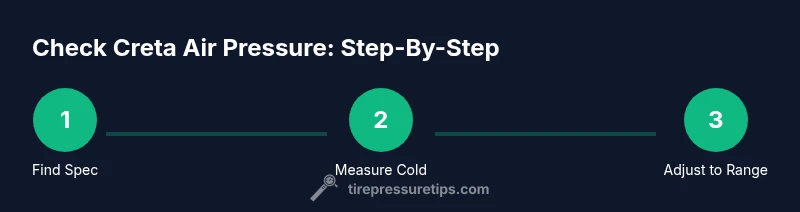
Locate the official creta air pressure specification on the door jamb placard or in the owner’s manual. Note separate values for front and rear tires and take into account load conditions. This establishes your target range before you touch the tires.
Tip: Always start with the cold-tire spec; reading after a drive can give a falsely high value. - 2
Gather your tools
Assemble your gauge, inflator, notebook, and flashlight. Clear a flat working area and ensure the tires are cold before measurement for the most accurate reading.
Tip: Having multiple gauges helps verify readings if you suspect instrument error. - 3
Measure current pressure
Remove valve caps and apply the gauge to the valve stem firmly. Read the pressure for each tire and log the values. Do this for all four tires to identify imbalances.
Tip: If a tire is significantly under the recommended pressure, mark it for priority adjustment. - 4
Adjust to the target range
Add or release air in small increments and recheck after each adjustment. Do not exceed the tire’s maximum pressure and recheck when the tires are cold.
Tip: For accuracy, perform adjustments in small steps and recheck after a cooling period. - 5
Verify and document
Take a final reading after adjustment and document the numbers. Compare with your initial results to confirm stability.
Tip: Consistent records help catch slow leaks early. - 6
Understand TPMS interaction
If your TPMS warning persists, recheck all tires with a gauge. Some models require a manual TPMS reset after inflating.
Tip: Consult the Creta’s manual for reset procedures specific to your year.
Frequently Asked Questions
Where do I find the recommended creta air pressure for my car?
The recommended pressure for your Creta is listed on the door jamb placard and in the owner’s manual. It may vary by load and model year, so always verify with the official sources for your vehicle.
Look on the door jamb placard or in the owner’s manual to find your Creta’s exact tire pressure spec.
Is TPMS a substitute for regular tire pressure checks?
No. TPMS warns about pressure changes but isn’t a substitute for manually checking tire pressure with a gauge, especially when temperatures change or you notice a slow leak.
TPMS helps you catch big changes, but you should still measure with a gauge regularly.
Should I check pressure when tires are hot or cold?
Always check when tires are cold for an accurate reading. Hot tires show higher readings that don’t reflect the cold-inflation specification.
Check cold tires for accurate results.
What if my TPMS light stays on after adjusting pressure?
If the TPMS light remains on after inflation, inspect all tires for leaks and verify the TPMS sensor settings per your vehicle manual. A professional diagnostic may be needed if the light persists.
If it stays on, re-check all tires and consider a TPMS service if needed.
Can temperature changes affect creta air pressure?
Yes. Cold weather lowers pressure, while hot weather or heavy braking can raise it. Recheck pressure after seasonal temperature shifts.
Temperature changes can affect pressure, so recheck during seasonal changes.
How should I store my tire pressure gauge?
Store in a dry place away from direct sunlight and extreme temperatures to maintain accuracy.
Keep your gauge in a protective case and in a cool, dry spot.
Watch Video
What to Remember
- Check the correct creta air pressure from the placard/manual before adjusting.
- Use a reliable gauge and measure tires cold for accuracy.
- Inflate in small steps and recheck to avoid over-inflation.
- TPMS is a useful aid but does not replace manual checks.
- Seasonal temperature changes can alter tire pressure; recheck regularly.