Air Pressure Manual: How to Check and Adjust Tire Pressure
A comprehensive guide to using an air pressure manual gauge, understanding PSI, and maintaining safe tire pressure for better fuel efficiency and safety.


Using an air pressure manual gauge, you can accurately measure tire pressure and adjust to the vehicle’s recommended PSI. This guide shows step-by-step checks, how temperature and load affect readings, and how to maintain consistent pressures for safety and efficiency. You’ll need a reliable gauge, the recommended PSI source, and a safe spot to check tires.
Why air pressure manual matters
Maintaining correct tire pressure is one of the simplest, most impactful aspects of vehicle maintenance. An air pressure manual approach puts you in direct control of tire firmness, ride quality, and safety. When you frequently rely on tire pressures that match the manufacturer’s specifications, you reduce uneven wear, improve fuel efficiency, and lower the risk of blowouts or tire failures. The air pressure manual workflow emphasizes understanding your gauge, reading results accurately, and applying adjustments with a calm, methodical process. According to Tire Pressure Tips, consistent checks under real-world driving conditions help you spot slow leaks before they become emergencies and keep your tires operating at their designed performance envelope.
The basics: PSI, kPa, and gauge types
Tire pressure is commonly measured in PSI (pounds per square inch) or kPa (kilopascals). A reliable air pressure manual gauge displays a reading as soon as you press the valve stem, and many gauges offer a dial or a digital readout. Key terms to know include the target PSI value for your vehicle, the minimum and maximum range of your gauge, and the difference between cold and hot readings. The manual gauge relies on a mechanical or spring-loaded system to translate the air pressure into a readable scale. When selecting a gauge, ensure readability, durability, and a clear scale. In general, the air pressure manual method provides a tangible, no-battery-required way to verify factory-recommended pressures.
Temperature and load effects on readings
Temperature plays a critical role in tire pressure measurements. Cold air holds less pressure, so readings taken after long drives or in heat can be higher than the true cold baseline. For accuracy, check tires when they’re cold—ideally after the vehicle has been parked for a few hours. Vehicle load also matters: heavier loads can slightly increase tire pressure, especially in the front tires for front-wheel-drive cars. The air pressure manual approach helps you account for these factors by establishing a cold baseline, then applying adjustments as needed when conditions change. Consistent measurement conditions yield the most reliable comparisons over time.
Dial vs digital gauges: which to trust
Dial gauges (analog) and digital gauges each have strengths. Dial gauges are often rugged, quick to read, and battery-free, making them reliable in varying conditions. Digital gauges can provide immediate numeric readings and store recent data, but require batteries and can drift if not calibrated. The air pressure manual method benefits from choosing a gauge you trust and using it consistently. Whichever type you pick, calibration is key—check the gauge against a known reference and replace it if readings drift noticeably. The goal is repeatable accuracy, not fancy features.
Preparing your setup for an accurate check
Begin with a level, shaded, and paved surface to prevent uneven readings. Park on flat ground, set the parking brake, and turn off the engine. Remove the valve cap and wipe away any dust from the valve stem. If you’re checking all four tires, plan a route that minimizes repeated handling of the gauges and avoids tire heat build-up. Have your target PSI handy, drawn from the door jamb sticker or the owner’s manual, and keep a notebook or app to track readings. The air pressure manual process becomes easier when you approach it as a routine rather than a one-off task.
Step-by-step practice scenarios for accuracy
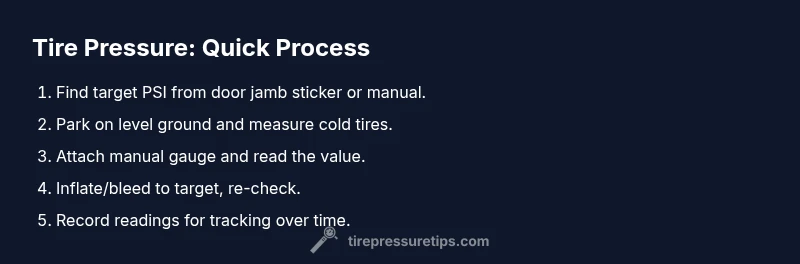
In this section, you’ll find practical scenarios that illustrate how to apply the air pressure manual process in common situations. You’ll learn to (1) locate the correct target PSI, (2) measure with cold tires, (3) inflate or bleed in small increments, and (4) re-check to confirm stability. Scenarios include checking for a slow leak, preparing for a long road trip, and adjusting tire pressure for seasonal temperature changes. By walking through these examples, you’ll gain confidence in diagnosing issues, maintaining optimal pressure, and interpreting results across different tires and loads.
Common mistakes and how to avoid them
Even with a straightforward tool, mistakes happen. Common errors include measuring after driving, inflating too quickly, neglecting the spare tire, and ignoring temperature effects. Avoid rounding readings—read the gauge to a precise decimal when possible and re-check after a short rest if readings seem unusual. Always use your target PSI as the reference, not the gauge’s arbitrary mid-scale value. A small habit—taking notes after each tire check—can prevent confusion and make seasonal adjustments much easier.
Safety considerations and best practices
Handling air and tires carries minimal risk when done carefully. Wear eye protection if you’re inflating near the needle, and never exceed the recommended PSI. If a tire looks visibly damaged or the gauge reads wildly inconsistent values across tires, stop and inspect for punctures, valve stem issues, or bead leaks. Keep the gauge away from moisture and heat, store it in a protective case, and calibrate it regularly. Regular checks with a trusted air pressure manual gauge reinforce safe driving and help extend tire life.
Maintenance, calibration, and long-term practice
Treat tire pressure checks as part of a broader maintenance routine. Schedule monthly checks and before long trips, especially in extreme temperatures. Calibrate your gauge against a known reference at least every few months, or whenever you notice unusual readings. Record the profile of each tire over time—this helps you spot slow leaks or gradual changes that might require professional attention. With consistent practice, the air pressure manual process becomes second nature and supports reliable vehicle performance.
Seasonal adjustments and how to adapt
Seasonal changes can shift your target pressures. In colder months, aim for readings closer to the lower end of the recommended range, while in heat you may need to resist over-inflating beyond the upper limit. The air pressure manual method makes these adjustments straightforward because you’re always comparing measured values against a fixed target. Maintain a simple log and update targets if the manufacturer releases revised specifications or if your tires are replaced.
Quick monthly routine you can adopt
Create a 10-minute monthly check that covers all tires and the spare. Start by recording ambient temperature, read each tire cold, compare to the target PSI, and adjust as needed. Recheck and document the final readings. This routine supports consistent tire pressures, enhances safety, and reduces unnecessary wear. A simple habit today can prevent expensive repairs later.
Tools & Materials
- Manual tire pressure gauge(Calibrated in PSI or kPa; ensure dial scale is easy to read.)
- Air pump or compressor(Use for inflating tires to target PSI; stop early and recheck.)
- Vehicle's recommended PSI source(Door jamb sticker or owner's manual; check for front vs rear differences.)
- Notebook or digital log(Record readings, ambient temperature, and date for trend tracking.)
- Valve core tool (optional)(Helpful for minor valve stem adjustments or repairing leaks.)
- Cleaner rag(Wipe stems and caps to keep readings accurate.)
Steps
Estimated time: 20-40 minutes
- 1
Find the target pressure
Locate the recommended PSI for each tire from the door jamb sticker or owner's manual. Note whether front and rear tires have different targets based on load and axle. Record the numbers clearly for reference during inflation.
Tip: Double-check the target value for your specific vehicle model. - 2
Park on level ground and prepare
Shield the area from wind, set the parking brake, and turn off the engine. Ensure tires are cold before measurement, as driving heats air and skews readings. Remove valve caps and wipe stems to remove debris.
Tip: Allow several hours after driving for a truly cold baseline. - 3
Attach the gauge and take a reading
Firmly place the gauge on the valve stem and press straight on until the reading stabilizes. Note the value and compare it to the target PSI. If readings bounce, wait a moment and read again.
Tip: Ensure no air leaks around the valve during measurement. - 4
Inflate or bleed to target PSI
If the reading is low, inflate slowly in small increments, then recheck after each increment. If high, bleed air in 1–2 psi steps and recheck. Avoid overshooting the target.
Tip: Make minor adjustments; a small change can reach the target precisely. - 5
Re-check and document
Re-measure all tires to confirm stability after adjustments. Record final readings, ambient temperature, and any notable conditions. This creates a baseline for future checks.
Tip: Use the same gauge for consistency across checks. - 6
Check the spare tire
Don’t overlook the spare; check its pressure periodically. The spare can lose pressure over time and is essential in emergencies.
Tip: Keep the spare inflated to its recommended target. - 7
Store the gauge properly
Clean and dry the gauge, then store it in a protective case or pouch. Proper storage reduces damage and prolongs gauge life.
Tip: Calibrate the gauge if you suspect wear or after long storage. - 8
Make it a routine check
Incorporate tire pressure checks into monthly maintenance or before long trips. A regular habit improves safety and extends tire life.
Tip: Set calendar reminders to stay consistent.
Frequently Asked Questions
Why should I use a manual air pressure gauge instead of digital?
Manual gauges are simple, affordable, and do not rely on batteries. They provide a direct mechanical readout that’s easy to verify. Digital gauges can vary in accuracy and require power.
Manual gauges are affordable and reliable; you don’t need batteries, and readings are straightforward.
How often should I check tire pressure?
Check at least once a month and before long trips. Always measure with cold tires for accurate readings.
Check monthly and before trips, with tires cold for accuracy.
What temperature effects tire pressure?
Cold temperatures reduce tire pressure and warm temperatures increase it. Use the cold-reading baseline and adjust accordingly when weather changes.
Temp changes affect readings; check in cold conditions for accuracy.
What if readings are inconsistent across tires?
If readings vary widely, inspect tires for damage, leaks, or valve stem issues. Re-measure after a rest and consider professional inspection if readings remain inconsistent.
If readings differ a lot, inspect tires and valves; recheck after rest.
Can I use a manual gauge to check TPMS accuracy?
TPMS and manual gauges serve different purposes. Use a manual gauge to verify the target pressure but don’t rely on it as a replacement for TPMS readings.
Use a manual gauge to verify TPMS targets, not replace TPMS.
What to Remember
- Check tires when cold for accuracy
- Use a reliable manual gauge and calibrate regularly
- Inflate gradually to target PSI, then re-check
- Record readings to monitor seasonal changes
- Always check the spare tire pressure