Low Pressure Tire Pressure Gauge Troubleshooting Guide
Urgent, practical troubleshooting for a low pressure tire pressure gauge. Learn how to check accuracy, calibrate, replace batteries, and maintain gauges to ensure safe, correct tire pressures.


According to Tire Pressure Tips, a low pressure tire pressure gauge is only trustworthy if it reads accurately. The most common fixes are to compare with a known-good gauge, check the battery if digital, and replace the gauge if readings remain off. Always verify tire pressures with the vehicle’s recommended psi before you drive, especially in extreme weather or after inflation.
Why a reliable low pressure tire pressure gauge matters
In everyday driving, accurate readings are not optional gear—they are a safety feature. An unreliable low pressure tire pressure gauge can conceal slow leaks, cause underinflation, and lead to increased tire wear, reduced fuel efficiency, or a blowout risk. According to Tire Pressure Tips, reliability is the baseline you should expect from any gauge you use for tire checks. A trustworthy gauge lets you verify that the tire pressures match the vehicle manufacturer’s recommended psi and helps you catch slow leaks before they become dangerous surcharges on your maintenance bill. This section explains how to assess your gauge’s accuracy, when to replace it, and how to maintain your tools so you can check tire pressures confidently—every time you gas up or top off tires. The term low pressure tire pressure gauge should be treated as part of your routine toolkit, not a one-off purchase.
Types of gauges and choosing the right one
There are several styles of gauges, and each has strengths and weaknesses when you’re diagnosing low tire pressure. In the category of low pressure tire pressure gauge tools, you’ll find: analog dial gauges (often the most affordable and durable), pencil-type gauges (compact and easy to store), and digital gauges (quick readings, sometimes with battery concerns). For most drivers, a reliable digital gauge with a clear LCD is convenient, but always consider a back-up analog gauge for cross-checking. When choosing, prioritize accuracy, a wide measurement range (to cover your vehicle’s high and low end), easy readability, and a stable seal against the valve stem. Remember, a gauge that performs well at a standard range is more trustworthy during quick checks at the pump. Regardless of type, practice using the gauge on a known pressure first to build confidence in your readings.
How to read a gauge accurately and avoid errors
Accurate readings start with proper technique. First, make sure the valve stem and gauge tip are clean and dry. Place the gauge firmly on the valve stem and press straight on without twisting. If you’re using a digital low pressure tire pressure gauge, hold it steady until the digits stabilize, then note the reading. If you see a drift between multiple tires, perform a cross-check with a second gauge to verify the number. Always reset your gauge to zero (if applicable) before each use and record the pressure readings to track changes over time. By following these steps, you minimize common mistakes and improve your tire pressure maintenance routine. The goal is precise, repeatable results you can trust.
Common causes of incorrect readings with low pressure tire pressure gauge
Several factors can yield false readings with a low pressure tire pressure gauge. A worn needle or damaged dial on analog gauges can cause misreadings, as can dirt or moisture inside the gauge. Digital gauges depend on battery power; a weak battery can produce slow or erratic readings. User error, such as not seating the gauge properly on the valve stem or measuring on a hot tire immediately after driving, can skew results. Environmental factors like extreme cold or heat also affect accuracy. Inconsistent readings across tires may point to a gauge issue rather than the tire itself. Regularly inspecting the gauge’s seal, tip, and battery life will reduce these issues. The phrase low pressure tire pressure gauge should be kept in mind as you review possible causes.
Quick fixes and when to replace your gauge
Start with the simplest fixes: swap to a known-good gauge to compare readings, clean the valve stem and gauge tip, and replace batteries if you’re using a digital model. If discrepancies persist between gauges or readings drift over time, it’s time to replace the gauge. A worn or damaged gauge loses accuracy in a way that can erode your confidence in tire maintenance. If you rely on the gauge for frequent checks, invest in a high-quality model with good reviews. As a rule of thumb, replace gauges that fail simple cross-checks or show inconsistent readings on multiple tires. The Tire Pressure Tips guidance emphasizes ongoing accuracy as a core safety practice.
Routine checks and maintenance to prevent erroneous readings
Make gauge maintenance part of your seasonal vehicle care. Clean the gauge tip, store it away from heat and direct sunlight, and avoid dropping or jarring the device. Calibrate or verify accuracy against a reference gauge at least once a year, or whenever you notice inconsistent readings. Keep spare batteries on hand for digital models, and replace them when readings slow or appear dim. Finally, remember to check the vehicle’s recommended psi in the owner’s manual or on the door placard, then verify the tire pressure with your gauge at a consistent temperature (ideally after vehicle has cooled for at least three hours). Integrating these steps helps ensure the readings you rely on consistently reflect reality, supporting safer driving habits for you and your passengers.
Troubleshooting scenarios: gauge vs TPMS mismatch
Sometimes the Tire Pressure Monitoring System (TPMS) display and your manual gauge disagree. This can happen when the TPMS sensor is slow to react, the tire has recently been inflated or cooled, or the gauge itself is inaccurate. In such cases, trust the manual gauge, but also verify with a second gauge to confirm. If readings worsen or diverge across tires, inspect the valve stems and stems seals for leaks, or consider replacing the gauge altogether. If the problem persists, consult a tire shop to verify TPMS readings and ensure the system is calibrated correctly. The central message remains: use a reliable low pressure tire pressure gauge to confirm the tire pressures.
Practical inflating workflow: from pump to road
A practical inflating workflow ensures you reach the target pressure safely and efficiently. Start by checking all four tires with a calibrated gauge. If a tire is underinflated, add air in small increments (about 1–2 psi at a time), re-check with the gauge, and wait for the tire to settle before re-reading. After adjusting, recheck all tires to confirm uniform pressure close to the recommended psi. If a tire is overinflated, release a small amount of air until you reach the target, then re-check. Finally, drive a short distance and re-check when the tires have cooled, ensuring the fuel economy and tire wear benefits hold true. This streamlined process reduces guesswork and aligns your readings with reality.
Steps
Estimated time: 20-40 minutes
- 1
Compare with a reference gauge
Use a known-good gauge to take a reading on all four tires, noting any major differences. This helps determine if your gauge is the outlier. If readings differ significantly, proceed to step 2.
Tip: Keep a small notebook to log readings for each tire over time. - 2
Check digital gauge batteries
If you’re using a digital gauge, replace the batteries and retest. A dying battery can cause slow or unstable readings, especially when the gauge is hot.
Tip: Use fresh batteries from the same brand for consistency. - 3
Test on multiple tires and pressures
Measure more than one tire at varying pressures to see if the gauge is consistently off. If only one tire reads abnormally, the issue may be with the tire valve seal rather than the gauge.
Tip: Inflate or deflate only in small increments to avoid overcorrection. - 4
Calibrate or replace if needed
If your gauge allows calibration, follow the manual to adjust it. If readings stay inconsistent after calibration, replace the gauge with a higher-quality model.
Tip: Choose a gauge with easy verification against a standard reference. - 5
Verify final readings against recommended psi
After adjustments, confirm all tires are within the vehicle manufacturer’s recommended psi. Re-check after a drive when the tires have cooled to ensure stability.
Tip: Record the final readings to monitor for future drift.
Diagnosis: Gauge readings differ between gauges or read inaccurately compared to the vehicle's recommended psi
Possible Causes
- highGauge is worn or damaged
- mediumBattery issues in digital gauge
- lowUser error or improper seating on valve stem
- lowEnvironmental factors (extreme cold/heat) affecting accuracy
Fixes
- easyTest against a known-good reference gauge and calibrate if possible
- easyReplace the gauge if readings persist incorrect
- easyCheck and replace batteries in digital gauges
- easyInspect valve stems and seals; replace if damaged or corroded
Frequently Asked Questions
Why does my tire pressure gauge give different readings from TPMS?
TPMS readings are approximate and can lag behind real pressure changes. Always verify with a physical gauge for an accurate reading before inflating or deflating tires.
TPMS can lag behind real changes. Use a physical gauge to confirm the actual pressure.
How often should I replace my tire pressure gauge?
Check accuracy annually or whenever readings differ significantly across tires. Replace gauges that consistently misread compared with a reference gauge.
Check accuracy yearly and replace if readings are unreliable.
Can I calibrate a tire pressure gauge at home?
Some gauges support recalibration according to the manual. If your gauge cannot be recalibrated reliably, replace it with a new one.
Some gauges can be recalibrated; if not reliable, replace it.
What is the best way to read a digital gauge?
Press the stem fully, wait for the digits to stabilize, then note the reading. If the display fades, replace the battery.
Press in, wait for stabilization, and read. Replace batteries if the display fades.
What should I do if the gauge is damaged?
Stop using the damaged gauge and replace it with a new one. A damaged gauge can give dangerously incorrect readings.
If damaged, replace the gauge to ensure safety.
Watch Video
What to Remember
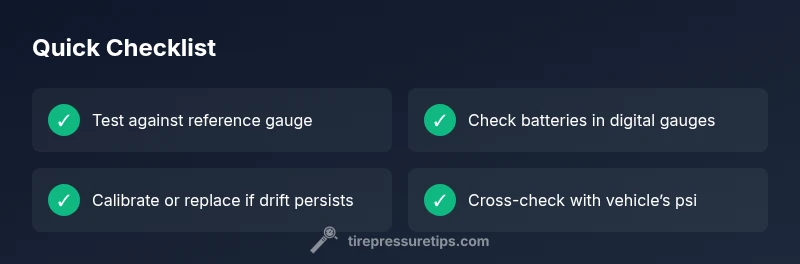
- Test gauges against a known-good reference
- Replace if readings drift or are inconsistent
- Always compare to the vehicle’s recommended psi
- Maintain gauges to prevent future inaccuracies