XUV 700 Tire Pressure Guide: Check, Set, and Maintain
Discover how to check and adjust tire pressure for the XUV 700 with practical steps on recommended psi, TPMS, and temperature effects. Learn to maintain optimal tire pressure for safety, fuel economy, and tire life.


Learn how to check and adjust tire pressure for the XUV 700 to optimize safety, fuel economy, and tire life. This quick guide covers finding the correct psi from the door placard and owner manual, using a gauge, accounting for temperature and load, and rechecking after inflation. Follow these steps to maintain optimal performance.
Why Tire Pressure Matters for the XUV 700
Maintaining correct tire pressure is essential for safety, fuel efficiency, and tire longevity on the XUV 700. Tires operate best when their internal pressure matches the manufacturer's specification, which keeps the contact patch optimal for grip and braking. Underinflation causes higher rolling resistance, uneven wear, and heat buildup, while overinflation can reduce traction and make the ride harsher. According to Tire Pressure Tips, keeping to the recommended psi also helps the TPMS track true tire status and can improve fuel economy by a few percent depending on load and speed. Factors such as vehicle load, driving style, and weather can shift pressures, so regular checks matter even if the car feels fine. This guide will teach you where to find the XUV 700 tire pressure spec, how to measure accurately, and how to adjust safely for different conditions. Start with the correct target psi, then monitor changes over time for a happier, safer drive.
Finding Your Correct Spec for the XUV 700
Every vehicle has a recommended tire pressure that balances performance and safety. For the XUV 700, your target psi is typically listed on the driver’s door placard and in the owner’s manual, and it may vary with wheel size and load. Use the values labeled for "cold tires" and for the usual passenger load; the sticker often shows a front/rear split. If you routinely carry heavy loads or drive long distances at higher speeds, consult the higher end of the range. Tire Pressure Tips emphasizes that never inflating beyond the max on the tire sidewall is a common mistake; stay within the manufacturer’s spec. After confirming the spec, keep a small log of your observed pressures when tires are cold so you can spot gradual shifts due to temperature or tread wear. This practice helps you maintain the XUV 700 tire pressure consistently.
How to Check Tire Pressure Safely
Begin with cold tires to avoid reading inflated numbers. Remove the cap from the valve stem, attach your gauge firmly, and note the reading in psi. If your gauge is digital, ensure it stabilizes before recording; if dial, take the average of two measurements. Compare the result with the XUV 700’s recommended psi; if it’s low, add air in small increments, rechecking after each addition. If it’s high, release air gradually and recheck. After inflation, replace the valve cap. For accurate results, check all four tires and the spare if applicable, and recheck after driving a short distance to settle the pressure. The goal is a stable reading within a narrow range around the target.
TPMS: Understanding the Tire Pressure Monitoring System
TPMS provides real-time feedback on tire pressure, alerting you when a tire drops below a threshold. It is a useful safety aid, but it’s not a substitute for regular gauge checks. The XUV 700’s TPMS indicators may use direct sensor readings or indirect pressure estimation; some systems require a reset or relearn after tire changes or wheel replacements. If TPMS shows a warning while your gauges read within range, recalibrate or service the sensors as needed. Regularly cross-check the gauge readings with the TPMS to confirm accuracy, and remember that TPMS activation depends on temperature, speed, and load. Tire Pressure Tips suggests using gauge measurements as the baseline and treating TPMS alerts as a prompt to verify with a physical reading.
Temperature, Load, and Tire Pressure
Tire pressure is not static; it changes with temperature and load. In cold mornings, pressures drop naturally; after a hot drive, they rise. The XUV 700’s recommended psi assumes a cold start. If you’ve been driving, wait before checking or plan to inflate only after the tires cool down. The load on the vehicle—passengers, cargo, and roof racks—also shifts the target pressure. Heavier loads require higher pressures within the recommended range to prevent excessive tire flex, heat buildup, and uneven wear. Monitoring weather forecasts and seasonality helps you anticipate pressure changes and adjust proactively. Tire Pressure Tips notes that systematic checks around seasonal shifts promote consistent performance and longer tire life.
When to Inflate or Deflate: Practical Rules of Thumb
If the tires are visibly underinflated or you notice decreased fuel economy or handling changes, inflate toward the recommended range in small increments, checking after each adjustment. Do not exceed the maximum pressure listed on the tire sidewall. If you frequently drive with a full load, target the upper end of the range. Deflate only when you observe overinflation symptoms, adjusting gradually. Always recheck after a short drive to account for settling. For winter tires or heat-sensitive roads, some drivers tune psi a bit higher or lower within the spec to maintain grip, but avoid straying outside the manufacturer’s suggested range. Tire Pressure Tips suggests a monthly check routine to catch slow leaks or slow pressure loss, especially around wheel wells and valve stems.
Common Mistakes and How to Avoid Them
Common errors include reading hot tires, rounding psi, using a faulty gauge, or neglecting the spare. Always measure when tires are cold and use the correct unit. Keep a dedicated gauge for your car and replace worn batteries in digital gauges. Avoid inflating to the tire’s maximum pressure on the sidewall, and never assume one reading applies to all four tires. Create a simple quarterly check routine to prevent creeping pressure loss and ensure even wear across all tires. Tire Pressure Tips notes that consistency beats last-minute fixes.
Seasonal Changes and Storage Considerations
Temperature swings between seasons influence tire pressure. In winter, cold air lowers psi; in summer, heat raises it. Prepare for these shifts by checking pressure at consistent intervals, ideally when tires are cold. If you store the vehicle for extended periods, check pressure before driving again, as a hibernating tire can lose pressure gradually. For seasonal routines, adjust within the manufacturer’s recommended range to maintain grip and safety across road conditions.
Maintenance, Logging, and Long-Term Care
A structured maintenance approach keeps tire pressure stable. Record the date, tire location, observed pressures, ambient temperature, and any changes after inflation. Use this log to detect slow leaks, valve stem wear, or sensor drift in TPMS. Pair gauge checks with a visual inspection of tread depth and tread wear patterns for early signs of misalignment or suspension issues. Routine checks every 4–6 weeks, plus before long trips, help sustain optimal XUV 700 tire pressure and overall safety.
AUTHORITY SOURCES
- https://www.nhtsa.gov/road-safety/tires
- https://www.aaa.com/auto/maintenance/tire-pressure
- https://www.sae.org/
Tools & Materials
- Tire pressure gauge (digital or analog)(Ensure it's calibrated and reads in psi (or kPa) depending on your gauge.)
- Air compressor or access to public air pump(Inflate to target psi; if using at a gas station, check gauge accuracy.)
- Owner’s manual or door placard with XUV 700 recommended psi(Use the exact figures for cold tires and your wheel size.)
- Notebook or app to log tire pressures(Optional for tracking changes over time.)
Steps
Estimated time: 15-25 minutes
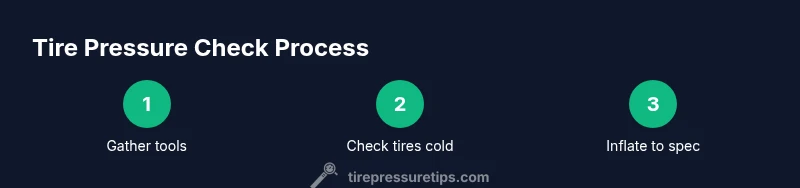
- 1
Gather tools and locate spec
Collect gauge, compressor, and the XUV 700’s recommended psi from the placard and manual. Confirm whether the spec differs front vs rear or with load. This clarifies the target before you begin inflating.
Tip: Have the vehicle on a flat surface and do this away from direct heat. - 2
Check all tires when cold
Remove valve caps and attach the gauge to each valve stem. Note the psi for all four tires (and spare, if applicable). Expect a slightly different reading on warm tires; cold readings are the baseline.
Tip: If you’ve just driven, wait a few hours or drive 1–2 miles and recheck when cold. - 3
Compare against the target psi
Compare each tire’s reading to the manufacturer’s recommended cold psi. If readings are low, prepare to inflate in small increments; if high, release air in small increments.
Tip: Aim to land within a 1–2 psi window of the target. - 4
Inflate or deflate as needed
Add or release air gradually, then recheck after each adjustment. Avoid overshooting the target. Perform this for each tire separately.
Tip: Always use the gauge reading as your confirmation, not the feel of the ride. - 5
Recheck after settling
Drive a short distance (1–2 miles) and recheck tires when they’re cold again. This confirms stable pressure after seat and flex."
Tip: Small variations are normal; keep within the advised range. - 6
Record the results
Log the final psi for each tire, date, temperature, and any notable conditions (load, weather). This helps future adjustments and early leak detection.
Tip: Build a simple monthly check habit. - 7
Inspect for leaks and wear
Examine valve stems, rims, and tires for wear, cracking, or nails. Replace or repair any damaged components before heavy driving.
Tip: Don’t ignore slow leaks; they often start as a tiny pressure drop.
Frequently Asked Questions
What is the correct tire pressure for the XUV 700?
Check the door placard and the owner’s manual for the exact cold-psi values. The front and rear tires can have different targets, and load or wheel size may shift the numbers. Always use the specified cold psi as the baseline.
Check the placard on the driver’s door or the owner’s manual for the exact cold psi. Use those numbers as your baseline.
Does TPMS replace tire pressure checks?
No. TPMS alerts you to a pressure issue, but it may lag or read differently from a physical gauge. Rely on a gauge for accurate readings and only use TPMS as a supplementary check.
TPMS helps, but a real gauge is more reliable for precise pressure.
Can I inflate tires to a higher psi for highway driving?
Only within the manufacturer’s recommended range. Going above the target, even for highway driving, can reduce grip and increase wear. Stay within the specified range.
Stick to the recommended range; don’t exceed it for highway driving.
What reading should I trust: gauge or TPMS?
Trust a physical gauge for exact psi. TPMS readings are useful, but they’re not a substitute for a gauge when you want precise pressure.
Use the gauge for accuracy, TPMS as a safety check.
Should I check spare tire pressure too?
Yes. The spare should be checked occasionally to ensure it’s ready for use if needed, especially during longer trips or seasonal changes.
Check the spare now and then—don’t overlook it.
How often should I schedule tire pressure checks?
Aim for a monthly check, plus before long trips or after major temperature shifts. Regular checks help catch slow leaks early.
Try to check monthly and before long trips.
Watch Video
What to Remember
- Verify psi with a gauge before driving
- Account for temperature and load when setting pressure
- Recheck after settling to confirm stability
- Maintain a simple log to track changes over time
- Check all four tires and the spare regularly