Hyundai Tyre Pressure: Check, Set, and Maintain
Learn how to check and maintain Hyundai tyre pressure for safety, efficiency, and tire life. Practical steps, TPMS guidance, and pro tips from Tire Pressure Tips to keep your Hyundai tyre pressure in spec.


Check Hyundai tyre pressure to improve safety, handling, and fuel economy. This guide shows how to locate the official pressure spec, measure cold tires with a reliable gauge, and adjust air safely at home or a gas station. You’ll learn TPMS basics, signs of under- or over-inflation, and a simple routine you can repeat monthly. Proper Hyundai tyre pressure protects tires and reduces risk on the road.
Hyundai tyre pressure: Why it matters for safety and performance
Maintaining correct Hyundai tyre pressure is a foundational step in keeping your car predictable, safe, and fuel-efficient on every trip. When you keep tires inflated to the Hyundai-recommended level, you improve steering response, braking, and tire wear. Underinflated tires flex more and heat up, increasing the risk of a blowout, uneven tread wear, and reduced fuel economy. Overinflated tires can make the ride harsher and wear the center of the tread faster. In this guide, we unpack Hyundai tyre pressure guidance with practical steps you can follow at home or at a service station. According to Tire Pressure Tips, consistent checks are the simplest way to catch slow leaks before they become costly problems. We’ll cover where to find the spec, how to measure accurately, and how to adjust safely across different Hyundai models.
Understanding tyre pressure metrics and terminology
Tire pressure is not a single number; it is a specification that can be measured in pounds per square inch (psi), kilopascals (kPa), or bars. Most passenger Hyundai vehicles list a PSI range on a sticker located on the driver’s door jamb or in the owner’s manual. The exact value is not universal across models; it changes with load, speed, and temperature. In practice, you’ll read a number in psi (or kPa if you prefer metric units) and compare it to the manufacturer’s recommended figure. Tire pressure can drift as road conditions and weather change, so you should measure it when the tires are cold and the vehicle has not been driven more than a mile. Using a gauge you trust is more important than chasing perfect precision, and a consistent unit helps you track changes over time.
Where to find the Hyundai tyre pressure spec for your model
The recommended tyre pressure for Hyundai cars is usually shown on a sticker on the driver's door jamb or on the fuel filler flap. If you cannot locate the sticker, consult the owner’s manual or Hyundai’s official support site. The tyre labeling may refer to front and rear pressures separately, and some SUVs may have slightly different ratings for front and rear axles. For most daily driving, you’ll want to start with the standard passenger car value rather than sport-tuned settings. Remember that this figure is for cold tires; warm tires will read higher and should not be inflated to the same value. Keeping a copy of the spec in your glove box is a small but effective habit.
Cold vs warm tires and when to measure
Tire pressure changes with temperature. As tires cool after a car sits overnight or after a drive ends, the air inside contracts and the gauge reads lower. Conversely, heat from rolling or from sunny days raises the pressure slightly. The best practice is to check tyre pressure when the tires are cold and the car has been stationary for several hours. If you must check after a trip, wait at least three hours or until the tires have cooled. Always adjust to the cold-spec value rather than the warm reading. This discipline prevents overinflation or underinflation caused by temperature swings and keeps Hyundai tyre pressure readings reliable across seasons.
Tools and materials you’ll need to check Hyundai tyre pressure
- A reliable tire pressure gauge (digital or analog) and a notebook or phone to record readings; to avoid inconsistency, pick one gauge and use it consistently.
- The Hyundai owner’s manual or the door jamb sticker as your reference for the correct PSI.
- An air compressor or access to a service station air pump; choose one with a built-in gauge if you don’t have a handheld gauge.
- A clean rag for wiping valve stems and a small amount of soapy water to detect slow leaks.
- Optional: tire pressure log app to track trends over time.
Having the right tools handy makes the task quick and repeatable, reducing the likelihood of inflating to the wrong level. This is especially true for Hyundai tyre pressure where model variations may exist across trims and years.
Step-by-step: check and adjust Hyundai tyre pressure
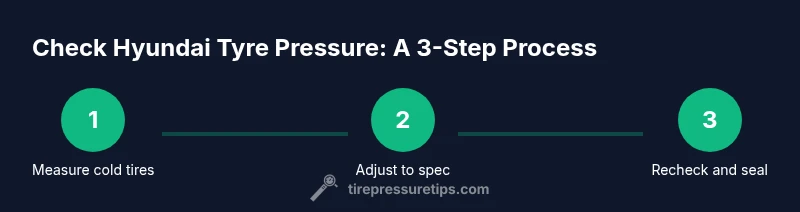
- Gather tools and locate the label with the recommended PSI from the door jamb or owner’s manual. The reason is to have a precise target before you start inflating.
- Make sure the vehicle is on a flat, level surface and the tires are cold. If the tires have been driven, wait at least three hours before measuring.
- Remove the valve cap, press the gauge onto the valve stem, and read the pressure in psi. If your gauge shows kPa, convert to psi using the simple formula or keep using psi consistently.
- If the reading is below the recommended value, attach air and add until you reach the target. Stop periodically to re-check, because small increments prevent over-inflation.
- If the reading is above the target, release air in small increments and recheck until you hit the spec. Do not guess; precise adjustment reduces tire wear and protects the wheel.
- Reinstall the valve caps and record the pressures for all four tires, including the spare if you check it. Pro tip: Inflate all tires to the same baseline during seasonal changes for even wear.
How TPMS interacts with Hyundai tyre pressure readings
Tire Pressure Monitoring Systems (TPMS) provide a quick alert when a tire drops below or rises above the nominal pressure. A TPMS warning does not replace manual checks, as the system senses relative changes and cannot indicate a precise pressure value. If a TPMS light comes on, verify each tire’s pressure with a gauge, ensuring you are reading the cold-spec value. A frequent cause for a persistent TPMS warning is a slow air leak from a valve stem, a faulty sensor, or a damaged wheel rim.
For Hyundai owners, it’s helpful to pair TPMS awareness with regular, hands-on checks. This combined approach minimizes risk and supports your ability to respond quickly to pressure changes caused by temperature shifts, load variation, or new tires.
Common mistakes and myths around Hyundai tyre pressure
- Myth: Higher pressure improves fuel economy and ride comfort; reality: excessive pressure reduces contact with the road, causing uneven wear and harsher rides.
- Mistake: Checking pressure only on hot tires; reality: you get inaccurate readings, leading to improper inflation.
- Myth: One tire pressure fits all models; reality: front and rear pressures may differ by model and axle load.
- Error: Ignoring TPMS warnings; reality: a TPMS signal usually indicates a leak or temperature-driven drift that should be checked.
- Mistake: Believing a single daytime reading is enough for seasonal changes; reality: temperatures swing, so track readings monthly and before trips.
Seasonal and temperature effects on Hyundai tyre pressure
Temperature swings impact tyre pressure noticeably. In cold weather, pressure drops; in hot weather, it rises. The body of the tire also stiffens in cold, affecting expansion and reading accuracy. To maintain reliable Hyundai tyre pressure, recheck during seasonal transitions and after long drives, especially when the forecast changes. When temperatures drop, expect pressure loss, sometimes enough to move you away from spec; proactively adjust and recheck.
Hyundai model differences and practical notes
Different Hyundai models may have different recommended tyres pressures for front and rear axles, and some trims may advise slightly different targets when carrying heavy loads or driving at higher speeds. Always favor the sticker or owner’s manual as the final authority for your vehicle’s Hyundai tyre pressure. If you swap tires or wheels (e.g., from stock to performance tires), re-check the spec and adjust accordingly. The general approach remains the same: use a reliable gauge, measure cold, and adjust to the model’s spec for best balance of safety and efficiency.
Maintenance routine: monthly checks and pre-trip checks for Hyundai tyre pressure
Develop a simple routine: quick checks monthly and before long trips. Keep a small gauge in your glove box or center console. Log your readings over several months to identify slow leaks or irregular wear. If you notice frequent pressure changes or see valve stems that look cracked, have the sensor and valves inspected by a professional. Consistency is the key to reliable Hyundai tyre pressure maintenance.
Quick reference: a simple checklist for Hyundai tyre pressure
- Locate the official PSI spec for your Hyundai model on the door jamb sticker or manual.
- Check tires when cold and before driving for an accurate reading.
- Use a reliable gauge and inflate to the cold-spec value, across all four tires.
- Recheck after adjusting and record the readings to monitor trends over time.
- Inspect valve stems and the TPMS for any signs of wear or leaks.
Tools & Materials
- Tire pressure gauge (digital or analog)(Choose one gauge and use it consistently for uniform readings)
- Hyundai owner's manual or door jamb sticker(Your exact PSI targets and axle-specific values)
- Air compressor or access to gas station air pump(Prefer units with a built-in gauge; bring a backup gauge if possible)
- Clean rag and soap solution(For quick leak checks at valve stems)
- Notebook or mobile app for logging(Track pressures over time and after seasonal changes)
Steps
Estimated time: 45-60 minutes
- 1
Gather tools and locate the spec
Collect your gauge, air source, and the door jamb sticker or manual to confirm the target PSI. This step ensures you inflate to the correct value and avoid guesswork.
Tip: Double-check whether front and rear pressures differ on your Hyundai model. - 2
Ensure tires are cold before measuring
Park on a level surface and wait several hours since last drive. Cold tires give the most accurate reading and prevent over-inflation.
Tip: If you’ve driven recently, wait at least three hours before testing. - 3
Remove valve caps and read pressure
Place the gauge on the valve stem and record the PSI reading. Use the same gauge for consistency and convert units if needed.
Tip: Wipe the valve stem first to remove dirt that could skew readings. - 4
Inflate or deflate to target PSI
If underinflated, add air until you reach the target. If overinflated, release air in small increments and recheck until you hit the spec.
Tip: Make small adjustments and recheck multiple times to avoid overshoot. - 5
Recheck all tires and replace caps
After adjustments, recheck each tire. Replace the valve caps and verify the spare if you checked it.
Tip: Record the final readings for future reference. - 6
Log results and monitor over time
Keep a simple log of pressures by tire and date to spot slow leaks or changes from season to season.
Tip: Note any leak symptoms such as hissing around the valve stem.
Frequently Asked Questions
What is the best time to check Hyundai tyre pressure?
The best time is when tires are cold, such as before you drive or after the car has sat for a few hours. This ensures an accurate reading that reflects the true cold PSI.
Check the tires when they are cold, ideally before driving, to get an accurate reading.
Where can I find the recommended tyre pressure for my Hyundai model?
Look for the sticker on the driver’s door jamb or consult the Hyundai owner's manual or official support site for model-specific values.
Check the door jamb sticker or the manual for your model’s exact pressure.
What should I do if the TPMS light stays on after adjusting pressure?
Recheck all tires with a gauge, inspect valve stems and wheels for leaks, and consider having the TPMS sensor system inspected by a technician if readings remain inconsistent.
If the TPMS light stays on after adjustments, recheck readings and inspect for leaks or sensor issues.
Can I check tire pressure with a phone app?
Phone apps can help log readings, but you should rely on a physical gauge for the actual pressure measurement. Apps are best for tracking data over time.
You can log readings with an app, but use a real gauge to measure pressure.
Is it safe to drive with low tyre pressure temporarily?
Driving on underinflated tires is unsafe and can cause overheating, excessive wear, and blowouts. Inflate to the recommended pressure as soon as possible.
No, avoid driving on underinflated tires; inflate to the recommended level promptly.
Do spare tires require the same pressure as regular tires?
Spare tires often have different pressure requirements. Check the spare’s label or the owner’s manual before inflating.
Check your spare tire pressure per its label or the manual.
Watch Video
What to Remember
- Check tires when cold for accuracy
- Follow the door-sticker PSI for Hyundai tyre pressure
- Use a consistent gauge and document readings
- Regular TPMS checks complement manual readings
- Record trends to catch slow leaks early