Honda Jazz Air Pressure: Check, Adjust, and Maintain
Learn how to check and adjust Honda Jazz tire pressure for safety, fuel efficiency, and even tire wear. Practical steps, TPMS tips, and essential tools from Tire Pressure Tips.


In this Honda Jazz air pressure guide, you’ll learn how to check tires when cold, set each tire to the factory-recommended pressure, and verify TPMS status after inflation. This quick, practical guide helps you avoid under- or over-inflation, improve fuel economy, and minimize uneven tire wear. Expect clear steps and safety reminders from Tire Pressure Tips.
Why correct air pressure matters for the Honda Jazz
Maintaining the correct tire pressure for your Honda Jazz is more than just a number on a label. It affects handling, steering response, braking, fuel economy, and tire wear. When tires are underinflated, rolling resistance increases, the tire’s contact patch expands, and heat builds up, shortening tire life. Overinflation can lead to a harsher ride and uneven wear, especially across the center tread. According to Tire Pressure Tips, erratic tire pressures are a common issue among drivers who rely on generic or outdated guidance. Always start with the vehicle’s own specifications printed on the door jamb sticker and cross-check with the owner's manual for seasonal considerations. In practice, most Jazz owners should check pressures when tires are cold (tires not driven for at least 3 hours) and adjust to the recommended values, which may vary between front and rear axles depending on load. This approach ensures predictable handling, better fuel efficiency, and a longer tire life, while keeping TPMS readings reliable.
Where to find the recommended tire pressure for your Honda Jazz
Your Honda Jazz’s official tire pressures are not a single number; there are separate values for front and rear tires and sometimes under different load conditions. The most reliable source is the door jamb sticker located on the driver’s side, which lists psi values for the front and rear tires and may show a different figure if you regularly carry heavy loads or drive on full load. The owner’s manual also provides guidance and notes about temperature effects. If you cannot access those, contact a dealer. For most models, the front tires might have a slightly higher recommended pressure than the rear, but always verify with the sticker. Remember: the tire sidewall max pressure is not the target; it’s the max safe pressure, not a recommended operating pressure.
Tools and prep before you check air pressure
Before you start, gather a few essentials; you’ll work faster and more accurately. A reliable tire pressure gauge, digital preferred for readability; an air compressor or inflator capable of delivering small, controlled bursts; the car’s door jamb sticker or owner's manual; a notebook or phone to record readings; and clean valve caps. Ensure the car is parked on a level surface away from direct sunlight or heat. If you have alloy wheels or sensitive sensors, take care to avoid removing valve caps unnecessarily; wearing gloves can help.
Understanding cold vs. warm readings and when to check
Readings taken after driving are higher due to heat buildup; for accurate numbers, check when tires are cold. Tire pressures can drop by a few PSI in cold weather, and seasonal changes can affect pressures by several PSI. Tire Pressure Tips suggests checking weekly or before long trips, especially if you drive with a heavy load or use different tires. After you inflate to the target, recheck after a few minutes to confirm the reading has settled, and re-check again after a few hours or a night’s rest to ensure stability.
Step-by-step approach to checking and adjusting tire pressure
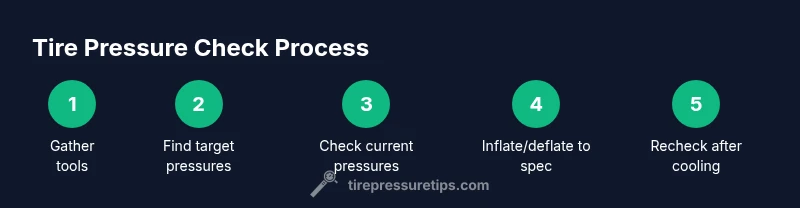
Follow this structured approach to ensure accuracy and safety. Start with the front left tire and move around, check cold pressures, compare to the sticker, adjust as needed, and recheck. Use short bursts with the inflator to avoid overshoot. Confirm your readings after the tires have cooled.
TPMS and seasonal considerations
Tire Pressure Monitoring Systems (TPMS) help alert you to underinflated tires, but they aren’t a substitute for checking actual pressures. After inflating to the recommended values, drive briefly to allow the system to register changes, then recheck when tires are cold. Seasonal changes—especially cold weather—can cause normal pressure to drop by several PSI. If TPMS readings consistently diverge from gauge measurements, inspect valve stems, sensors, and wheel rims for damage or leaks.
Tools & Materials
- Tire pressure gauge (digital or analogue)(Use cold tires for accurate readings; calibrate if needed.)
- Air compressor or tire inflator(Ensure it can reach the door-jamb target pressure range.)
- Honda Jazz owner’s manual or door jamb sticker(Locate the recommended psi values for front and rear tires.)
- Valve caps(Keep them on to protect valve cores and prevent dirt ingress.)
- Notebook or smartphone for readings(Record values for trend tracking and future reference.)
Steps
Estimated time: 10-15 minutes
- 1
Prepare tools and vehicle
Assemble your gauge, inflator, and the Honda Jazz tire pressure information. Ensure tires are cold and the car sits on a level surface away from heat sources.
Tip: Check tires in the morning after a cold night for the most accurate readings. - 2
Find the target pressures
Locate the door jamb sticker on the driver’s door and note the front and rear pressures. If your model supports different loads, record the values for each axle.
Tip: Axle-specific values are common; front can differ from rear. - 3
Measure current tire pressures
Remove the valve cap, press the gauge onto the valve stem, and record the reading for each tire. Do this for all four tires.
Tip: Take multiple readings and use the average to reduce error. - 4
Inflate or deflate to spec
Add or release air in small increments (1–2 psi) and recheck after settling. Aim for the sticker values on each axle.
Tip: If you overshoot, let air out slowly and recheck. - 5
Reinstall caps and document
Replace valve caps to protect stems; log the final readings or save a photo of the gauge results and door sticker.
Tip: Photos help with future reference and consistency. - 6
Drive and recheck
Take a brief, gentle drive, then recheck tires once they have cooled. This confirms stability and accuracy after a real-world test.
Tip: Recheck again after a few days and during seasonal changes.
Frequently Asked Questions
What is the recommended tire pressure for the Honda Jazz?
The Honda Jazz’s official pressures vary by model and load. Check the door jamb sticker or owner's manual for exact front and rear values for your tires and axle position.
Check the door sticker or manual for the exact front and rear pressures for your Jazz.
Should I check tire pressure when the tires are cold?
Yes. Check tire pressure when tires are cold, ideally after at least a few hours of no driving, to get an accurate reading.
Yes, check when cold for accuracy.
What should I do if the TPMS light stays on after inflating?
If the TPMS light remains on after inflating to spec, drive a short distance to allow the system to reset, or have the system inspected if it stays on.
If TPMS stays on after inflation, get it checked.
Can I inflate to max pressure to improve stability?
No. Do not inflate beyond the manufacturer’s recommended pressures; max pressure is not the target and over-inflation can harm ride quality and wear.
Don't over-inflate beyond the recommended numbers.
Is there a difference between front and rear tire pressures for the Honda Jazz?
Pressure recommendations may differ by axle; confirm front and rear values on the sticker and adjust accordingly.
Front and rear pressures can differ; check the sticker.
How often should I check tire pressure?
Check monthly or before long trips, and whenever you notice changes in temperature or load.
Check monthly or before trips.
Watch Video
What to Remember
- Check tires when cold before long trips
- Follow the door jamb sticker for Honda Jazz pressures
- Use a reliable gauge and recheck after settling
- Verify TPMS readings align with gauge measurements
- Document readings for future reference