Equinox Tire Pressure Guide: Check, Adjust, Maintain
Learn how to check, adjust, and maintain Equinox tire pressure for safer handling and better fuel efficiency. Includes TPMS insights, seasonal tips, and a step-by-step routine for Chevy Equinox owners.


With this guide, you will learn to check and maintain equinox tire pressure for safer handling, better fuel efficiency, and longer tire life. You’ll locate the recommended psi, learn cold-tire checking, adjust for load and speed, and understand TPMS signals. According to Tire Pressure Tips, start with the vehicle placard and verify measurements when tires are cold.
Why Equinox tire pressure matters
Maintaining the right equinox tire pressure isn't just about avoiding a warning light. Proper inflation affects grip, braking, ride comfort, tire wear, and fuel economy. The Tire Pressure Tips team emphasizes that under-inflation or over-inflation changes load distribution, increases rolling resistance, and can compromise steering accuracy in emergency maneuvers. For equinox tire pressure, the recommended levels are shown on the door jamb placard and in the owner's manual, and they can vary between the front and rear tires, depending on trim level and typical load. Seasonal temperature swings can also shift tire pressure, meaning that a cold morning reading might not match a hot afternoon ride. Checking pressure at least once a month, or before long trips with a full passenger or cargo load, gives you a more predictable driving experience. Using a reliable gauge, taking readings when tires are cold (driven less than a mile in the past three hours), and cross-checking both sides helps you avoid under- or over-inflation. A stable tire pressure between the manufacturer’s specifications supports even tread wear, better cornering, and improved straight-line stability.
Finding your Equinox's recommended tire pressure
The first step is to locate the official specification for your vehicle. Open the driver’s door and read the placard on the door jamb; this is where Chevrolet and the tire manufacturer agree on the baseline inflation. The numbers are usually labeled for the front and rear tires and may differ from the maximum cold tire pressure printed on the sidewall of the tire. If you don’t have the placard handy, consult the owner’s manual or the dealership, and compare to typical values for SUVs of your trim. Remember that the recommended pressure is a target, not a maximum; staying within it keeps tread wear even and handling predictable under normal driving. When you check, see whether your tires are standard load or higher load, as this can influence the target. The bottom line: always use the placard on the door jamb for Equinox tire pressure and verify any change with the tire size you’re using.
How to check tire pressure accurately
Begin with cold tires because heat from recent driving can skew the reading. Remove the valve cap, press your gauge onto the valve stem squarely, and note the pressure on the gauge. Compare to the placard; if you’re low, add air in small increments and recheck until you’re within range. If you’re over, release air until you’re within range. Repeat for all four tires, including the spare if you rotate it into service. Use a digital gauge for the most consistent results, then recalibrate your gauge against a known pressure reference periodically. The steps are quick but crucial for safety and efficiency. Do not rely on the dashboard readout for precise inflation, as TPMS can lag or react to ambient conditions.
Adjusting pressure for load, speed, and seasonal changes
Your Equinox may carry different loads depending on whether you’re commuting, traveling with family, or towing. Heavier loads usually require slightly higher inflation to maintain tire footprint and stability. Likewise, higher speeds can marginally shift the ideal pressure, although you should always return to the placard specification for everyday driving. Temperature matters too: a cold morning reading will appear lower than the same tires after a drive. In practical terms, if you’re adding cargo, rebalance by increasing pressure toward the upper end of the range, but never exceed the placard maximum or the tire’s sidewall limit. If you swap to winter tires, check the tire pressure inside the door jamb chart for those tires specifically; the Equinox’s guidance may differ from winter-rated tires.
TPMS: Understanding and diagnosing sensor alerts
TPMS is designed to alert you when a tire’s pressure falls significantly below the recommended level. If you see a TPMS warning, pull over safely and check all tires with a gauge; sometimes a tire can lose pressure slowly due to a small puncture or a seal failure. If one tire’s pressure is notably low, adjust within the placard range and reset the system if your vehicle requires manual TPMS resets after service. Some older systems require a drive cycle to re-activate after inflation; others auto-recalibrate after you drive. Always address a TPMS warning promptly rather than ignoring it, as it can indicate a slow leak or a damaged valve stem. If you’re unsure how to reset, consult the owner’s manual or your dealer.
Seasonal considerations: winter, summer, and temperature changes
As temperatures drop, air contracts and pressure readings fall, which can create a false sense of under-inflation. In the same vein, hot weather can boost tire pressure slightly, potentially pushing you toward over-inflation if you’ve recently added air. The practical rule is to check tire pressure in the morning when temperatures are cooler and adjust gradually if the reading remains outside the placard range after a few trips. If you live in a climate with wide seasonal swings, set a reminder to re-check when the season changes and before long trips. The Equinox’s tire design and TPMS are calibrated for typical ambient conditions, but extremes can degrade handling and wear.
Common mistakes and troubleshooting
Common mistakes include inflating tires while they are hot, relying solely on the dashboard light rather than measuring with a gauge, and ignoring differences between front and rear tire pressures. Another error is using an old or inaccurate gauge or failing to replace valve caps, which can cause slow leaks. If you notice uneven wear, vibration, or pulling, re-check all tires, verify the gauge accuracy, and inspect the valve stems for damage. If you suspect a slow leak, you’ll want to inspect for punctures or consult a tire professional. Finally, don’t forget the spare tire: it should be checked periodically and inflated to the same target range if it’s a full-size spare that could see service.
Safety implications and maintenance routine
Maintaining correct Equinox tire pressure is a core safety practice. Properly inflated tires provide better braking, improved cornering, and shorter stopping distances in wet or icy conditions. Develop a simple maintenance routine: check your tire pressure monthly, before long trips, and whenever you notice a change in ride quality or fuel economy. Keep a portable gauge in your glove box for quick checks, and log readings if you’re troubleshooting a slow leak. Finally, remember to inspect tires for signs of damage, tread depth, and even wear patterns. A small habit—checking pressure—contributes to broader road-safety outcomes.
How to extend tire life and fuel efficiency through proper pressure
Tire pressure plays a direct role in how evenly your tread wears and how efficiently your engine uses fuel. When the pressure is within the recommended range, tires distribute weight evenly, reduce rolling resistance, and improve fuel economy. Conversely, under-inflated tires can cause shoulder wear, increase heat buildup, and raise the risk of tread separation, while over-inflation can lead to a harsher ride and increased risk of road hazard damage. Combine pressure checks with regular tire rotation and alignment checks for balanced wear. If you use winter tires seasonally, be aware that your pressure targets may shift due to different tire construction. In short, steady, mindful inflation practices keep you safer, save you money, and help your Equinox perform as its engineers intended.
Tools & Materials
- Tire pressure gauge(Digital gauge recommended for accuracy; keep a spare battery.)
- Air pump or portable compressor(Ensure access to a reliable source of air; know target psi for your tires.)
- Owner’s manual and door jamb placard(Essential for the exact Equinox tire pressure values.)
- Valve caps(Keep caps on to prevent leaks and contamination.)
- Notebook or digital log(Optional; track readings over time to spot leaks or trends.)
Steps
Estimated time: 15-25 minutes
- 1
Locate the recommended pressure
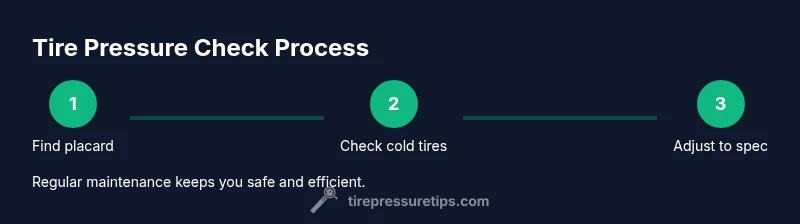
Find the exact psi on the door jamb placard and cross-check with the owner's manual. Note differences for front and rear tires and consider load conditions.
Tip: If you don’t know your tire size, verify it on the tire sidewall and match to the placard. - 2
Check tires when cold
Plan readings after tires have cooled for at least three hours or before driving. Heating from recent use inflates readings.
Tip: Ignore readings immediately after a highway drive; wait for cooling for accuracy. - 3
Attach gauge and read
Remove the valve cap, press the gauge squarely on the valve stem, and note the pressure. Repeat on all four tires.
Tip: Take multiple readings per tire to ensure consistency. - 4
Adjust to spec
If low, add air in small increments; if high, release air until within the target range. Recheck after each adjustment.
Tip: Never guess; adjust in 1–2 psi increments and re-measure. - 5
Check all four tires and the spare
Inflate each tire to the placard value, including the spare if you intend to deploy it in emergencies.
Tip: Spare tires often require different pressures; verify if applicable. - 6
Record and reset if needed
Document readings or reset TPMS as required by your model after inflation.
Tip: A quick log helps spot leaks and plan future checks. - 7
Recheck after a short drive
Drive gently for a few miles and recheck; heat can cause minor changes, but you should still stay within the range.
Tip: If you consistently see changes, seek professional inspection for leaks.
Frequently Asked Questions
Where can I find the Equinox tire pressure specification?
The specification is on the driver door jamb placard and in the owner’s manual. It may differ between front and rear tires and between trims.
Check the door jamb placard, then confirm with the owner’s manual.
Should I check tire pressure when tires are cold or warm?
Check when tires are cold for the most accurate reading. Driving heats tires and inflates the air inside them.
Check when cold; readings can rise after driving.
What happens if I drive with under-inflated tires?
Under-inflation can increase wear on the edges of the tread, reduce fuel efficiency, and worsen handling and braking.
Under-inflated tires wear unevenly and can affect safety.
Can TPMS always be trusted to show exact pressures?
TPMS signals a warning when pressure drops significantly, but you should verify with a gauge for precise numbers.
TPMS warns you; always verify with a gauge.
How often should I check tire pressure?
Check at least monthly, before long trips, and after seasonal changes or noticeable ride changes.
Check monthly and before long trips.
What about the spare tire?
If your spare is a full-size tire, inflate it to the same target range as the others when it’s meant for use.
Ensure the spare’s pressure is within the same range if it’s a usable full-size spare.
Watch Video
What to Remember
- Check pressure when tires are cold.
- Refer to the door jamb placard for Equinox tire pressure.
- Keep pressure within the recommended range for safety and efficiency.
- Use TPMS as a guide, not a precise gauge in all conditions.
- Seasonal changes require re-checks and possible adjustments.