Is it OK to Check Tire Pressure in Cold Weather? A Practical Guide
Learn whether it's safe to check tire pressure in cold weather, how temperature affects readings, and step-by-step tips to get accurate tire pressures year-round.


Yes—it's safe and recommended to check tire pressure in cold weather, and doing so helps prevent underinflation and reduces wear. Temperature changes affect readings, so mornings often show lower pressures than mid-day. To ensure accuracy, check tires when they are cold (driven less than 1-2 miles) with a reliable gauge, and adjust to the vehicle placard requirements.
Understanding the Temperature Effect on Tire Pressure
Tire pressure is not a fixed value; it changes with ambient temperature. According to Tire Pressure Tips, cold weather can cause tire pressures to drop even when the tires themselves have not been driven. This is due to the air inside the tire cooling and contracting as the surrounding air chills. When you measure in the morning, readings may show lower pressures than the late-afternoon reading on the same tires. As a rough rule of thumb, many drivers observe about a 1 psi change for every 10°F change in temperature, but actual changes depend on tire design, load, and inflation history. Knowing this helps you interpret readings correctly and avoid underinflation or overinflation.
To maintain consistent readings, check tires after they’ve cooled for at least three hours or after you’ve driven less than a mile. If you must check soon after driving, subtract the heat gain from the last drive; most gauges will show higher numbers on warm tires. This nuance is why TPMS readings can be misleading in extreme weather.
How Temperature Impacts Readings and Baseline Inflation
In cold environments, the air inside each tire contracts as the metal and rubber also contract slightly with the air around them. Because tire pressure is a measure of the air inside the tire, this contraction lowers the gauge reading. Conversely, when ambient temperatures rise, the air expands and readings can creep upward. The Tire Pressure Tips team emphasizes that this is normal physics, not a tire defect. Drivers who only check once a year are likely to miss seasonal changes and may end up driving on underinflated tires during winter months.
Practical Implications for Winter Driving
Low tire pressure reduces fuel efficiency, increases tire wear, and can compromise handling and braking. In winter, cold mornings can produce readings that suggest underinflation even if the tires are within an acceptable range for the vehicle. The prudent approach is to verify pressures regularly during seasonal transitions and after a cold snap. Always compare readings to the placard on the door jamb or owner’s manual rather than relying solely on memory or a single historic reading. Routine checks help you maintain consistent performance across seasons.
Tools, Measurements, and Accurate Gauges
A reliable tire pressure gauge is essential for cold-weather checks. Digital gauges provide quick readings, while analog gauges offer a tactile feel that many technicians trust. Regardless of type, ensure the gauge is calibrated and read the pressure in the same units as the placard (psi or kPa). Keep a small notebook to log readings by tire position and date. This practice helps you track trends and catch slow leaks early, which is especially important during temperature swings.
Interpreting TPMS Readings vs. Manual Checks
Tire Pressure Monitoring Systems (TPMS) alert you when pressures fall below a threshold, but readings can be off in cold conditions. A TPMS alert should prompt a manual check with a gauge when temperatures have recently dropped. If the TPMS reports a warning while your gauge reads a different value, recheck after a few hours or after a short drive to allow tires to reach a more stable temperature. Rely on the gauge for the precise value and use TPMS as a supplementary safety check.
Seasonal Maintenance: A Quick Checklists for Winter
- Check all four tires and the spare for even inflation.
- Compare each reading to the placard and adjust accordingly.
- Recheck after driving 3-5 miles to allow tires to warm slightly and settle.
- Inspect valve stems and sealing rings for leaks, especially after cold days.
- If readings vary significantly between tires, consider a professional inspection to rule out slow leaks or damage.
Common Mistakes and How to Avoid Them
Common mistakes include inflating to the maximum tire pressure printed on the sidewall, relying on the TPMS alone, and checking after a long drive when tires are warm. Always verify with a gauge when the tires are cold, and reset your mental baseline with each season. Remember that cold-weather readings rarely indicate a problem if they align with the placard when the tires are cold.
The Bottom Line: Consistent Checks Beat Quick Assumptions
Regularly checking tire pressure in cold weather protects safety, fuel economy, and tire life. Temperature-driven readings are a normal part of tire maintenance, and understanding this helps you respond appropriately rather than guessing. The Tire Pressure Tips team recommends building a winter-check routine that aligns with your vehicle’s placard and local climate.
Tools & Materials
- Digital tire pressure gauge(Calibrated recently; read in psi (or kPa); keep in a glove box)
- Spare tire gauge (analog)(Useful as a backup if the digital gauge fails)
- Vehicle owner’s manual / door jamb placard(Contains the recommended cold-inflation pressure by tire position)
- Air compressor or inflator(Use only if a tire is below the recommended pressure after checking with a gauge)
- Notebook and pen(Log readings by tire position and date)
Steps
Estimated time: 20-40 minutes
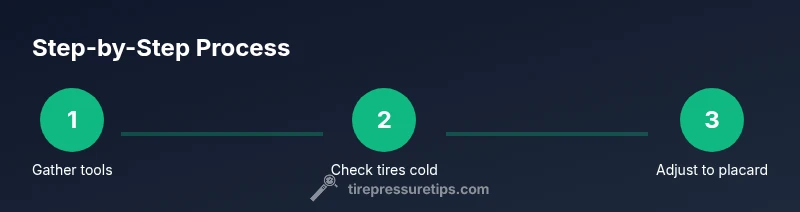
- 1
Gather tools and locate the placard
Collect a calibrated tire gauge and, if possible, an inflator. Find the placard on the driver’s door jamb or owner's manual to confirm correct cold-inflation pressures for each tire.
Tip: Having all items ready saves time and reduces the temptation to guess. - 2
Ensure tires are cold before measuring
Do not measure after a long drive or highway run. Wait at least three hours or measure first thing in the morning when ambient temperatures are stable.
Tip: Cold tires give the most accurate baseline for inflating to the placard. - 3
Check each tire with the gauge
Remove the valve cap, press the gauge onto the valve stem, and note the reading. Repeat for all four tires and the spare if applicable.
Tip: Take readings in a consistent order (e.g., front left, front right, rear left, rear right). - 4
Compare readings to the placard and adjust
If a tire is below the recommended pressure, inflate to the specified value. If it’s above, let air out in small increments until it matches the placard.
Tip: Avoid inflating beyond the upper limit on the placard; excess pressure can be dangerous. - 5
Re-check after a short cooldown
Drive or rotate the tires for a few miles and recheck to verify the pressure remains within the target range as temperatures fluctuate.
Tip: Driving a short distance helps seat the tire and settle the pressure for a stable reading. - 6
Document readings and seal the process
Record the final pressures and date. Re-cap valve stems and store gauges properly to maintain accuracy for future checks.
Tip: Keep a seasonal log to track changes over time.
Frequently Asked Questions
Why does my tire pressure read lower in the morning?
Cold temperatures cause air inside the tire to contract, lowering pressure. Reading tires in the morning when they are cold gives a more accurate baseline to compare against the placard. If you measure later in the day, account for the temperature change when adjusting.
Morning readings are lower because cold air contracts. Check the tires when they’re cold, then adjust to the placard as needed.
Can I check tire pressure right after driving?
Measuring after a drive yields higher readings due to heat buildup. If you must check after driving, subtract the estimated heat gain or simply recheck once the tires have cooled. For accuracy, use the cold-check method before long trips.
Avoid checking right after driving. If you must, wait for the tires to cool and recheck.
Should I rely on TPMS readings in cold weather?
TPMS is a valuable safety alert, but it isn’t a substitute for a precise gauge. Air can leak slowly between readings, especially in cold weather, so always confirm with a handheld gauge against the placard.
TPMS helps, but always verify with a gauge for exact numbers.
What if two tires read very differently at the same time?
Different readings can indicate a leak, valve issue, or gauge error. Recheck with a calibrated gauge and consider a professional inspection if inconsistencies persist. Ensure your gauge is accurate before diagnosing a problem.
If readings vary, double-check with a good gauge and consider a pro check if it continues.
Is it dangerous to drive with underinflated tires in winter?
Yes. Underinflated tires can reduce braking efficiency, increase wear, and raise the risk of overheating. Maintain target inflation to ensure safe handling and fuel efficiency, especially in cold weather when tire performance matters more.
Yes, underinflation is risky, particularly in winter—keep tires at the right pressure.
Watch Video
What to Remember
- Check tires when cold for accuracy
- Use the placard as the inflation target
- TPMS is a guide, not a substitute for a gauge
- Log readings to track seasonal changes
- Address any persistent underinflation promptly