Tire Pressure QX60 Guide: Check, Adjust, and Maintain
Learn how to check and maintain tire pressure on the QX60. Step-by-step guidance, TPMS tips, and best practices for safer handling, better fuel economy, and longer tire life.


Goal: check and adjust the QX60’s tire pressure to the recommended level for safe handling, fuel efficiency, and tire wear prevention. You’ll need a reliable tire gauge, access to an air pump, and the vehicle’s PSI targets from the placard or owner’s manual. Follow the step-by-step process below to complete this task confidently.
Why Tire Pressure Matters for the QX60
Maintaining correct tire pressure is essential for safe handling, efficient fuel economy, and even tire wear on the QX60. Underinflated tires reduce cornering grip and increase rolling resistance, which can stress the tires and suspension. Overinflated tires risk a harsher ride and uneven tread wear, especially on imperfect road surfaces. For the QX60, official PSI targets depend on wheel size, load, and sometimes trim, making it important to confirm the exact numbers for your setup. The Tire Pressure Tips team often emphasizes that dashboard warnings are not a substitute for a precise pressure check with a gauge. Checking when tires are cold yields the most accurate reading, and maintaining the correct pressures helps prevent punctures, improves steering feel, and preserves tire life. This guide walks through practical checks and adjustments tailored to the QX60, with clear steps you can follow.
Quick context from Tire Pressure Tips
According to Tire Pressure Tips, the right tire pressure is not a one-size-fits-all value; it varies by vehicle, wheel size, and load. Always cross-check the placard on the door jamb or the owner's manual for the correct targets for front and rear tires. A consistent, properly inflated setup contributes to improved braking, better fuel economy, and safer highway performance.
What you’ll gain by keeping the QX60 tires properly inflated
- Better fuel efficiency and reduced CO2 emissions
- More predictable handling and braking performance
- Even wear across the tread and extended tire life
- Fewer nuisance TPMS alerts and improved ride quality
Remember: tire pressure can change with temperature and usage, so regular checks are essential. The Tire Pressure Tips framework highlights that proactive maintenance reduces the likelihood of unexpected tire issues and helps you stay safer on the road.
Tools & Materials
- Digital tire pressure gauge(High accuracy (+/- 1 psi if possible); choose a gauge with a clear display)
- Air compressor or access to an air pump(Prefer a regulator and a gauge built into the device; ensure it can reach the vehicle’s target PSI)
- Owner’s manual or door placard(Contains the correct front/rear PSI targets for your wheel size)
- Soapy water or leak detector(Optional for checking suspected slow leaks around valve stems or tire beads)
- Notebook or digital log(Record readings over time to spot slow changes)
Steps
Estimated time: 20-40 minutes
- 1
Check tires cold
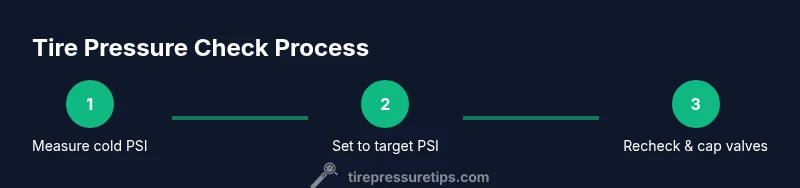
Before driving, inspect and measure tire pressures for all four tires. Driving heats tires and increases readings, which skews accuracy. If you’ve just driven, wait at least a few hours, or check first thing in the morning for best results.
Tip: Warming tires in operation will raise pressure; always use cold readings for target comparison. - 2
Find the target pressures
Locate the correct PSI targets for your QX60 front and rear tires from the door jamb placard or the owner's manual. Note that different wheel sizes or trims can require different targets; write them down for reference.
Tip: If two values exist (front vs rear), apply both as specified; do not average them. - 3
Measure current pressures
Remove the valve cap and press the gauge evenly onto the valve stem to obtain a stable reading. Do this for each tire and record the numbers. If a tire reads well below target, plan to adjust.
Tip: Ensure the valve stem and gauge are clean to avoid false readings. - 4
Inflate or deflate to target
Use the air pump to add air until the reading matches the recommended PSI. If overinflated, release air in small increments and recheck. Repeat until all tires match their targets.
Tip: Inflate in small increments and recheck frequently to prevent overshoot. - 5
Recheck and finalize
Recheck all four tires after adjustments and replace valve caps. If your TPMS warned during inflation, drive a short distance to allow the system to recalibrate, or consult the owner’s manual for TPMS reset guidance.
Tip: Document final readings to monitor for changes over time.
Frequently Asked Questions
What is the recommended tire pressure for the QX60?
Check the door placard on the driver’s side jamb or the owner's manual for the exact front and rear tire pressures for your wheel size and trim. Values vary by configuration, so verify the correct targets.
Check the door placard or owner's manual for your exact tire pressures, as values vary by wheel size and trim.
How often should I check tire pressure on a QX60?
Aim to check tire pressures at least monthly and before long trips, especially when changing seasons or after air temperature shifts.
Check your tires at least monthly and before long trips, especially with seasonal changes.
What should I do if the TPMS warning light turns on after inflating?
Recheck all four tires with a gauge. If readings are correct and the light stays on, there may be a sensor fault or a slow leak; service is recommended.
If the light stays on after inflation, recheck and if it persists, seek service for sensor or leak issues.
Can I use a home air compressor for QX60 tires?
Yes, a home compressor can work as long as you can control the pressure accurately and stop at the target PSI. Avoid over-inflating and use a gauge to verify.
A home compressor is fine, just be precise and stop at the target PSI.
Why does temperature affect tire pressure?
Air expands in warm conditions and contracts when cold, which changes the PSI. Check pressures after temperature changes and adjust as needed.
Temperature changes affect air pressure, so recheck after weather shifts.
Should I adjust tire pressure when the car is loaded?
Yes. If you routinely carry heavier loads, follow the target pressures specified for loaded conditions in the placard or manual. This helps maintain handling and tire wear.
If you regularly haul loads, use the higher target pressures specified for loaded conditions.
Watch Video
What to Remember
- Check cold PSI against the correct targets for your QX60.
- Use a reliable gauge and a steady inflation/deflation process.
- Record readings and monitor changes over time.
- Temperature and load influence tire pressure; adjust as needed.
- TPMS behavior is supportive—don’t rely on it alone for accuracy.