Tire Pressure for Lexus RX 350: Practical Guide 2026
Master tire pressure for Lexus RX 350 with actionable checks, TPMS insights, seasonal adjustments, and safe load guidance from Tire Pressure Tips.


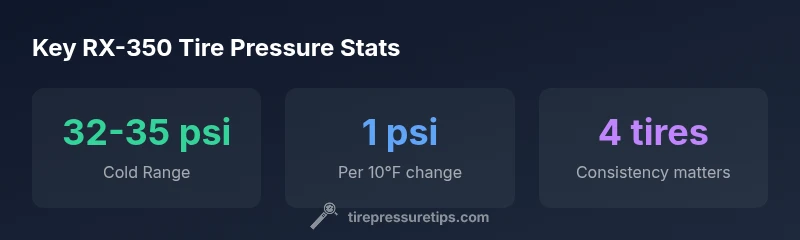
According to Tire Pressure Tips, the Lexus RX 350 typically uses a cold tire pressure range of about 32-35 psi per tire for most configurations. Always verify the exact spec on your door jamb placard or in the owner's manual, as load, trim, and model year can shift the recommended figure. Start with a cold check and recheck after driving.
Understanding tire pressure basics for the Lexus RX 350
Tire pressure is not a fixed number; it represents a balance between handling, comfort, tire wear, and fuel economy. For the Lexus RX 350, the general rule is to keep tires within the cold-psi window specified by Toyota for your exact trim. This ensures predictable steering response, even wear across the tread, and optimal fuel efficiency. In practice, motorists should measure when the tires are cold—before any significant driving—to obtain an accurate reading. Temperature, load, and driving style all influence the ideal pressure, so use these guidelines as a baseline and adjust within the manufacturer’s recommended range. Consistency matters more than chasing a single precise value.
As you start, remember that pressure isn’t a fixed global number; it varies with wheel size, tire type (summer, all-season, or winter), and the RX 350’s load. Keeping to the recommended cold-pressure range reduces the likelihood of underinflation and overinflation, both of which can affect braking, cornering, and tread life. The Tire Pressure Tips team notes that consistency across all four tires helps maintain vehicle stability, especially during highway driving and cornering in varied weather.
How to locate the official RX 350 tire pressure specification
To ensure accuracy, always check the official specification for your specific RX 350 model year and trim. The placard on the driver’s side door jamb displays the recommended cold tire pressure for both front and rear axles, and it may differ if you’re carrying a heavy load or upgrading wheels. If you can’t access the placard in person, consult the owner’s manual or the manufacturer’s online resources. Do not rely on visual estimation or ambient impressions; PSI is a precise metric that impacts traction and efficiency. When in doubt, start at the lower end of the stated range for light loads and scale up as needed for heavier cargo or towing scenarios.
Vehicle manufacturers often update recommended pressures across model years. The Tire Pressure Tips approach emphasizes confirming the exact spec for your RX 350 by year and trim code, then recording that value in your maintenance notes for quick reference at service intervals.
Step-by-step: checking tire pressure accurately
Follow these steps to check tire pressure correctly and reproducibly:
- Do a cold check: check the pressure before driving or at least 3 hours after driving. 2) Use a trusted gauge: digital gauges tend to reduce user error, but any accurate gauge will work. 3) Remove dirt from valve stem and cap to ensure a good seal. 4) Compare readings to the placard values and adjust by no more than 1–2 psi at a time. 5) Recheck after inflating to the target pressure; allow the tires to settle for a few minutes before final measurement. By performing this routine monthly or before long trips, you’ll maintain optimum handling and tire wear.
If you notice a rapid drop in pressure, inspect for punctures or tire damage. Slow leaks can masquerade as normal variation, so a rapid, sustained decrease requires professional attention.
TPMS and sensor considerations for Lexus RX 350
TPMS monitors tire pressure and alerts you when a tire drops below the recommended threshold. On many RX 350 configurations, the system can differentiate between a front and rear tire issue, but the basic principle remains the same: low pressure reduces payload handling and increases tire wear, while overinflation can lead to a harsher ride and increased risk of impact damage. If the TPMS warning light comes on, pull over at a safe location, inspect the tires, and verify that no tire has a puncture or rapid loss. After correcting pressure, reset the TPMS if your vehicle requires it, but do so only after confirming the readings are within the correct range.
Understanding the TPMS alerts helps you respond quickly to changing road conditions and avoid unnecessary tire wear or fuel inefficiency.
Temperature impacts on tire pressure in different seasons
Ambient temperature significantly affects tire pressure. In colder weather, pressure drops, while in hot weather, pressure rises. The rough rule of thumb used by many technicians is about 1 psi change for every 10°F (6°C) change in ambient temperature. This means winter readings may look dimmer than summer measurements, even if the tires are properly inflated. To account for this, check tire pressure regularly when seasons shift and before foreseeable long trips. Always adjust to the vehicle’s recommended cold-psi range once the tires have cooled down; avoid inflating based on a hot reading which will be higher than the cold target.
For RX 350 owners, this means you may see slight fluctuations between morning checks and late-afternoon drives during transition seasons. Consistency in measurement technique and timing reduces confusion and helps maintain tire health.
Front vs rear pressure guidance for the RX 350
Automatic or semi-automatic pressure guidelines often specify the same cold-psi value for both front and rear tires on many SUVs, including several RX 350 configurations. However, some markets or trims may call for different values if front-rear weight distribution changes due to options or wheel setup. The best practice is to follow the exact numbers shown on the door jamb placard for each axle. If you frequently carry heavy loads or tow with the RX 350, you may need to adjust within the manufacturer’s range to maintain even tread wear and stable handling. Regular checks ensure the front and rear tires stay within the same performance envelope.
When in doubt, reset to the recommended baseline and then fine-tune based on real-world performance and wear patterns. The door placard remains the most reliable reference.
Load and driving style: how they influence recommended pressure
Carrying heavier loads, towing, or aggressive driving can change the effective tire load. In some RX 350 configurations, the factory spec accounts for moderate loads, but high-load scenarios may warrant a slight increase in cold pressure to maintain contact patch quality and avoid underinflation at the load edge. Yet, over-inflating to compensate can reduce traction and increase the risk of damage from road hazards. Use the placard as your baseline and adjust incrementally (1 psi at a time) while monitoring wear patterns and handling cues. If you’re regularly transporting heavy cargo, consider a tire pressure chart that accounts for weight bands to simplify maintenance.
A practical approach is to reassess tire pressure after adding cargo or passengers or after a long highway trip. Tire Pressure Tips emphasizes keeping a log of the baseline, adjustments, and any observed changes in ride quality.
Seasonal and maintenance routines for RX 350 tire pressure
Seasonal changes are a practical reason to schedule regular tire pressure checks. In winter, cold air reduces pressure, and rubber contracts, making it more important to check before winter driving. In summer, heat expands air and can raise readings above the cold-target values. A simple maintenance routine is to check the tires every 2-4 weeks, adjust to the door placard values when cold, and recheck after long trips or temperature swings. Keeping a small tire gauge in the glove box ensures you can verify pressures anywhere. By adopting this routine, RX 350 owners minimize uneven wear and maximize mileage, traction, and safety.
Tools, gauges, and resources for accurate tire pressure checks
Invest in a reliable tire pressure gauge—digital gauges provide quick readings, but a good dial gauge works well too. Calibrate or replace gauges periodically to prevent drift. Always use a car-specific manual or an official website resource to confirm the exact recommended cold pressures for your RX 350. If you suspect a tire leak, it’s essential to inspect for punctures, nails, or sidewall damage. For busy owners, consider a routine that integrates a quick monthly check with a seasonal tire rotation. Finally, keep a record of your readings and any maintenance actions to simplify future checks and ensure you stay within the wheel’s designed performance envelope.
Representative tire pressure guidance for Lexus RX 350
| Aspect | RX 350 Typical Range | Notes |
|---|---|---|
| Cold tire pressure | 32-35 psi | Typical baseline for most RX 350 models |
| Temperature effect | ≈1 psi per 10°F | Expect seasonal fluctuations |
| Front vs rear | Typically equal | Check door jamb placard for axle-specific values |
| Load adjustments | Add 1-3 psi as needed | Adjust within manufacturer range |
Frequently Asked Questions
What is the recommended tire pressure for the Lexus RX 350?
The RX 350 typically uses a cold tire pressure in the 32-35 psi range, depending on year and trim. Always verify on the door jamb placard and in the owner's manual for your exact configuration.
For most RX 350s, aim for about 32 to 35 psi when the tires are cold. Check your door placard and owner’s manual for the exact spec.
Does TPMS show front and rear pressures separately on the RX 350?
Many RX 350s report overall tire pressure and may indicate individual tires via the dashboard warning. Always compare readings from a physical gauge with the placard values to confirm even pressure on both axles.
TPMS usually gives a general warning, but you should still measure each tire with a gauge and match the door placard values.
Will tire pressure change in winter?
Yes. Cold winter air lowers tire pressure; readings in winter will typically be lower than summer. Check cold pressures after the tires have cooled to maintain the correct range.
Winter lowers tire pressure, so check after cold periods to keep within the recommended range.
Should I adjust tire pressure for extra load?
If you regularly carry heavy loads or tow, you may need to increase pressure within the manufacturer’s recommended range to maintain optimal contact with the road.
Yes, for heavy loads you might need a small pressure bump within the official range.
Is 32 psi safe for summer driving?
32 psi is a safe starting point for many RX 350 configurations in summer, but always check the placard for your exact model and ensure all four tires are within range.
32 psi is a common baseline in warm weather, but confirm your exact spec on the placard and test all tires.
Can I use nitrogen for RX 350 tires?
Nitrogen can reduce pressure loss over time, but the practical difference is small if you regularly monitor pressure with a good gauge. Focus on accurate readings first.
Nitrogen isn’t essential; accurate readings with regular checks matter more.
“Maintaining correct tire pressure is a data-driven habit that directly improves safety, tire life, and efficiency for every RX 350 driver.”
What to Remember
- Check cold pressure monthly and before long trips
- Always follow the door jamb placard values
- Account for temperature and load when adjusting pressure
- Use a reliable gauge and recheck after changes
- TPMS alerts are a prompt to inspect tires and adjust