Toyota Tacoma Tire Pressure Sensor Troubleshooting: Quick Answers and Step-by-Step Fixes
Urgent troubleshooting guide for the Toyota Tacoma tire pressure sensor (TPMS). Diagnose, relearn, and maintain TPMS to keep tires safe and efficient.


Most Toyota Tacoma TPMS warnings come from a weak battery in a wheel sensor, a tire at low pressure, or a failed sensor. Quick fix: (1) inflate all tires to the recommended PSI when cold, (2) perform a TPMS relearn or reset, (3) replace any faulty sensor if the light stays on. If unresolved, seek professional help.
Toyota Tacoma tire pressure sensor basics
According to Tire Pressure Tips, TPMS is a safety feature that monitors tire pressure and alerts you when it falls outside the recommended range. For the Toyota Tacoma, the tire pressure sensor (TPMS) in each wheel communicates with the vehicle’s data system to provide real-time readings. This system helps prevent underinflation, which can reduce fuel efficiency and increase tire wear. In practice, the Toyota Tacoma tire pressure sensor relies on a battery-powered sensor, a receiver in the wheel well, and a central control unit. When you see the TPMS warning light, you should verify your tire pressures and inspect for sensor issues. Regular maintenance, such as checking tire pressures when the tires are cold, ensures the sensor data stays accurate and reliable. This guide focuses on practical, urgent troubleshooting steps you can perform safely to address a TPMS warning in a Toyota Tacoma.
Common failure modes for the Toyota Tacoma TPMS
The most frequent TPMS faults tend to fall into a few predictable categories. A dying or weak battery inside a wheel sensor is a common culprit, especially on older Tacomas or vehicles with high mileage. A tire that has dropped pressure due to a slow leak or a puncture can trigger a warning even if the sensor is healthy. Damaged valve stems, corroded sensor connections, or physical damage from hitting a pothole can also cause sporadic readings. Finally, rotating tires without reprogramming the TPMS or a faulty wheel sensor can create mismatches that confuse the system. Understanding these failure modes helps you prioritize checks and avoid unnecessary costs.
Diagnostic approach: quick checks and data you need
Start with the simplest checks to rule out obvious causes. Use a reliable tire pressure gauge to verify each tire is at the manufacturer’s recommended PSI when cold. If pressures are correct but the light remains, inspect the wheel for visible sensor damage, cracked sensors, or corroded electrical connections. Note the TPMS fault codes if you have access to a scan tool; these codes point to specific wheels or sensor functions. Confirm that the spare tire, if equipped with a TPMS sensor, is also monitored, as some Tacomas track the spare in the system. If you recently inflated tires or rotated wheels, the issue may be a relearn requirement rather than a hardware fault.
Relearn and reset: how to pair sensors after service
A successful relearn or reset is often necessary after replacing a sensor or after battery service. The procedure typically involves bringing the vehicle to a specified state (vehicle speed, ignition on, no key cycling) and using either the onboard menu or a TPMS programming tool to register each sensor ID with the vehicle’s ECU. Some Tacomas require the vehicle to be driven for a short distance to complete the relearn, while others accept an auto relearn after a key cycle and a controlled drive. Always refer to the owner’s manual and follow the steps in order to avoid false positives. If your model requires a professional tool or shop procedure, don’t delay care.
Maintenance and prevention tips for long-term TPMS health
Preventive care is cheaper than repeated sensor replacements. Regularly check tire pressures when cold and log the readings. If you frequently drive on rough roads or frequently rotate tires, inspect sensors for physical damage during tire service. Keep the wheel rims clean and free of corrosion, and check the battery life of each TPMS sensor if you’re able to inspect them. Consider scheduling an annual TPMS diagnostic with a trained technician to verify sensor health and alignment with the ECU. Small habits—like a quick gauge check at every oil change—can extend TPMS reliability.
When to replace vs repair TPMS components
Not all TPMS issues are repairable. A sensor battery will eventually fail and may require sensor replacement, which may involve swapping the entire sensor module or the valve stem assembly. Damaged sensors or broken wiring around the wheel can necessitate replacement. If the ECU or wheel module has failed, replacement or professional reprogramming may be necessary. If the light returns after a replacement, recheck all tires and ensure proper relearn steps were completed. In many cases, replacing a faulty sensor with a compatible unit and performing a correct relearn resolves the issue.
Steps
Estimated time: 60-90 minutes
- 1
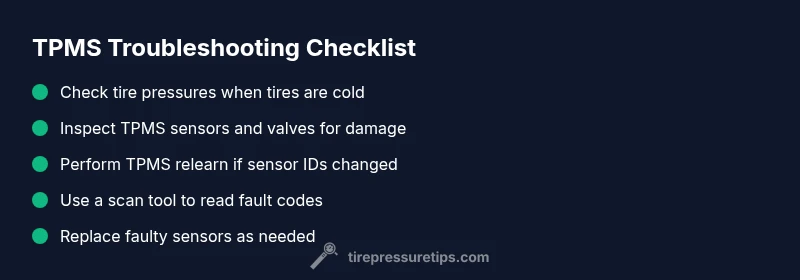
Check all tires for correct cold pressure
Use a reliable gauge to verify each tire reads at the manufacturer’s recommended PSI when the tires are cold. Adjust as needed and note any tire with significantly lower pressure.
Tip: Record the PSI readings to compare with past checks for trends. - 2
Inspect tires and sensors visually
Look for visible damage, leaks, or cracked sensor stems. Inspect valve stems for wear and ensure the wheel mounting area is clean of corrosion.
Tip: A suspect sensor with a damaged stem is often the culprit. - 3
Attempt a TPMS relearn if required
Follow the Tacoma’s relearn procedure via the instrument cluster or a TPMS tool. This step registers current sensor IDs with the ECU and can clear false alarms.
Tip: Do not drive aggressively during relearn; a calm, steady drive supports the process. - 4
Use a scan tool to read TPMS codes
If available, connect a TPMS-capable scan tool to pull fault codes. Note which wheel is flagged and assess sensor health accordingly.
Tip: Codes help avoid guessing which sensor is faulty. - 5
Decide on replacement if necessary
If the light returns after a relearn, replace the faulty sensor or a damaged valve stem. Relearn again after replacement.
Tip: Ensure replacement sensors are compatible with your Tacoma model year. - 6
Test drive and recheck
Take a short test drive to allow the system to stabilize. Recheck the TPMS light after the drive to confirm the issue is resolved.
Tip: If the light remains on, escalate to professional service.
Diagnosis: TPMS warning light on Toyota Tacoma remains on after checking tire pressures
Possible Causes
- highLow or fluctuating tire pressure in one or more tires
- highWeak or dead TPMS sensor battery
- mediumFaulty TPMS sensor or damaged wiring
- lowRecent tire rotation or sensor relearn not completed
Fixes
- easyInflate all tires to the recommended PSI when cold and recheck readings
- easyPerform TPMS relearn/reset according to the Toyota Tacoma procedure or vehicle manual
- mediumInspect sensors for damage and replace any faulty unit; verify wiring connections
- hardIf light persists after these steps, consult a tire or TPMS specialist for advanced diagnostics
Frequently Asked Questions
How can I tell if a TPMS sensor is failing on my Toyota Tacoma?
A failing TPMS sensor often triggers a warning light even after inflating tires. You may see inconsistent readings or fault codes on a scan tool pointing to a specific wheel sensor. If this persists after a relearn, the sensor is a likely fault.
If the warning stays on after you check pressures, a failing sensor is likely—get a diagnostic with a TPMS tool to confirm.
Can I relearn TPMS myself on a Toyota Tacoma?
Yes, many Tacomas support a DIY relearn using the instrument cluster or a TPMS tool. Some models require a dealer or tire shop tool for a guaranteed relearn. Always follow the owner’s manual steps in order.
You can usually relearn TPMS yourself with the manual or a tool, but check your model’s specifics.
Is it safe to drive with a TPMS warning?
It is not safe to drive long distances with underinflated tires. Inflate to the recommended PSI as soon as possible and limit highway speeds until tires are properly inflated.
No, don’t push your luck—inflation it to the recommended level and get a quick check if the warning sticks.
How long does TPMS relearn take?
Relearn procedures vary by model, but most take only a few minutes of setup and a short drive for the system to recognize the sensors. Follow the exact sequence in your manual or TPMS tool prompts.
It usually just takes a few minutes plus a short drive for the system to confirm.
When should I replace a TPMS sensor?
Replace a TPMS sensor if the battery has failed, the sensor is physically damaged, or the diagnostic codes repeatedly point to the same wheel. After replacement, perform a relearn to ensure proper operation.
Replace the sensor if it’s faulty or damaged, and relearn afterward to ensure it works.
Do TPMS issues affect fuel efficiency?
While TPMS issues themselves don’t directly cause mileage loss, underinflated tires increase rolling resistance, which can reduce fuel efficiency. Keeping tires at the correct pressure helps maximize efficiency.
Underinflated tires hurt efficiency, so fix TPMS issues promptly to protect mileage.
Can a faulty TPMS be repaired or just replaced?
Most TPMS issues require sensor replacement or wheel electronics repair when confirmed faulty. Minor wiring or connector issues may be repairable, but a failed battery typically means replacement.
Usually replacement is needed for a dead battery or a failed sensor, with repair possible for some wiring problems.
Watch Video
What to Remember
- Check tire pressures first to rule out simple causes
- Perform TPMS relearn after sensor service or battery replacement
- Inspect sensors and wiring for damage during service
- Replace sensors only when diagnostics indicate a fault