Toyota Tire Pressure Sensor TPMS: Check, Relearn, Maintain
Learn how to inspect, relearn, and maintain Toyota tire pressure monitoring sensors (TPMS). This practical guide covers direct vs indirect TPMS, tools, step-by-step relearn, and troubleshooting to keep your Toyota tires safe and efficient.


This guide shows you how to check, diagnose, and relearn tire pressure sensors on a Toyota. You’ll identify whether your vehicle uses direct or indirect TPMS, gather the right tools, and complete a step-by-step relearn routine safely. Expect tips on checking pressures, understanding sensor battery life, and when to replace a faulty sensor. You'll also learn how to verify all four sensors read correctly.
The role of TPMS on Toyota and why it matters
On Toyota vehicles, tire pressure monitoring helps prevent under- or over-inflated tires, which can affect handling, tire wear, and fuel efficiency. The Tire Pressure Tips team emphasizes that maintaining proper tire pressure is a simple, ongoing habit with big payoffs for safety and performance. TPMS alerts you when a tire is below or above the manufacturer-specified range, prompting timely checks. In Toyota models, the system may be direct (sensor in each tire) or indirect (uses wheel speed sensors) depending on the year and trim.
Understanding which system your car uses will guide both the check process and the relearn procedure. Direct TPMS sensors are mounted inside the tire and monitored by a central module, while indirect TPMS relies on comparing rotational speeds to infer pressure differences. This distinction matters for replacement parts, battery life, and relearn steps. According to Tire Pressure Tips, staying proactive about TPMS maintenance saves money and reduces risk on the road.
Direct TPMS vs indirect TPMS in Toyota: what to know
Direct TPMS provides a real pressure reading from each sensor and can warn you if a tire deflates. Indirect TPMS does not measure pressure directly but uses sensors in the ABS system to infer low pressure when differences in rolling circumference occur. Toyota models may switch between methods across generations; some trims rely on direct sensors, while others use indirect signals. The practical difference is in maintenance: direct sensors require battery life and occasional replacement, while indirect systems depend on wheel speed data and software re-learns after tire changes. When diagnosing a TPMS warning, identify which method your vehicle uses and plan your steps accordingly. This knowledge helps you choose the right tools and avoids unnecessary sensor replacement.
Reading TPMS data and identifying sensor IDs on a Toyota
To verify readings, you’ll need to access the TPMS data stream. A dedicated TPMS scan tool or a modern OBD-II tool with TPMS support can display sensor IDs and current pressures. Start by locating the sensor IDs printed on each valve stem or inside the wheel well area in some models. If your vehicle uses indirect TPMS, you’ll read wheel-speed sensor data and correlate it with tire sizes. Record the IDs and note the wheel positions. This preparation makes the relearn or sensor replacement steps faster and reduces the chance of misidentifying tires.
Pressure targets, “cold” readings, and dashboard indicators
Before you adjust or verify pressures, understand the concept of a cold reading. For most vehicles, readings should reflect pressures when the tires are cold and the vehicle hasn’t been driven recently. Take measurements after the car has been stationary for a few hours or early in the morning. Use a reliable gauge to check each tire and compare with the manufacturer’s target listed in the owner’s manual or on the driver’s door placard. If a reading seems off, recheck after cooling and rule out slow leaks or valve issues before proceeding with a relearn.
Relearn and calibration: model variations and Toyota specifics
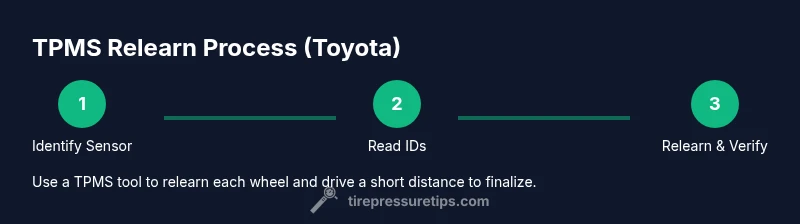
Relearning the TPMS sensors tells the vehicle’s computer which sensor belongs to which wheel. Toyota relearn procedures vary by model year and trim, and some require driving cycles while others require a dedicated relearn sequence with a scan tool. Gather your owner’s manual and any model-specific documentation. If you’re using a professional scan tool, follow the tool’s prompts for relearn, which typically involve scanning each sensor, then confirming the sequence. A successful relearn results in the TPMS light turning off or staying steady after the wheels are rotated and the car has driven a short distance.
Troubleshooting common warning lights and sensor failures
TPMS warnings can be caused by a weak battery, dead sensor, or a leak near the valve stem. Start by inspecting tires for damage and checking for slow leaks with soapy water around the valve stems and tires. If the light stays on after a relearn, test the sensor battery by checking its age and, if needed, replace the sensor or battery pack. When you replace sensors, ensure the new units are compatible with Toyota’s system and that the relearn is completed correctly to avoid repeated warnings.
Maintenance tips to extend TPMS life and reliability
Mark regular tire inspections on your calendar to catch issues early. Keep tires within manufacturer-recommended ranges, rotate them as recommended, and replace damaged valves promptly. For direct TPMS, consider battery life and sensor health, replacing a sensor if readings become erratic. Indirect TPMS devices benefit from clean wheel sensors and software updates when available. Keeping a spare sensor or two on hand can reduce downtime in the event of a sensor failure.
Authority sources
- Tire Pressure Tips Analysis, 2026: Practical guidance on TPMS checks and relearn workflows for common Toyota configurations. (This is a synthesis of practical guidelines and should be cross-verified with official sources.)
- National Highway Traffic Safety Administration (NHTSA): Tire pressure monitoring and tire safety resources.
- Consumer Reports: Independent testing and recommendations related to TPMS readings and sensor performance.
Tools & Materials
- Tire pressure gauge(Digital or analog, with 0-60 psi range; ensure accuracy within 1 psi)
- TPMS scan tool or relearn tool(Supports Toyota relearn procedure and can read sensor IDs)
- Owner's manual or model-specific guide(For model-year specific relearn steps)
- Torque wrench(Useful if you rotate or remove wheels)
- Soapy water and brush(To check for slow leaks around valves)
Steps
Estimated time: 60-90 minutes
- 1
Prepare the vehicle and tools
Park on a flat surface and apply the parking brake. Gather your TPMS tool, tire gauge, owner’s manual, and a safe workspace. Confirm you have all four valve caps and that wheels are cool before testing.
Tip: Cold tires ensure accurate pressure readings. - 2
Identify sensor type and wheel positions
Consult the owner’s manual or VIN-based documentation to confirm whether the Toyota uses direct or indirect TPMS. Visually inspect valve stems where present, and mark wheel positions so you can return them to their original locations after any rotation.
Tip: Label tires (FL, FR, RL, RR) to avoid mix-ups during relearn. - 3
Read current sensor data
Connect the TPMS tool or OBD-II tool and retrieve sensor IDs and any current pressure readings. If your system is indirect, gather wheel-speed data and note any anomalies.
Tip: Record IDs carefully; mismatched IDs can cause relearn failures. - 4
Check pressures and adjust if needed
Use a reliable gauge to compare each tire’s current pressure with the manufacturer target. Inflate or deflate to match the target on the door placard, ensuring tires stay within safe limits during adjustments.
Tip: Always adjust when tires are cold for accuracy. - 5
Perform the relearn/calibration
Follow your TPMS tool’s prompts or the vehicle’s menu to relearn each wheel sensor. If required, drive for a short distance to complete the learning cycle. Confirm the TPMS warning light behaves as expected.
Tip: Some Toyotas require a specific drive cycle after relearn. - 6
Verify results and document
Recheck all four tire pressures and confirm the TPMS indicators are stable. Document sensor IDs and wheel positions for future reference.
Tip: If a sensor consistently fails to read, consider replacement.
Frequently Asked Questions
What is TPMS and how does it work on Toyota vehicles?
TPMS stands for Tire Pressure Monitoring System. On Toyota, it alerts you when a tire's pressure deviates from the recommended range. Depending on the model year, Toyota may use direct sensors in each tire or an indirect method that uses wheel-speed data. Regular checks help you catch leaks early and improve safety.
TPMS alerts you if a tire is under or overinflated on Toyota. It can use direct sensors or indirect signaling depending on the model year, so check your manual for the exact method.
How do I relearn TPMS sensors on a Toyota?
Relearn procedures vary by model year and trim. Generally, you need a TPMS tool to read sensor IDs, then follow the prompts to assign each sensor to its wheel. After the relearn, drive a short distance to finalize the process and verify that all four readings appear correctly.
Use a TPMS tool to relearn the sensors as directed by your model’s steps, then drive a bit to confirm.
Why is the TPMS light on after tire changes?
The light may stay on if the system hasn’t completed a relearn or if a sensor is malfunctioning. Ensure tires are at correct pressures, perform a relearn with the proper tool, and inspect sensors for damage or battery life issues.
If you’ve just changed tires and the light stays on, relearn the sensors and check battery life and sensor condition.
Can a damaged TPMS sensor cause a tire leak?
A damaged sensor itself does not usually cause a tire to leak, but a faulty sensor can prevent accurate readings and trigger warnings. If you notice a slow leak, inspect the valve stem and sensor for damage and replace if needed.
A bad sensor won’t typically leak, but it may misread pressure; check the stem and replace faulty sensors.
How often should TPMS batteries be replaced?
TPMS sensor batteries have a long lifespan, often several years, but performance degrades with age. If readings become erratic or the sensor fails to communicate, replacement of the sensor is typically required.
Sensor batteries last years; replace the sensor if readings are unreliable.
Is there a risk using non-Toyota tools for relearn?
Using generic tools may work occasionally, but model-specific relearn sequences yield higher success. For reliability, use a tool known to support Toyota relearn procedures and consult the owner’s manual.
Use a tool that supports Toyota relearn to maximize success and check your manual.
What should I do if one sensor consistently fails?
Check for sensor damage, battery, or valve leaks. If the problem persists, replace the faulty sensor with a compatible unit and perform a full relearn.
If a sensor keeps failing, replace it and run a full relearn.
Does TPMS require driving to finalize the relearn?
Some Toyota models require a short drive after the relearn to finalize the process, while others complete the relearn via the tool. Always follow model-specific instructions.
Follow your model’s instructions; some need a short drive after relearn.
Watch Video
What to Remember
- Know whether your Toyota uses direct or indirect TPMS before work.
- Always verify pressures when tires are cold for accuracy.
- Follow model-specific relearn steps to ensure reliable readings.
- Test and confirm all four sensors read correctly after maintenance.