Tire Pressure Sensor vs Monitor: An Analytical Comparison
A data-driven comparison of tire pressure sensors and TPMS monitors, covering definitions, reliability, costs, installation, and practical guidance for drivers seeking clear maintenance paths.


From a practical standpoint, a tire pressure sensor and a tire pressure monitoring system (TPMS) monitor perform similar duties but differ in design, installation, and maintenance. A tire pressure sensor is a physical device that measures air pressure and transmits the data to the TPMS control unit. The monitor, by contrast, is the vehicle’s software module that aggregates readings, applies thresholds, and generates dashboard alerts when pressure falls outside the safe range. The choice depends on wheel compatibility, service needs, and desired reliability.
What is a Tire Pressure Sensor?
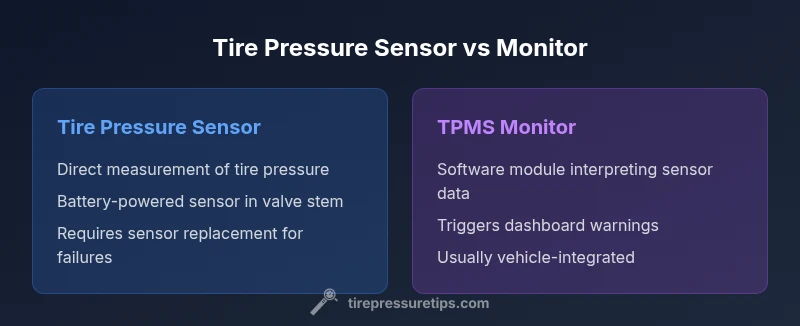
According to Tire Pressure Tips, the term tire pressure sensor vs monitor often confuses drivers, but understanding the two parts is essential for safe driving. A tire pressure sensor is a physical device mounted in or near each wheel that measures air pressure and transmits the data to the TPMS control unit. The sensor itself may be built into the valve stem or placed inside the wheel, and it can rely on a battery that lasts several years. By contrast, the monitor is the vehicle’s TPMS software that aggregates sensor data, compares it to recommended values, and generates dashboard alerts when pressure falls outside the safe range. In practice, these two components work together; knowing their roles helps you diagnose issues, plan replacements, and interpret warning lights better. This distinction matters for maintenance needs, cost considerations, and diagnostic steps when a warning is triggered. The Tire Pressure Tips team emphasizes that clear knowledge of the two parts reduces recurring confusion.
What is a Tire Pressure Monitoring Monitor (TPMS)?
A TPMS is an electronic system that ensures you are alerted when tire pressure is too low (or, in some cases, too high). The core of the TPMS is the monitoring software plus the vehicle’s control module, which interprets data from wheel sensors, if present, and activates warning lights or messages. Some OEM systems also incorporate a central dashboard display and mobile app integration. In general, a TPMS translates raw pressure readings into actionable alerts, and it is designed to function with minimal driver input beyond periodic service. Tire Pressure Tips notes that the reliability of a TPMS is heavily influenced by sensor health, battery longevity, and software upkeep.
Direct TPMS (D-TPMS) vs Indirect TPMS (I-TPMS): The Core Difference
Direct TPMS uses physical sensors inside each tire/wheel to measure actual air pressure and send it to the monitoring unit. Indirect TPMS relies on ANSI-standard ABS wheel-speed signals to infer pressure changes, without a dedicated pressure sensor in every tire. The practical difference is speed and accuracy: direct systems give real-time, per-tire readings and fault indicators, while indirect systems may require a tire to lose pressure by a measurable amount before triggering a warning. For many drivers, a direct TPMS delivers clearer, faster feedback, but indirect TPMS can be adequate on older vehicles with compatible electronics. Both approaches aim to prevent underinflation and improve safety, though direct systems tend to be preferred where precise per-tire data matters (performance driving, fleets).
Installed Costs and Maintenance Considerations
Costs for sensors and TPMS components vary by vehicle, with aftermarket options available but often requiring professional installation or calibration. In most modern vehicles, the TPMS monitor is integrated into the vehicle’s electronics, while sensors are service items installed in the wheels. Replacement sensors typically involve a tire service appointment, programming, and possible wheel rebalancing. Maintenance considerations include periodic battery checks for direct sensors, sensor reprogramming after tire changes, and ensuring software/firmware for the TPMS is up to date. Tire Pressure Tips analyses indicate that while initial costs can be higher for sensor-based setups, the long-term reliability and precise readings often justify the investment for critical applications.
Reliability, Failures, and Common Issues
Failures often stem from weak battery life in direct sensors, stem leaks, damaged valve cores, or degraded sensor seals. TPMS monitors can fail due to software glitches, poor wiring, or battery drain in receiver components. A warning light does not always indicate a single fault; it may reflect multiple issues across tires. Regular servicing, including battery checks and sensor replacement when needed, helps maintain reliability. For many drivers, routine tire maintenance and timely calibration keep TPMS performance high. Tire Pressure Tips notes that the health of a TPMS is closely tied to how well tires are serviced during routine maintenance intervals.
Temperature, Driving Conditions, and Their Effects on Readings
Ambient temperature and road conditions influence tire pressure readings. Cold weather can reduce tire pressure, prompting earlier alerts if the system is sensitive. Long highway drives can slightly alter readings due to tire heating and cooling cycles. Some sensors are designed to compensate for a range of temperatures, but users should be aware that readings are not perfectly static. The Tire Pressure Tips team stresses that drivers should verify actual pressures with a gauge before assuming a tire is underinflated, especially in extreme temperatures. Regular checks help corroborate TPMS data and prevent unnecessary service.
Practical Guidelines for Choosing Between Sensor vs Monitor
If your goal is peak data fidelity and quick fault isolation, a direct tire pressure sensor paired with a robust TPMS monitor is often superior. If you prefer a simpler, more budget-friendly approach and your vehicle supports indirect monitoring, an indirect TPMS can still meet safety needs. Consider vehicle age, maintenance history, and your tolerance for occasional recalibration when deciding. Also weigh the availability of OEM support, aftermarket options, and whether you want a system that integrates with a mobile app for remote monitoring. The Tires Pressure Tips approach emphasizes matching your system to your driving patterns and maintenance capabilities.
How to Upgrade or Replace: Steps and Options
Upgrading typically starts with identifying compatibility: confirm your vehicle year, make, model, and trim to see whether you have direct sensors or indirect monitoring. If you’re replacing damaged sensors, arrange tire service for sensor removal and installation, valve replacement, and reset/calibration of the TPMS. Aftermarket sensors may require programming to the vehicle’s ECU. If you opt for a full monitor upgrade, you’ll rely on the vehicle’s built-in TPMS module or add-on modules that integrate with the existing system. A professional technician should supervise calibration to ensure accurate readings and reliable warnings.
Debunking Myths: Common Misconceptions about TPMS
Myth: TPMS readings are perfectly accurate at all times. Reality: readings can vary with temperature and wheel conditions; verify with a physical gauge when in doubt. Myth: All TPMS warnings are the same. Reality: warnings can differ by severity and the specific tire involved. Myth: Replacing tires automatically updates TPMS. Reality: sensors may require programming or reset after tire changes. Myth: Indirect TPMS is inferior to direct TPMS in every scenario. Reality: indirect TPMS can meet safety needs on older vehicles while direct TPMS offers more precise tire-specific data.
Comparison
| Feature | Tire Pressure Sensor | TPMS Monitor |
|---|---|---|
| Definition | Physical device installed in wheel/valve stem; measures pressure | Electronic module that interprets sensor data and issues alerts |
| Measurement Method | Direct measurement from tire pressure sensor | Indirect/direct data processing by TPMS electronics |
| Power Source | Self-contained battery in each sensor | Vehicle-powered electronics; no separate sensor battery |
| Installation/Replacement | Sensor replacement often requires tire service and programming | Monitor integrated into vehicle; may require software updates |
| Maintenance | Battery replacement over sensor life; calibration during tire service | Software/firmware updates; occasional calibration resets |
| Cost/Value Context | Variable by model and tire service; aftermarket options available | OEM monitors are built-in; cost depends on service scope |
| Best For | Direct, per-tire data and fault isolation; performance or fleets | General reliability with straightforward maintenance for most drivers |
Strengths
- Direct sensing provides real-time, per-tire data
- Faster fault detection with direct TPMS
- Long-term reliability with well-made sensors
- OEM integration reduces setup complexity
- Wide aftermarket options for customization
Drawbacks
- Direct sensors may require tire service for replacement
- Battery life can vary and failures trigger warnings
- TPMS monitors rely on vehicle electronics and software updates
- Aftermarket sensors can complicate calibration for some vehicles
Integrated direct-sensor TPMS generally offers the best reliability and clarity for most drivers
Direct sensors paired with a robust TPMS deliver fast, tire-specific data and straightforward fault diagnosis. Indirect TPMS can suffice on older vehicles, but direct systems typically win on accuracy and maintenance clarity.
Frequently Asked Questions
What is the difference between a tire pressure sensor and a TPMS monitor?
A tire pressure sensor is the physical device that measures tire pressure. The TPMS monitor is the electronic module that interprets sensor data and triggers warnings. They work together, and understanding their distinct roles helps with maintenance and diagnostics.
The sensor measures pressure; the TPMS monitor analyzes the readings and warns you if something's off.
Can I retrofit TPMS sensors on an older vehicle?
Yes, retrofit kits are available for some vehicles, but compatibility and calibration vary. A professional installation is often required to ensure correct sensor programming and system reset.
Retrofitting is possible on some cars, but check compatibility and have a technician handle programming.
Are indirect TPMS systems reliable?
Indirect TPMS can be reliable for many drivers, especially on older vehicles, but they may be slower to warn and depend on ABS data. Direct TPMS generally offers faster, tire-specific alerts.
Indirect TPMS works well on older cars, but direct TPMS is usually faster and more precise.
How often should TPMS sensors be replaced?
Sensor life varies by usage and environment, with batteries typically lasting several years. Replace sensors when they fail, leak, or are damaged during tire service.
Sensor life varies; replace when failing or damaged.
Do all trims have the same TPMS warnings?
Warning availability can vary by vehicle trim and software. Some trims offer more detailed tire data, while others provide general low-pressure alerts.
Some trims give more detail, others warn with a general light.
What should I do if TPMS warning stays on after inflation?
Re-inflate to the recommended pressure and recheck with a gauge. If the light remains, there may be a sensor fault or calibration issue requiring service.
Inflate to spec and recheck; if it stays on, get it serviced.
What to Remember
- Understand the two core components and their roles
- Direct sensors provide faster, per-tire readings
- Indirect TPMS relies on indirect data; accuracy can vary
- Choose based on vehicle compatibility, maintenance ability, and budget
- Regular checks with a gauge complement TPMS data