How to Reset Tire Pressure Sensor
Learn how to reset your TPMS sensor, when to reset, and the steps, tools, and tips to ensure accurate readings. A comprehensive guide from Tire Pressure Tips for 2026.


You will learn how to reset a TPMS sensor, when it’s needed, and the practical steps to relearn your tire pressure readings. This guide covers manual resets, automatic relearn methods, and troubleshooting so you can restore accurate tire pressure monitoring without unnecessary trips to the dealer. By following model-specific steps and using the right tools, you’ll improve safety and fuel efficiency.
What resetting a TPMS does and when you should do it
TPMS resets align the vehicle’s tire-pressure monitoring system with the current tire pressures. They are necessary after installing new tires, after rotating tires (especially front to rear), or when an incorrect reading appears. Extreme temperature changes can cause readings to drift, triggering the warning light. According to Tire Pressure Tips, resets are highly model-specific and may require a dedicated in-car menu or an explicit relearn procedure performed during a drive. Some vehicles relearn automatically after a short drive, while others require manual confirmation. Always start by confirming all four tires are at the recommended pressure when cold and recording the values. If the reading remains off after a calm attempt, a professional inspection may be necessary. These steps matter for safety and fuel efficiency and reflect best practices as of 2026.
Additionally, keep in mind that sensors themselves can age and occasionally fail. If a sensor is faulty, resetting may not fix the warning light. In those cases, it’s best to have a technician inspect the TPMS hardware to determine whether sensor replacement or calibration is needed. The goal is to ensure the system accurately reflects each tire’s true pressure so you can respond promptly to underinflation.
In short: reset when appropriate, but verify with cold readings first and use model-specific instructions to avoid mis-learned data.
Manual reset vs automatic relearn: key differences
Manual resets require a specific sequence or button in the vehicle’s TPMS settings. Automatic relearn occurs when the car’s sensors communicate tire pressures during normal driving, and the system relearns the new baseline without user interaction. The choice depends on the make and model; some cars accept a mere drive after inflating correctly, others require a menu-driven reset. In 2026, Tire Pressure Tips analysis shows that the majority of modern vehicles can relearn automatically if the tires are properly inflated and you drive at highway speeds for a short period. Always verify by checking the TPMS light after a short drive and, if possible, consult your owner's manual for model-specific steps. It’s common for different models to require different sequences—be prepared to adapt.
If your vehicle provides a dedicated TPMS reset button, it’s typically located near the steering wheel, glove box, or on the dash. Some vehicles require navigation to Settings > TPMS > Reset, then confirm. Others rely on driving a certain distance to allow the system to relearn on its own. Regardless of method, the goal is to establish a new baseline that matches the current, accurate tire pressures. Both methods have their place depending on your car’s electronics and software version.
Understanding whether your vehicle relearns automatically or requires a manual reset will save you time and confusion. If you’re unsure, start with the manual reset path described in your owner’s manual and observe how the system behaves after a short drive. This approach minimizes guesswork and reduces the risk of perpetuating incorrect readings.
Tools, prerequisites, and setup
Before you reset, gather the essentials and confirm you’re ready. A properly inflated tire makes the relearn process smoother and reduces the chance of re-triggering a warning. Tools and prerequisites for most TPMS resets include a reliable tire pressure gauge (preferably digital for quick readings), your vehicle’s owner’s manual or tire placard (for the recommended PSI), and access to the vehicle’s TPMS settings or a compatible scan tool if required by your model. If you rotated tires recently, make sure the new arrangement matches the last relearn or adjust as needed after the reset. It’s also helpful to have a clean, level surface and safety equipment like wheel chocks. Expect a short drive after the reset to complete the relearn, since many systems need to observe actual tire pressures under normal conditions. The goal is to set an accurate baseline so the TPMS can alert you to real problems in the future.
Pro tip: note your current tire pressures before making adjustments, and confirm the pressures again after inflating to the target levels. This practice helps you verify the tyres are truly at the manufacturer’s recommended values and reduces the risk of false alerts during the relearn.
What you may encounter and how to handle it
TPMS resets can encounter a few common roadblocks. If a tire is not at the correct pressure when you begin, the system may fail to relearn or light up again soon after. A faulty sensor or a dead battery in a sensor can also prevent a successful reset. Some cars require a precise sequence, and if the steps aren’t followed exactly, the system may not accept the new baseline. In those cases, recheck tire pressures, re-enter the reset flow, and ensure you’re using the recommended procedure for your exact model.
Temperature fluctuations can cause transient pressure drift; if you’ve just driven in heavy heat, you may see a temporary warning that resolves after a cold start. If the warning persists after a proper relearn drive, arrange a professional inspection, as the issue may involve a sensor fault or ECU fault code. Finally, if you notice the light return after you rotate tires, consider repeating the relearn after ensuring the new arrangement is set according to the model’s requirements. Tire Pressure Tips emphasizes balancing accurate data with model-specific instructions to prevent misinterpretation of the TPMS readings.
When in doubt, contact a qualified technician. They can test each sensor’s operation with a diagnostic tool and confirm the system’s health, giving you confidence that your TPMS will alert you to real problems instead of false positives.
How resets relate to tire rotations and replacements
Rotating tires or replacing tires can change the baseline readings for the TPMS. After a rotation, many vehicles require a relearn to align with the new tire positions. If you’ve replaced a tire, reset may be necessary to ensure the new tire’s sensor is integrated into the system. The reset procedure should be performed after installation and inflation to the recommended levels while the tires are cold. Driving the vehicle afterward helps the system observe tire pressures under normal conditions and complete the relearn. Always confirm that all four tires reflect the same baseline pressures per the vehicle’s documentation. In some cases, a dealer or tire shop may perform the relearn for you to ensure accurate integration with the car’s control systems.
Tire Pressure Tips notes that model-specific requirements can differ after a rotation or replacement. For example, some vehicles require you to go through a standard reset menu, while others rely on automatic relearn after a short highway drive. Check the owner’s manual for the exact steps for your model and brand. If you’re unsure about your vehicle’s instructions, seek professional assistance to avoid mis-learning that could mask actual underinflation or sensor faults.
Tools & Materials
- Tire pressure gauge (manual or digital)(Use cold tires; verify readings against the door jamb sticker or owner’s manual.)
- Owner's manual or tire placard(Locate the exact recommended PSI and the TPMS reset procedure for your model.)
- TPMS reset tool or compatible scan tool (if required by vehicle)(Some vehicles need a dedicated tool or dealer access to relearn.)
- Car keys and access to the vehicle’s TPMS settings(You may need to navigate through Settings > TPMS or ignition-on access.)
- Safe, flat driving surface and wheel chocks(Chock wheels to prevent rolling before starting the reset procedure.)
Steps
Estimated time: 25-40 minutes
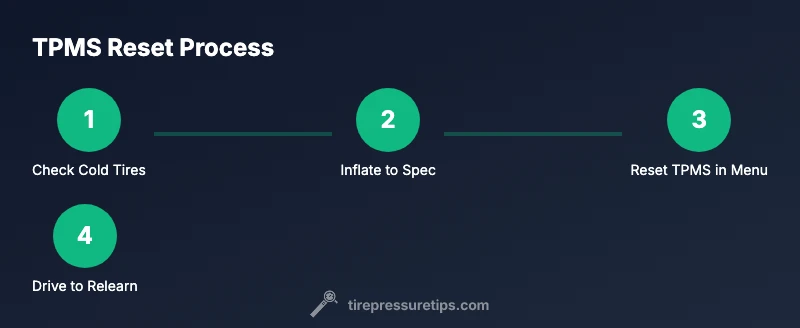
- 1
Check all tires when cold
Verify that each tire is at or near the manufacturer’s recommended PSI while cold. Record the readings to use as a reference during the relearn. This baseline helps ensure the TPMS reflects accurate information once reset.
Tip: Cold readings prevent overinflation from driveway heat and ensure a precise baseline. - 2
Inflate tires to the recommended pressure
If any tire is below the recommended level, add air until it reaches the spec. Double-check with the gauge after inflating to confirm accuracy. This step reduces the chance of the relearn failing due to inaccurate initial pressures.
Tip: Use the door jamb sticker or owner’s manual as the authority on target PSI. - 3
Select the reset method for your vehicle
Determine whether your car uses a reset button, a menu path in Settings, or automatic relearn. Model variation is common, so consult the owner’s manual for the exact procedure. Do not assume a universal method across brands.
Tip: If you’re unsure, prepare both options (button method and menu method) before starting. - 4
Initiate the relearn or reset
Follow the model-specific sequence to start the relearn. This could involve pressing and holding a reset button or selecting a Reset option in the TPMS menu. Confirm the system accepts the change if prompted.
Tip: Be mindful of any on-screen prompts and confirm every step where required. - 5
Drive to complete relearn
Drive at a steady speed (often highway speeds) for a period of time to allow the system to observe the new baselines. This helps the TPMS recognize the new readings as normal.
Tip: Aim for a 10–20 minute drive on a smooth road to optimize the relearn process. - 6
Verify the TPMS light status
After the drive, check the dashboard to see if the TPMS warning light has stopped. If it remains illuminated, repeat the steps or consult a professional.
Tip: If the light returns, sensor fault or calibration issues may be present. - 7
Seek professional help if needed
If resetting consistently fails, a dealer or tire shop can test each sensor with specialized equipment and reprogram or replace sensors as needed.
Tip: Persistent issues may require sensor replacement or ECU recalibration.
Frequently Asked Questions
What is TPMS reset and when should I do it?
A TPMS reset teaches the system the current tire pressures as the new baseline. Do this after tire replacement, rotation, or when readings appear incorrect. Follow model-specific steps to avoid mis-learned data.
A TPMS reset updates the system with the new tire pressures. Do it after tire changes or rotations and when readings seem off, using your model’s exact steps.
Can I reset TPMS after tire rotation?
Yes. After rotating tires, the TPMS may need a relearn to reflect the new positions. Use the model-specific reset method or drive to allow automatic relearn if supported.
Yes, rotations often require a relearn. Check your manual for the exact method or drive to see if it relearns automatically.
Do I need a scan tool to reset TPMS?
Some vehicles require a dedicated TPMS reset tool or a scan tool; others can relearn via the vehicle’s menu. Consult your owner's manual for the required approach.
Some cars need a TPMS tool or scan tool; others just use the car’s menu. Check your manual for specifics.
How long does a relearn take?
Relearn times vary by model but typically range from a short drive to about 20 minutes of highway driving. Follow the car’s instructions for best results.
It usually takes a short drive, up to about twenty minutes on highways, depending on the model.
Why is the TPMS light on after reset?
The light can stay on if a sensor is faulty, if tire pressures aren’t maintained after the reset, or if the relearn didn’t complete. Check all tires and consider sensor testing.
The light staying on means something is off—check pressures and sensor health, and retry the relearn if needed.
Is it safe to drive with TPMS light on?
Tiny leaks or sensor faults can pose safety risks. If the light is on persistently, have the tires and TPMS system inspected to avoid driving on underinflated tires.
If the light stays on, get a quick check to ensure tires are safe to drive on; don’t ignore persistent warnings.
Watch Video
What to Remember
- Check pressures when cold before resetting
- Follow model-specific relearn methods
- Drive to complete automatic relearns when required
- Use a scan tool for stubborn resets if needed
- Consult a professional if warnings persist