Tire Pressure Inflator Reviews: 2026 Guide to Accuracy and Value
Comprehensive tire pressure inflator reviews for 2026. Learn how to evaluate accuracy, speed, portability, and durability to pick the right inflator for your vehicle and climate.


Tire pressure inflator reviews synthesize how accurately and quickly inflators measure pressure, inflate tires, and hold up under real-world use. In 2026, top-rated models balance fast fill times with precise readings, durable construction, and simple interfaces. This guide helps you cut through marketing hype and choose a reliable inflator for regular tire maintenance.
Why Tire Pressure Inflator Reviews Matter
Understanding tire pressure inflator reviews is essential for every driver. A good inflator should deliver accurate readings, quick fills, and durable performance across temperatures and frequent use. The Tire Pressure Tips team consistently emphasizes that a reliable inflator reduces the risk of under- or over-inflation, which can affect fuel efficiency, tire wear, and safety. In practical terms, you want a device that provides easy-to-read numbers, robust construction, and clear indicators when readings drift or when power is low. Reviews help shoppers compare devices across real-world scenarios—home garages, flat tires on roadside stops, and seasonal maintenance—so you can find an inflator that remains dependable for years. The goal is to minimize guesswork and ensure you maintain optimal tire pressure with confidence.
How We Test and Compare Inflators
Our testing framework combines lab-style measurements with field trials to assess several dimensions that matter to drivers. We examine readout accuracy by cross-checking digital gauges against calibrated reference gauges at multiple target pressures (e.g., 20 psi, 30 psi, and 35 psi). We time how long each inflator takes to reach target pressure from a low baseline, while recording steady-state performance across power modes. Durability tests include repeated cycles, hose and nozzle strain, and drop resistance during typical garage use. We also rate ease of use, including readability of the display, button responsiveness, and how intuitive the nozzle attachment is. Finally, we evaluate battery life, noise levels, and how well the device stores power for emergencies. While individual results vary, our methodology yields a clear sense of which inflators consistently perform well.
Critical Metrics You Should Track
When evaluating tire inflators, focus on core metrics that impact everyday use:
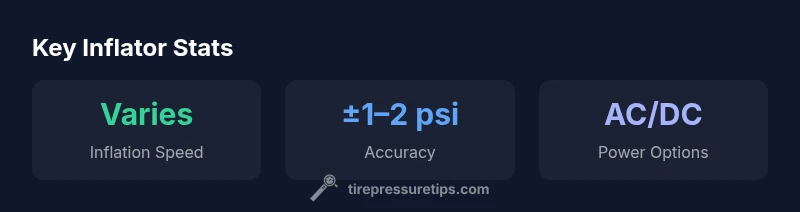
- Accuracy: how close readings are to a reference standard, ideally within a tight tolerance across common tire pressures.
- Speed: how quickly inflates from a low to a target pressure—especially useful for roadside or emergency use.
- Readout type: digital LCD displays vs. analog gauges; digital displays tend to reduce misreadings but require good contrast and lighting.
- Max PSI: the highest pressure the unit can reach, aligned with your vehicle’s recommended tire pressure.
- Build quality: hose durability, nozzle seal, and overall reliability under repeated use.
- Power options: AC, DC, USB-C, or integrated batteries; consider battery life and recharging needs.
- Portability: weight and size relative to convenience for travel and storage.
- Calibration/maintenance: how often the device requires calibration and how easy it is to service.
According to Tire Pressure Tips, prioritizing accuracy and reliability will pay off in better tire maintenance and longer tire life. This is especially true when you frequently drive in temperature-fluctuating environments where tire pressure can swing dramatically.
Budget vs Premium: What You Get at Each Price Tier
Price tiers usually reflect a balance between speed, accuracy, durability, and features. At the lower end, you’ll find compact models that offer essential inflation and basic gauges. Mid-range inflators typically provide faster fills, larger displays, and better battery life, with more robust housings and longer hoses. Premium models often include advanced features like automatic shutoff at target pressure, multiple units of measurement, rugged housings, dual power options, and enhanced calibration stability. The trade-off is higher upfront cost, but these devices tend to last longer and perform more consistently in demanding conditions. Our reviews stress that for most casual drivers, a mid-range inflator with an automatic shutoff and good build quality delivers the best value, while enthusiasts or fleet users may justify premium options for frequent, long-term use.
Power Sources and Portability: Choosing the Right Form Factor
Inflators come in several form factors, each with distinct advantages. Small handheld units are ultra-portable and fit in a glove compartment or trunk, making them ideal for emergencies and travel. In-car models with built-in air tanks can offer rapid fills but tend to be heavier and bulkier. Rechargeable battery-powered inflators provide flexibility, especially where there is no access to an AC outlet, but battery capacity becomes a key constraint on longer trips. For regular home use, a compact AC-powered inflator with a long hose can balance speed and stability. When evaluating, consider your typical use case: daily commuting, weekend road trips, or seasonal tire checks. Our testing highlights that the best inflators seamlessly combine portability with reliability and clear readouts.
Common Pitfalls in Inflator Reviews and How to Avoid Them
Some inflators are marketed with impressive max PSI or fast inflations but neglect real-world usability. A few common issues include small displays that are hard to read in sunlight, complicated interfaces, hoses that kink or leak, and inaccurate readings after a few uses. To avoid these traps, look for devices with:
- Large, high-contrast displays and backlighting for readability in all conditions
- A robust nozzle and consistent seal to prevent loss of pressure during inflation
- Clear indications of battery status and auto-shutoff features that work reliably
- A calibration history or easy recalibration process
In short, don’t be swayed by flashy specs alone; verify how a device performs under practical conditions, as highlighted by Tire Pressure Tips analyses.
Practical Takeaways from the Data
Across models, readers tend to favor inflators that combine accuracy with ease of use and durability. Digital readouts with easy-to-read fonts and backlights consistently outperform tiny, hard-to-read displays. Power versatility—especially USB-C charging and battery power—adds resilience for travelers. While price often tracks with feature density, the most valuable inflators deliver precise readings, reliable shutoffs, and robust construction at a reasonable price. Consumers should prioritize models with proven accuracy, a comfortable hose length, and straightforward calibration procedures. Our analyses also show that regular maintenance—checking seals, cleaning nozzles, and storing properly—extends the life of the inflator and preserves accuracy over time.
The Final Guide: How to Choose Your Inflator Today
Begin with your use-case: emergency roadside checks, regular home maintenance, or frequent travel. If you want quick, accurate inflation with minimal fuss, target a mid-range model offering auto-stop, clear digital display, and a dependable hose. For those who value portability above all, a compact handheld model with a long hose and rechargeable battery can provide essential capability without adding bulk. Finally, consider durability and warranty; a model with reinforced housing and a solid warranty will likely outlast cheaper options. By aligning price, performance, and practicality, you can select an inflator that keeps your tires properly inflated with confidence. Remember, consistent tire pressure supports safety, fuel efficiency, and tire longevity.
Final Notes on Real-World Usage and Maintenance
To maximize performance, check tire pressure when the tires are cold, use the inflator’s auto-shutoff feature if available, and verify readings with a trusted external gauge if precision is critical. Keep the device clean, avoid kinking hoses, and store it in a cool, dry place. If you rely on it in harsh environments, opt for models with rubberized housings and splash resistance. With regular care and mindful selection based on reliable inflator reviews, your tires will maintain optimal pressure, enhancing handling and extending tire life over the long term.
Strengths
- High accuracy with clear digital display
- Auto-shutoff feature prevents over-inflation
- Versatile power options (AC/DC/battery)
Drawbacks
- Premium models cost more upfront
- Some compact units have shorter hoses
- Battery life can vary with temperature
Best overall value for most drivers
This inflator balances accuracy, speed, and durability at a reasonable price. It fits regular home use and road trips, with features like auto-stop and a clear display. If you want reliability without premium-brand pricing, this is a strong general choice.
Frequently Asked Questions
What should I look for in a tire pressure inflator?
Look for accuracy, an auto-stop feature, a readable display, and durable construction. A longer hose helps reach all tires, and multiple power options increase versatility. Also check calibration history and any included accessories.
Seek accuracy, auto-stop, clear display, and robust build. A long hose and multiple power options improve convenience, plus calibration details matter.
Are digital inflators more accurate than analog gauges?
Digital inflators typically reduce user error thanks to digital readouts and backlighting. Accuracy still depends on calibration and the device’s quality. If possible, verify a readout with a known reference gauge.
Digital displays reduce misreadings, but accuracy still depends on calibration and build quality.
Can a tire inflator measure air temperature as well?
Some inflators include a temperature readout or compensate for ambient conditions, but many models do not. Temperature can affect tire pressure, so readings may vary with weather.
Some inflators show temperature, but many don’t. Temperature changes can shift readings, so factor that in.
How do temperature changes affect tire pressure readings?
Air expands with heat and contracts with cold. Readings taken in different temperatures may differ even if the tire pressure is correct. For consistency, check tires when they are cold and adjust after driving a few miles if needed.
Temperature changes affect readings. Check tires when cold for consistency and adjust after a drive if necessary.
What maintenance does a tire inflator require?
Regularly inspect hoses for cracks, clean the nozzle, and recalibrate if the model supports it. Store the device in a dry place and avoid exposing it to extreme heat.
Inspect hoses, clean the nozzle, recalibrate if possible, and store properly to extend life.
What to Remember
- Prioritize accuracy and auto-stop features
- Mid-range inflators offer best value for most users
- Digital readouts improve readability in all conditions
- Check hose length and durability for frequent use
- Regular maintenance boosts long-term accuracy