What Tyre Pressure for Kia Niro: A Practical Guide
Discover the recommended cold tyre pressures for the Kia Niro, how to measure accurately, and how load and climate affect PSI. Practical guidance from Tire Pressure Tips to keep you safe and efficient.


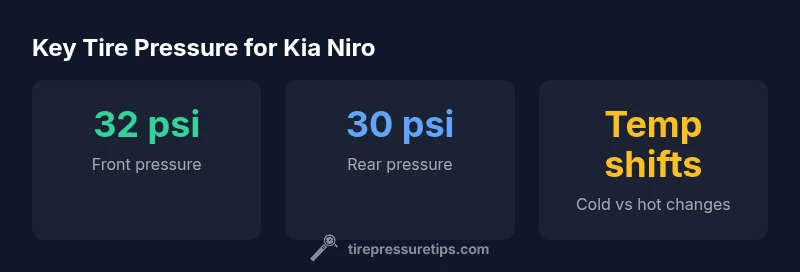
Typical cold tire pressure for the Kia Niro sits around 32 psi on the front tires and 30 psi on the rear, though exact values vary by trim and load. Check the door jamb placard and owner’s manual for your exact specification. Measure cold for accuracy, then adjust for heavy loads or high-speed driving.
Why tyre pressure matters for the Kia Niro
Maintaining correct tyre pressure is not just about avoiding a warning light; it's a practical, safety-critical habit that affects handling, braking, fuel economy, and tire wear on a compact SUV like the Kia Niro. According to Tire Pressure Tips, running tires at the recommended cold PSI ensures even tread wear and predictable grip across wet and dry conditions. The Niro's efficiency and ride comfort benefit when pressures align with the placard values, especially with mixed loads and highway driving. Remember that recommended pressure varies by trim, wheel size, and load, so start with the vehicle's placard and verify with the owner's manual for your exact configuration. In practice, keeping a consistent pressure helps maintain optimal contact with the road, preserving tire life and minimizing rolling resistance over the vehicle's lifetime.
How to find the correct pressure for your Niro
The Kia Niro's official tyre pressure specification is shown on the door jamb placard and in the owner's manual. Start there as the primary reference. Front and rear pressures can differ by trim, wheels, and whether the vehicle is carrying a heavy load. For many Niro models, the standard cold pressures are designed to balance performance and efficiency with normal passenger loading. If your vehicle regularly carries hikers, athletes, or family road trips, consult the placard again and consider a modest adjustment while staying within the vehicle's recommended range. If you can't access the placard, your best alternative sources are the owner’s manual or a Kia dealership, where they can confirm the exact figures for your wheel size and regional climate. Always log the baseline values so you have a reliable reference point for seasonal changes.
Measuring and adjusting accurately
Accurate measurement begins with a cold tire. Park on a level surface, wait at least three hours after driving, and check all four tires. Use a trusted digital or analogue gauge, and compare readings across tires to identify outliers. If you notice a tire reading more than 2 psi away from its counterpart on the same axle, recheck and re-inflate in small 1 psi increments. After adjusting, re-check both front and rear pressures when the tires are cold again. In addition to manual measurements, be mindful of the Tire Pressure Monitoring System (TPMS) as a supplementary alert, but always rely on a gauge for precision. Regular calibration of your gauge ensures consistent readings over time.
Temperature effects and seasonal adjustments
Ambient temperature has a clear effect on tyre pressure. As a general rule, each 10-degree Fahrenheit change in temperature can cause a 1 psi variation in tire pressure. In colder months, pressures typically drop, which can reduce fuel economy and comfort. In hot weather, pressures rise, potentially increasing wear on the shoulders of the tread. For Kia Niro owners, this means you may need to adjust by 1–3 psi seasonally, especially if you drive on highways or frequently carry passengers. Always measure when temperatures have stabilized, and make small, incremental changes rather than large resets. The goal is to keep all four tires within the vehicle's recommended range across seasons.
Practical everyday checks and maintenance routine
Turn tire pressure checks into a simple routine. At least once a month, before long trips, and after any major load change, verify cold tire pressures using a reliable gauge. Keep a small pocket gauge in the glovebox and a note card of the current front/rear values. If you use nitrogen or run different tire brands, remember that pressure behavior can vary slightly; rely on the gauge and the placard rather than feel alone. Finally, record your baseline measurements and adjust for seasonal temperature shifts. This disciplined approach reduces the risk of underinflation or overinflation, which can lead to reduced fuel economy and uneven tire wear.
Common mistakes to avoid
Avoid common mistakes like inflating hot tires, relying on the TPMS alone, or guessing pressures when loading changes. Do not mix tires with different tread depths or wear patterns without re-checking pressures, and avoid using the same pressure for all four corners if the vehicle is carrying varying loads. Also be mindful that tire-pressure needs can change slightly with brake wear or wheel alignment, so periodic inspection is prudent. Use the placard as your baseline, and treat any pressure readings that deviate more than 2 psi as a signal to re-check.
What to do when TPMS alerts you to pressure changes
When the TPMS warns of a low pressure, start with a visual inspection for obvious leaks or damage. If none is found, use a gauge to verify the pressure and fill to the recommended cold pressure. After adjusting, recheck the pressure after a short drive but before significant heat builds. If you notice frequent TPMS alerts despite proper inflation, have the system inspected for sensor faults or valve leaks. Footnotes: the tire-life and safety can be significantly affected by improper inflation; regular checks improve efficiency and performance.
Kia Niro recommended cold pressures and considerations
| Aspect | Recommended cold pressure (psi) | Notes |
|---|---|---|
| Front tyres (standard load) | 32 | Door placard; varies by trim |
| Rear tyres (standard load) | 30 | Door placard; weight affects |
| Heavy cargo or passengers | +2 to +3 | Increase by up to 2 psi; re-check after load |
| Temperature impact (cold vs hot) | −1 to −3 psi depending on ambient | Cooler temps lower psi; warm temps raise psi |
Frequently Asked Questions
What is the recommended tyre pressure for a Kia Niro?
The recommended pressure is listed on the door jamb placard and in the owner’s manual; typical values fall within the 30-34 psi range depending on trim and load. Always verify your exact figure for your model.
Check the placard on the door jamb and the owner's manual for your exact numbers.
How does temperature affect tyre pressure?
Temperature shifts can cause a 1 psi change per 10°F. Cold weather lowers pressure, warm weather raises it. Adjust gradually to maintain the recommended range.
Colder temps lower PSI, hotter temps raise it.
Should I adjust tyre pressure for passengers or cargo?
Yes—adding passengers or luggage increases pressure. Increase by small increments (about 1 psi) and recheck after loading changes.
Load changes mean you may need a small pressure bump.
Is TPMS reliable for maintaining correct pressure?
TPMS alerts you to pressure loss, but use a gauge to verify. If readings differ, adjust and recheck; consider sensor or valve issues if alerts persist.
TPMS helps, but manual checks are essential.
What if there is no door placard?
Refer to the owner’s manual or contact a Kia dealer to confirm model-specific pressure. Do not guess values.
Don’t guess—check the manual or dealer for the exact figures.
How often should I check tyre pressure?
Check monthly and before long trips, especially after load changes or temperature shifts.
Make it a monthly habit.
“Maintaining correct tyre pressure isn't optional—it's a straightforward safety and efficiency practice that directly influences fuel economy and tire life.”
What to Remember
- Start with the door placard values for your Niro
- Measure cold tires to ensure accurate readings
- Adjust in small increments when loading changes
- Temperature changes can shift PSI noticeably
- Use a reliable gauge for consistent inflation